
YOUR QUESTION. A CLEARER NEXT STEP.
Worrying about feeding selectivity at 6–9 months
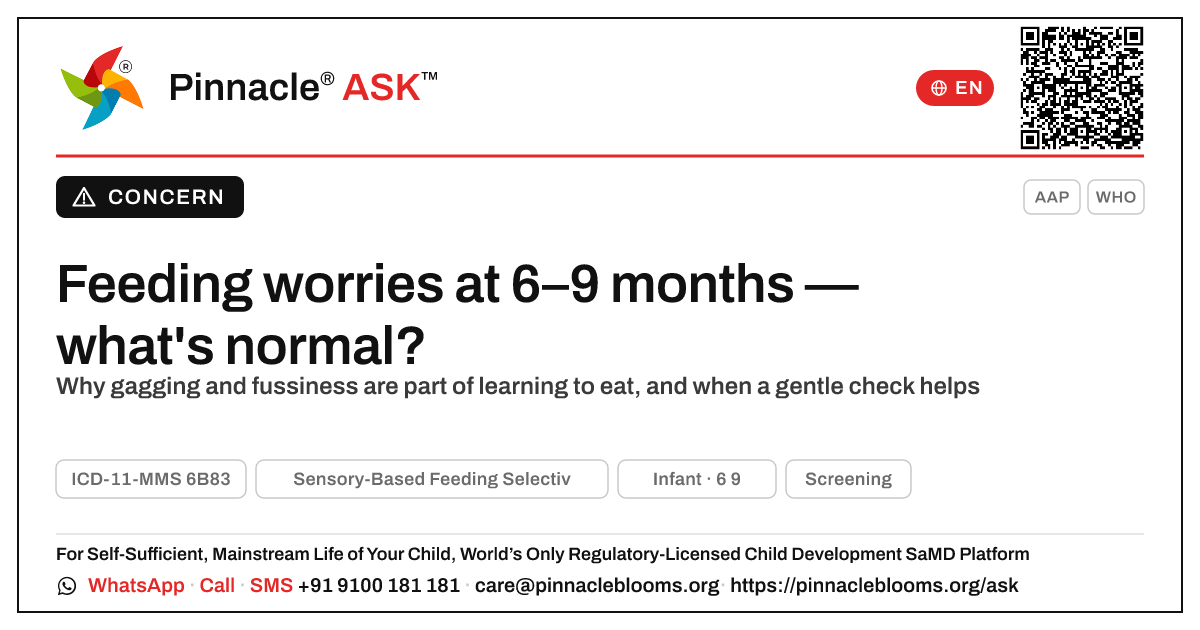
Between 6 and 9 months babies are only just learning to eat, so gagging on textures, refusing then accepting food, and variable appetite are normal and not a sign of Sensory-Based Feeding Selectivity. There is no fixed checklist at this age. A gentle clinical check is wise only if there is choking, persistent refusal across weeks, poor weight gain, or extreme distress — and only a Pinnacle clinician can assess, never an online form.
In this answer 5 sections
If mealtimes with your little one feel like a guessing game — gagging on new textures, turning away from the spoon — it's natural to wonder whether something more is going on.
In short
Between 6 and 9 months, your baby is brand new to the whole world of solid food — so being fussy, gagging on lumps, or refusing a flavour one day and loving it the next is completely normal and expected, not a sign of Sensory-Based Feeding Selectivity. At this age there is no fixed checklist that defines a feeding disorder; eating is a skill your baby is still learning. What deserves a gentle clinical conversation is not ordinary fussiness but persistent difficulty that affects safety, growth, or hydration.
What is normal at 6–9 months
This is the window where babies learn to eat, and the learning is messy by design:
- Gagging on new textures — the gag reflex sits far forward in young babies and naturally moves back as they practise; gagging is protective, not the same as choking.
- Spitting food out, pulling faces, refusing then accepting — exploring taste and texture, not rejecting food.
- Preferring purées over lumps for a few weeks — coordination is still developing.
- Variable appetite day to day — entirely normal in infancy.
Responsive feeding — following your baby's hunger and fullness cues, offering variety without pressure — is exactly the right approach now.
When a gentle check is wise
Think about a developmental conversation if you notice patterns that persist and affect wellbeing, rather than one-off fussy moments:
- Choking, coughing or distress with most feeds, or food/liquid coming back through the nose
- Refusing nearly all textures or whole food groups consistently over weeks
- Poor weight gain, fewer wet nappies, or signs of dehydration
- Arching, crying or extreme distress at the sight of food, feed after feed
- No interest in feeding at all by 7–8 months despite repeated calm attempts
These can have many causes — reflux, oral-motor coordination, or sensory factors — so they point to a check, never a label.
The Pinnacle way
A clinical AbilityScore® and any diagnosis are formed only at a Pinnacle Blooms Network centre, under qualified clinician care — never from an online form or a checklist. Our therapists look at your baby's whole feeding story — safety, oral-motor skills, growth and sensory comfort — and support families with gentle, evidence-led feeding and oral-motor therapy when it is genuinely needed. Most fussy eaters at this age simply need patience and responsive feeding, not treatment.
Trusted sources
AAP guidance on starting solids and responsive feeding (healthychildren.org); WHO infant and young child feeding recommendations (who.int); WHO ICD-11 (6B83, feeding and eating disorders).
Next step — If feeding feels worrying rather than just messy, the kindest move is a calm chat with a clinician. Book a developmental check with a Pinnacle therapist.
This is general information, not a diagnosis — individual assessment and diagnosis require an appropriately qualified healthcare professional.
CONNECT THE ANSWER TO YOUR CHILD’S DAY
Something to notice. Something to discuss.
What to notice
Watch for patterns that persist over weeks and affect safety or growth: choking or coughing with most feeds, food returning through the nose, refusing nearly all textures, poor weight gain or fewer wet nappies, or extreme distress at every feed. Occasional gagging, spitting out, and day-to-day appetite changes are normal learning.
In everyday life
Offer new textures calmly and without pressure — let your baby touch, mouth and explore food at their own pace, and follow their hunger and fullness cues. A relaxed, unhurried mealtime teaches a baby that food is safe and enjoyable.
Bring your observations and questions to your child’s professional. Choose activities that suit your child’s comfort, abilities and agreed plan.
Bring your questions to a first visitQuestions families ask
Is it normal for my 6-month-old to gag on new foods?
Yes. In young babies the gag reflex sits far forward in the mouth and naturally moves back with practice. Gagging is a protective reflex while your baby learns to manage textures, and it is not the same as choking. It usually settles as coordination improves over the coming weeks.
How is gagging different from choking?
Gagging is noisy and protective — your baby coughs, makes faces or brings food forward, and is still breathing. Choking is silent or high-pitched, with difficulty breathing, and is a medical emergency. If your baby cannot breathe or cry, seek urgent help immediately.
Can my baby be diagnosed with a feeding disorder at this age?
No firm diagnosis is made from ordinary fussiness at 6–9 months, because babies are still learning to eat. A clinician will only consider a feeding concern if there is persistent difficulty affecting safety, growth or hydration — and any assessment happens in person at a Pinnacle centre, never via a checklist.
What should I do if my baby refuses most foods?
First, keep mealtimes calm and pressure-free, and keep offering variety without forcing. If refusal persists across weeks, affects weight gain or wet nappies, or comes with distress or choking, arrange a gentle developmental check so a clinician can look at the whole feeding picture.
FOLLOW THE SOURCE
References behind this answer.
- Organisation website · further readingAAP: starting solids and responsive feeding
- Organisation website · further readingWHO: infant and young child feeding
- Organisation website · further readingWHO ICD-11: feeding and eating disorders
References are supplied with this answer. An organisation homepage offers further reading; it does not establish an independent review of this page.
Content attribution: SETU Consortium · Pinnacle Blooms Network.
PEOPLE, TOPICS & DEVELOPMENT
See the connections.
Browse the wider question collections connected with this answer’s audience, developmental area and stage.
FROM UNDERSTANDING TO PURPOSEFUL SUPPORT
One question. Your child’s whole life.
Your child’s self-sufficient, mainstream-included life is the purpose from the beginning. At Pinnacle, that purpose shapes what we understand, the goals we choose, the people we bring together, everyday practice and review.
Connect this question with the right support.
Explore how the relevant service contributes to everyday abilities, then speak with us about your child.
Make the next conversation useful.
Bring the situations you notice at home or school. We’ll explain a suitable service, centre and first visit, including availability and fees, before you decide.
How PinnacleAI® connects the journeyExplore the seven stages
- 1Understand abilities
A starting picture of your child’s capabilities.
- 2Choose meaningful goals
Readiness and a plan shaped around the child.
- 3Bring the right support together
Suitable therapies and people for those goals.
- 4Carry practice into everyday life
Guidance for family, home and school.
- 5Track and correct
Use observations to adjust the plan.
- 6Reassess and review
Decide what to continue, change or do next.
- 7Grow independence and participation
The child’s life gives each step its purpose.
Explore the whole PinnacleAI® system → · Participation at school and in the community →
PINNACLE’S EVIDENCE, OPEN TO YOU
Look at the evidence behind our work.
Read our research, inspect the original regulatory documents and check what each institutional measure means.
General information supports a conversation with an appropriately qualified professional. Advice, goals and support depend on the individual child.