
YOUR QUESTION. A CLEARER NEXT STEP.
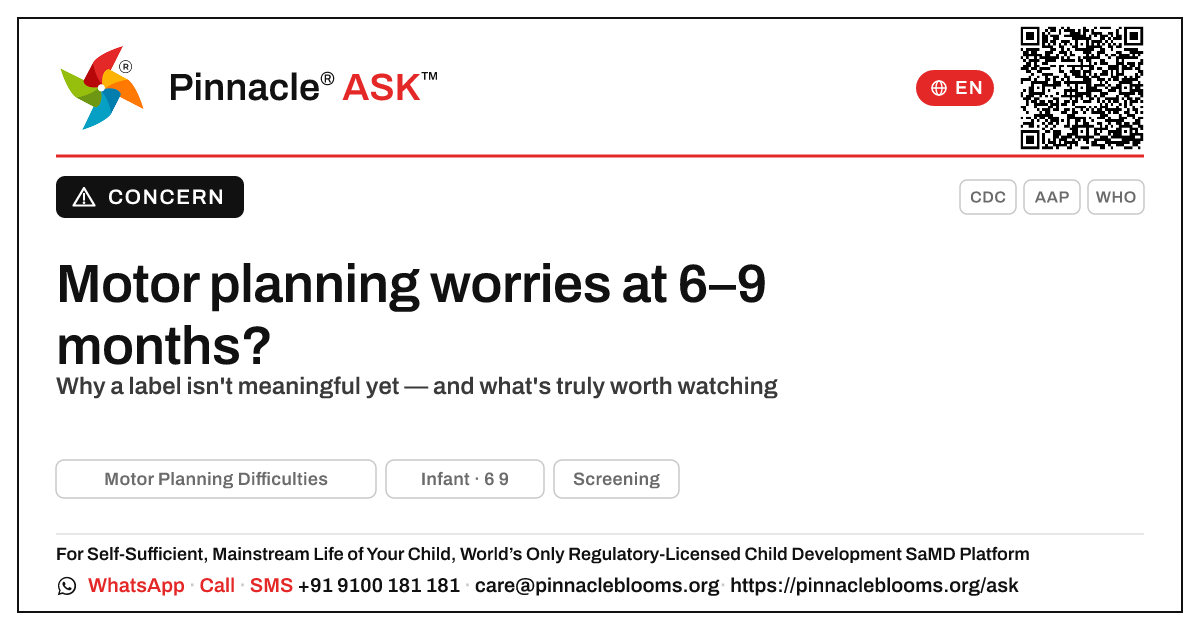
When to worry about motor planning difficulties at 6–9 months
Motor planning difficulties cannot be meaningfully diagnosed at 6–9 months, because babies are still building the foundations of movement and vary widely. The right stance is to observe and encourage. Flag to a clinician if, by around 9 months, your baby isn't sitting with support, isn't reaching or grasping, strongly favours one hand, or loses a skill. These warrant a calm developmental check, not alarm.
In this answer 4 sections
If you're watching your baby reach, roll and explore and wondering whether their movements should look smoother by now, that gentle attentiveness is exactly what helps a child thrive.
In short
At 6–9 months, "motor planning difficulties" — the brain's ability to plan and sequence a new movement — is not yet something that can be meaningfully diagnosed. Babies this age are still building the basic building blocks of movement, and there is enormous healthy variation in how quickly each one arrives. Rather than worrying about a label, this is the perfect age to gently observe and encourage movement — and to flag a few specific things to a clinician if you notice them.
What's actually appropriate to watch at 6–9 months
Motor planning (sometimes called praxis) becomes observable later, once a toddler is attempting purposeful, multi-step actions like stacking, feeding themselves or copying gestures. At 6–9 months we instead watch the foundations that motor planning will later build on. It's reasonable to mention to your paediatrician if, by around 9 months, your baby:
- Has not begun to sit with support or is very floppy or very stiff when held.
- Is not reaching for or grasping toys, or strongly favours one hand only (early hand preference can be a flag).
- Has lost a movement skill they clearly had before.
- Rarely brings hands to the middle, doesn't bear weight on legs when held, or shows very little spontaneous movement.
These are reasons for a calm developmental check, not alarm. Most variation at this age resolves naturally. A genuine concern about motor planning itself is something a clinician would explore around the toddler years, when planned, sequenced actions emerge.
The Pinnacle way
A clinical AbilityScore® and any diagnosis are formed only at a Pinnacle Blooms Network centre, under qualified clinician care — never from an online list or a single observation. For a baby this young, our clinicians focus on building your child's own movement baseline and reassuring you about typical variation. If foundations need gentle support, our occupational therapy team works through play that strengthens reaching, sitting and hand use. The goal is confidence and a clear picture — not a premature label.
Trusted sources
CDC developmental milestones and "Learn the Signs, Act Early" guidance for movement at 6–9 months; American Academy of Pediatrics developmental surveillance guidance; WHO motor development study windows.
Next step — Trust your watchfulness. Book a developmental check with a Pinnacle clinician for warm reassurance and an early, strengths-based baseline.
This is general information, not a diagnosis — individual assessment and diagnosis require an appropriately qualified healthcare professional.
CONNECT THE ANSWER TO YOUR CHILD’S DAY
Something to notice. Something to discuss.
What to notice
By around 9 months, mention it to a clinician if your baby isn't sitting with support, isn't reaching or grasping toys, strongly favours one hand only, seems very floppy or stiff, or has lost a movement skill they clearly had. These warrant a calm check, not alarm.
In everyday life
Give plenty of supervised floor and tummy time with a favourite toy placed just out of reach to either side — it invites reaching, weight-bearing and the early movement foundations that motor planning will later build on.
Bring your observations and questions to your child’s professional. Choose activities that suit your child’s comfort, abilities and agreed plan.
Bring your questions to a first visitQuestions families ask
Can motor planning difficulties be diagnosed at 6 months?
No. Motor planning (praxis) is the brain's ability to plan and sequence purposeful, multi-step movements, which only becomes observable in the toddler years. At 6–9 months babies are still building the basic foundations, so the focus is on observing and encouraging movement rather than diagnosing.
What movement signs should I flag to a doctor at this age?
By around 9 months, mention to your paediatrician if your baby isn't beginning to sit with support, isn't reaching for or grasping toys, strongly favours one hand only, feels very floppy or stiff, or has lost a movement skill they clearly had before. These warrant a calm developmental check.
Is early hand preference normal in a baby?
A strong, fixed preference for one hand before about 12 months is worth mentioning to a clinician, as most babies use both hands fairly equally at this stage. It's usually not a cause for alarm but is a useful thing to have reviewed.
FOLLOW THE SOURCE
References behind this answer.
- Source referenceCDC developmental milestones (Learn the Signs, Act Early)
- Organisation website · further readingAAP HealthyChildren developmental guidance
- Organisation website · further readingWHO motor development study windows
References are supplied with this answer. An organisation homepage offers further reading; it does not establish an independent review of this page.
Content attribution: SETU Consortium · Pinnacle Blooms Network.
PEOPLE, TOPICS & DEVELOPMENT
See the connections.
Browse the wider question collections connected with this answer’s audience, developmental area and stage.
FROM UNDERSTANDING TO PURPOSEFUL SUPPORT
One question. Your child’s whole life.
Your child’s self-sufficient, mainstream-included life is the purpose from the beginning. At Pinnacle, that purpose shapes what we understand, the goals we choose, the people we bring together, everyday practice and review.
Connect this question with the right support.
Explore how the relevant service contributes to everyday abilities, then speak with us about your child.
Make the next conversation useful.
Bring the situations you notice at home or school. We’ll explain a suitable service, centre and first visit, including availability and fees, before you decide.
How PinnacleAI® connects the journeyExplore the seven stages
- 1Understand abilities
A starting picture of your child’s capabilities.
- 2Choose meaningful goals
Readiness and a plan shaped around the child.
- 3Bring the right support together
Suitable therapies and people for those goals.
- 4Carry practice into everyday life
Guidance for family, home and school.
- 5Track and correct
Use observations to adjust the plan.
- 6Reassess and review
Decide what to continue, change or do next.
- 7Grow independence and participation
The child’s life gives each step its purpose.
Explore the whole PinnacleAI® system → · Participation at school and in the community →
PINNACLE’S EVIDENCE, OPEN TO YOU
Look at the evidence behind our work.
Read our research, inspect the original regulatory documents and check what each institutional measure means.
General information supports a conversation with an appropriately qualified professional. Advice, goals and support depend on the individual child.