
YOUR QUESTION. A CLEARER NEXT STEP.
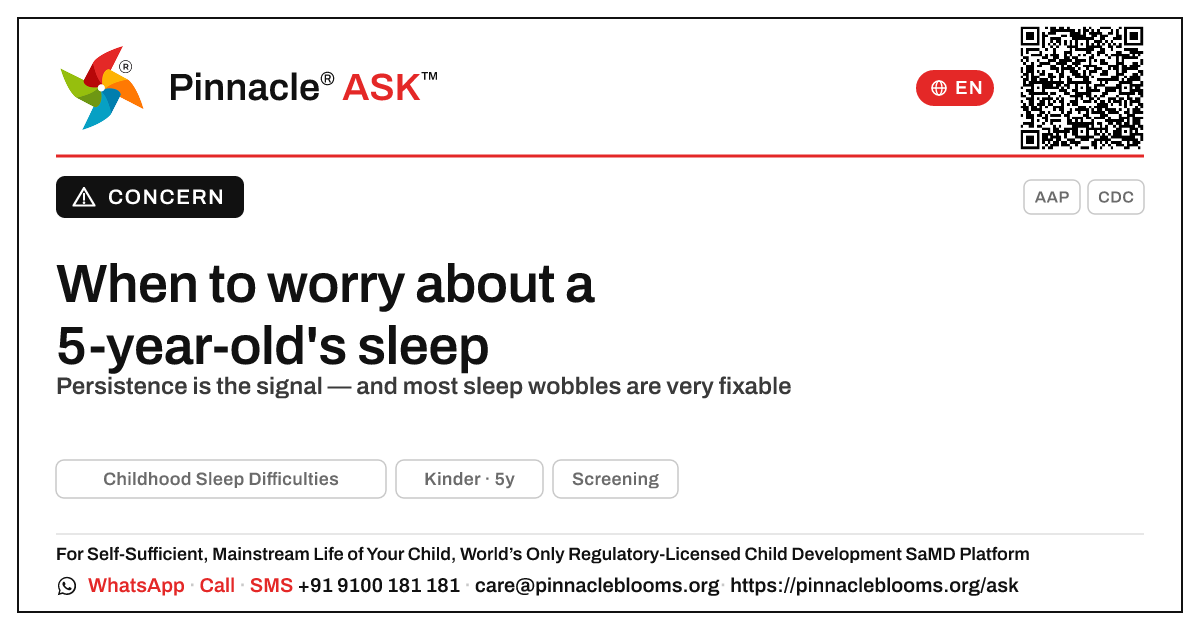
When to worry about a 5-year-old's sleep difficulties
At five, most sleep difficulties are about routine, not illness. The signal to act is persistence — trouble settling, frequent waking, snoring or breathing pauses, or daytime tiredness lasting most nights for a month or more. Snoring or breathing pauses warrant prompt medical review; otherwise, protect bedtime habits first, then seek a clinician if sleep doesn't settle.
In this answer 5 sections
If your five-year-old fights bedtime, wakes often, or seems tired and cranky by day, you're right to pay attention — and most of what you'll notice is very fixable.
In short
At five, most sleep wobbles are about routine, not illness. The signal to act is persistence — when difficulty falling asleep, frequent night waking, loud snoring, or daytime tiredness lasts most nights for a month or more and starts affecting your child's mood, learning or behaviour. A five-year-old needs roughly 10–13 hours of sleep in 24 hours; when good habits are in place but sleep still doesn't settle, it's worth a closer look.
What's worth watching
Most five-year-olds settle within 20 minutes and sleep through with the odd waking. Check in with a clinician if, over several weeks, you notice:
- Snoring, gasping, or pauses in breathing at night, or mouth-breathing and restless sleep — these can point to a treatable medical cause and deserve prompt review.
- Trouble falling asleep most nights (well past 20–30 minutes) despite a calm, consistent bedtime.
- Frequent night waking that needs your help to resettle, or very early rising.
- Daytime impact — persistent tiredness, irritability, trouble concentrating, or hyperactivity (in young children, tiredness can look like more energy, not less).
- Big distress at night — frequent nightmares, night terrors, or strong fear of sleeping alone that disrupts the household.
A few unsettled nights — around illness, travel, a new sibling or a change at home — are normal and usually pass. It's the steady pattern that matters.
First, the everyday foundations
Before worrying about a sleep disorder, it helps to protect the basics for a couple of weeks: the same calming wind-down each night, a consistent sleep and wake time, no screens in the hour before bed, and a cool, dark, quiet room. If sleep settles with these in place, the difficulty was likely habit-based. If snoring or breathing pauses are present, or good habits don't help within a few weeks, that's your cue to seek a review.
The Pinnacle way
This is general information, not a diagnosis — a clinical AbilityScore® and any diagnosis are formed only at a Pinnacle Blooms Network centre, under qualified clinician care. Our clinicians look first for any treatable cause behind disrupted sleep, build a picture of your child's daily rhythm, and shape practical, family-friendly steps. Where sleep difficulty sits alongside development, attention or behaviour concerns, our child development team can support the whole picture — gently and without labels.
Trusted sources
American Academy of Pediatrics and HealthyChildren.org guidance on recommended sleep duration and healthy sleep habits for young children; CDC guidance on children's sleep needs and routines.
Next step — Protect the bedtime basics for two weeks; if snoring, breathing pauses, or persistent tiredness continue, book a developmental check with a Pinnacle clinician.
CONNECT THE ANSWER TO YOUR CHILD’S DAY
Something to notice. Something to discuss.
What to notice
Seek a review if, over several weeks, your child snores or pauses breathing in sleep, struggles to fall asleep most nights despite a calm routine, wakes frequently, or is persistently tired, irritable or unfocused by day. A few unsettled nights around change are normal; a steady pattern is the cue to act.
In everyday life
Keep the same wind-down and the same sleep and wake times every day, switch off screens an hour before bed, and keep the room cool, dark and quiet. Two weeks of consistency often resolves habit-based sleep wobbles — and gives a clinician a clear picture if it doesn't.
Bring your observations and questions to your child’s professional. Choose activities that suit your child’s comfort, abilities and agreed plan.
Bring your questions to a first visitQuestions families ask
How much sleep does a 5-year-old actually need?
Around 10 to 13 hours in a 24-hour period, including any nap, is the typical range recommended by paediatric bodies. What matters is that your child wakes reasonably refreshed and copes well through the day — not hitting an exact number.
My child snores at night — is that a problem?
Occasional snoring with a cold is common, but regular loud snoring, gasping, mouth-breathing or pauses in breathing during sleep deserve a prompt medical review, as these can have a treatable cause. Mention it to your clinician sooner rather than later.
Are nightmares and night terrors something to worry about?
Occasional nightmares are very common at five and usually settle. Frequent night terrors or nightmares that regularly disrupt the household, or strong nightly fear of sleeping, are worth raising with a clinician — especially if daytime mood or behaviour is affected.
We have a good routine but sleep still won't settle — what now?
If a calm, consistent bedtime, fixed sleep and wake times, and screen-free wind-down are genuinely in place for a couple of weeks and sleep still doesn't improve, that's a reasonable point to seek a clinician's review to look for any underlying cause.
FOLLOW THE SOURCE
References behind this answer.
- Organisation website · further readingAAP HealthyChildren.org — healthy sleep habits and recommended sleep for young children
- Organisation website · further readingAmerican Academy of Pediatrics — paediatric sleep duration guidance
- Organisation website · further readingCDC — children's sleep needs and routines
References are supplied with this answer. An organisation homepage offers further reading; it does not establish an independent review of this page.
Content attribution: SETU Consortium · Pinnacle Blooms Network.
PEOPLE, TOPICS & DEVELOPMENT
See the connections.
Browse the wider question collections connected with this answer’s audience, developmental area and stage.
FROM UNDERSTANDING TO PURPOSEFUL SUPPORT
One question. Your child’s whole life.
Your child’s self-sufficient, mainstream-included life is the purpose from the beginning. At Pinnacle, that purpose shapes what we understand, the goals we choose, the people we bring together, everyday practice and review.
Connect this question with the right support.
Start with your child’s strengths, your observations and what you want everyday life to become.
Make the next conversation useful.
Bring the situations you notice at home or school. We’ll explain a suitable service, centre and first visit, including availability and fees, before you decide.
How PinnacleAI® connects the journeyExplore the seven stages
- 1Understand abilities
A starting picture of your child’s capabilities.
- 2Choose meaningful goals
Readiness and a plan shaped around the child.
- 3Bring the right support together
Suitable therapies and people for those goals.
- 4Carry practice into everyday life
Guidance for family, home and school.
- 5Track and correct
Use observations to adjust the plan.
- 6Reassess and review
Decide what to continue, change or do next.
- 7Grow independence and participation
The child’s life gives each step its purpose.
Explore the whole PinnacleAI® system → · Participation at school and in the community →
PINNACLE’S EVIDENCE, OPEN TO YOU
Look at the evidence behind our work.
Read our research, inspect the original regulatory documents and check what each institutional measure means.
General information supports a conversation with an appropriately qualified professional. Advice, goals and support depend on the individual child.