
YOUR QUESTION. A CLEARER NEXT STEP.
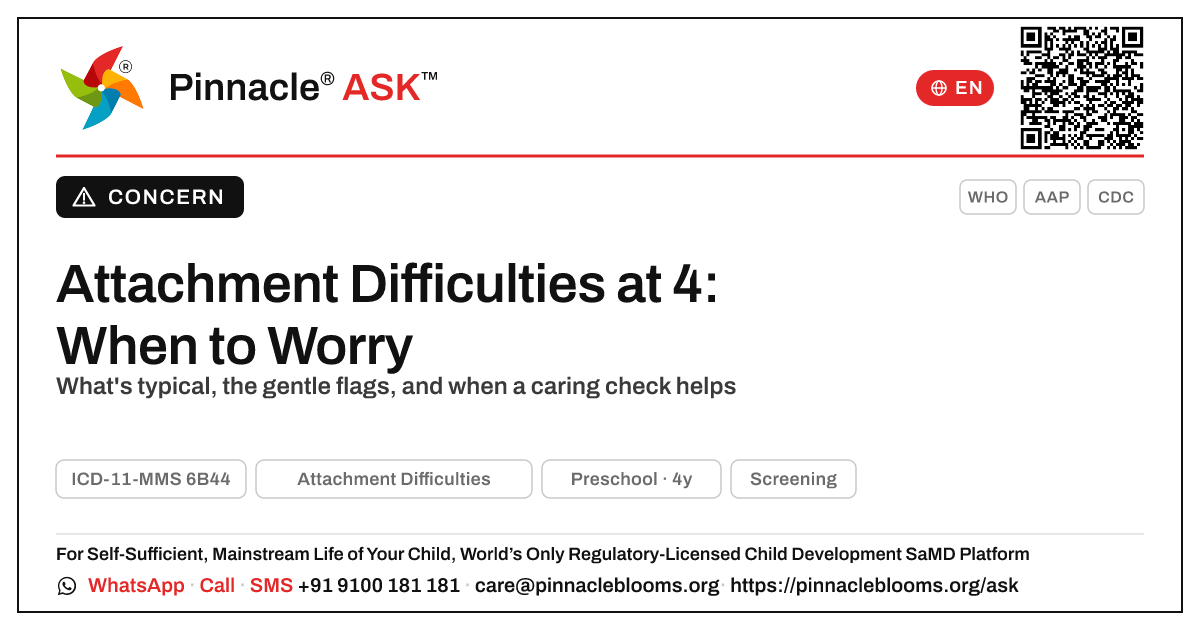
When to worry about attachment difficulties at 4
At four, attachment difficulties are uncommon and almost always linked to disrupted or changing early care. Most clinginess, meltdowns and shyness are normal. Seek a developmental check if your child rarely seeks or accepts comfort, shows no preference for familiar carers, is persistently withdrawn or flat, or is indiscriminately over-friendly with strangers — across settings for weeks. These are reasons to assess, not a diagnosis.
In this answer 5 sections
If you're watching how your 4-year-old connects with you and the people who love them, that thoughtful attention is itself a form of secure caregiving.
In short
At four, the better question than "do they have attachment difficulties?" is "does my child feel safe to seek comfort, and confident to explore?" True attachment difficulties are uncommon and almost always linked to a history of disrupted, neglectful or repeatedly changing care. Worth a developmental check at this age would be a child who shows no preference for familiar carers, seeks little comfort when hurt or frightened, is unusually wary and withdrawn, or is oddly over-friendly with complete strangers. None of these is a diagnosis — they are simply reasons to have a gentle professional conversation now.
What's typical — and what's worth watching at 4
Most 4-year-olds are still learning to manage big feelings, may cling at drop-off, melt down when tired, or test limits — all entirely normal. Attachment is about the pattern of seeking and accepting comfort, not single moments. Gentle flags worth a clinician's eye, especially where there has been a history of separations, multiple caregivers or early hardship, include:
- Comfort-seeking — when hurt, frightened or upset, your child rarely turns to you (or any familiar adult) for soothing, or cannot be comforted when they do.
- Wariness or flatness — persistently watchful, withdrawn or emotionally flat, with little shared joy, even in safe, calm settings.
- No clear preference — showing no special warmth toward primary carers over relative strangers.
- Indiscriminate friendliness — willingly wandering off with, or hugging, unfamiliar adults without checking back with you.
- Difficulty settling after upset that does not ease with familiar comfort and routine over time.
Context matters enormously. A recent house move, new sibling, illness or change in childcare can shift behaviour for weeks — this is adjustment, not disorder.
When to seek a check
Arrange a developmental conversation if several of these patterns persist across settings for more than a few weeks, if there is a history of disrupted early care, or simply if your instinct says something is off. Early, relationship-focused support is gentle and effective.
The Pinnacle way
A clinical AbilityScore® and any diagnosis are formed only at a Pinnacle Blooms Network centre, under qualified clinician care — never from an online list. Our clinicians look at your child's whole story, watch how comfort and connection work in real play, and build support around the parent–child relationship itself. You can learn more about attachment difficulties and how our child psychology and behavioural therapy team supports families with warm, evidence-based care.
Trusted sources
WHO ICD-11 framing of attachment-related conditions of childhood; American Academy of Pediatrics (healthychildren.org) guidance on social-emotional development and secure relationships in early childhood; CDC milestone resources on how preschoolers show feelings and seek comfort.
Next step — Trust what you've noticed. Book a developmental assessment with a Pinnacle clinician so your child's emotional connection is understood with clarity and care.
This is general information, not a diagnosis — individual assessment and diagnosis require an appropriately qualified healthcare professional.
CONNECT THE ANSWER TO YOUR CHILD’S DAY
Something to notice. Something to discuss.
What to notice
Seek a check if your child rarely turns to you for comfort when hurt or scared, can't be soothed, shows no special warmth toward familiar carers, is persistently withdrawn or flat, or wanders off happily with strangers — and these patterns persist across settings for more than a few weeks, especially after disrupted early care.
In everyday life
Build a daily 'comfort routine' your child can count on — a predictable cuddle at drop-off and a calm reunion at pick-up. When they're upset, get down to their level, name the feeling ('you're sad') and offer your arms. Consistent, available comfort is how secure attachment grows.
Bring your observations and questions to your child’s professional. Choose activities that suit your child’s comfort, abilities and agreed plan.
Bring your questions to a first visitQuestions families ask
Is clinginess at 4 a sign of attachment difficulties?
Usually not. Clinging at drop-off or seeking you when tired or frightened is normal and actually shows healthy attachment. Attachment difficulties are about a child who rarely seeks or accepts comfort, not one who seeks it often.
What causes attachment difficulties in young children?
They are strongly linked to early experiences of disrupted, neglectful or repeatedly changing care, rather than to ordinary parenting ups and downs. They are uncommon, and where there has been no such history, other explanations are far more likely.
Can attachment difficulties be helped?
Yes. Early, relationship-focused support that strengthens the parent–child bond is gentle and effective. A Pinnacle clinician can guide warm, practical steps tailored to your family.
My child is over-friendly with strangers — should I worry?
Indiscriminate friendliness — wandering off with or hugging unfamiliar adults without checking back with you — is one pattern worth a clinician's eye, especially with a history of changing care. Mention it at a developmental check.
FOLLOW THE SOURCE
References behind this answer.
- Organisation website · further readingWHO ICD-11: attachment-related conditions of childhood
- Organisation website · further readingAAP: social-emotional development in early childhood
- Organisation website · further readingCDC: how preschoolers show feelings and seek comfort
References are supplied with this answer. An organisation homepage offers further reading; it does not establish an independent review of this page.
Content attribution: SETU Consortium · Pinnacle Blooms Network.
PEOPLE, TOPICS & DEVELOPMENT
See the connections.
Browse the wider question collections connected with this answer’s audience, developmental area and stage.
FROM UNDERSTANDING TO PURPOSEFUL SUPPORT
One question. Your child’s whole life.
Your child’s self-sufficient, mainstream-included life is the purpose from the beginning. At Pinnacle, that purpose shapes what we understand, the goals we choose, the people we bring together, everyday practice and review.
Connect this question with the right support.
Start with your child’s strengths, your observations and what you want everyday life to become.
Make the next conversation useful.
Bring the situations you notice at home or school. We’ll explain a suitable service, centre and first visit, including availability and fees, before you decide.
How PinnacleAI® connects the journeyExplore the seven stages
- 1Understand abilities
A starting picture of your child’s capabilities.
- 2Choose meaningful goals
Readiness and a plan shaped around the child.
- 3Bring the right support together
Suitable therapies and people for those goals.
- 4Carry practice into everyday life
Guidance for family, home and school.
- 5Track and correct
Use observations to adjust the plan.
- 6Reassess and review
Decide what to continue, change or do next.
- 7Grow independence and participation
The child’s life gives each step its purpose.
Explore the whole PinnacleAI® system → · Participation at school and in the community →
PINNACLE’S EVIDENCE, OPEN TO YOU
Look at the evidence behind our work.
Read our research, inspect the original regulatory documents and check what each institutional measure means.
General information supports a conversation with an appropriately qualified professional. Advice, goals and support depend on the individual child.