
YOUR QUESTION. A CLEARER NEXT STEP.
When to worry about Selective Mutism at age 2
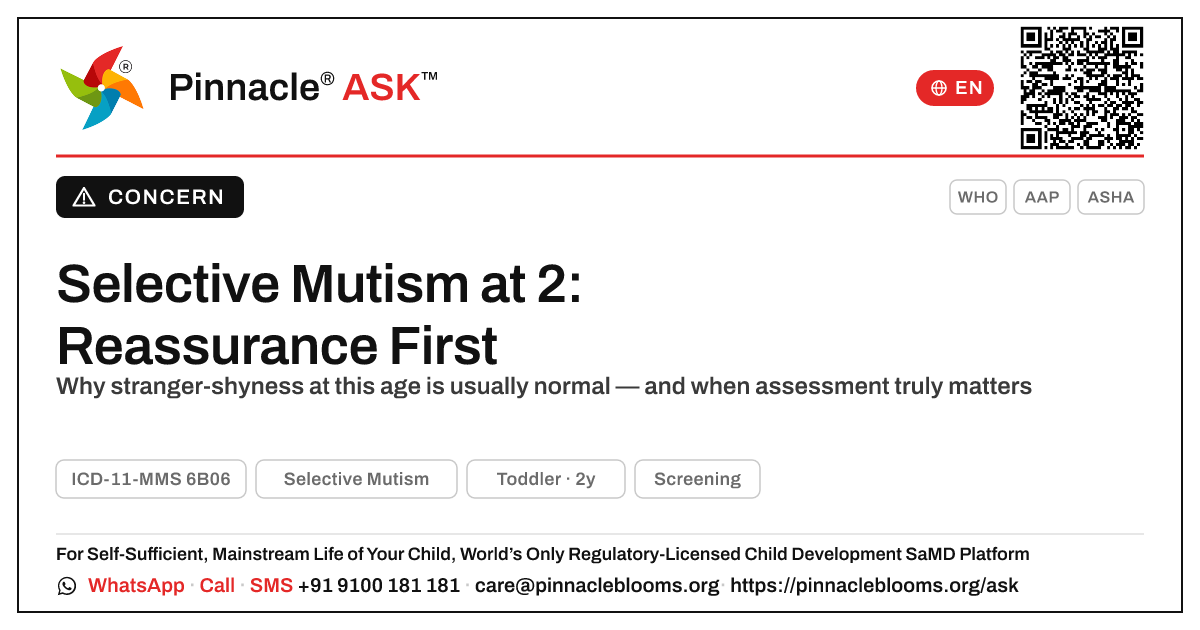
At 2, it is too early to diagnose Selective Mutism — going quiet with strangers or in new places is normal toddler shyness. The condition becomes meaningful around ages 3–5, when a child clearly speaks at home yet consistently cannot speak in specific other settings for over a month. At 2, the priority is overall language (using words at home, gestures, eye contact); if your child speaks little anywhere, seek a general speech check rather than worrying about Selective Mutism.
In this answer 5 sections
If your two-year-old chatters at home but goes quiet elsewhere, your noticing is exactly the right instinct — and at this age it usually points to something gentler than you fear.
In short
At 2, it is far too early to label Selective Mutism. Many toddlers are simply shy, slow-to-warm, or still building their first words, and going quiet with strangers or in new places is developmentally normal. Selective Mutism is recognised only when a child clearly speaks comfortably in some settings (usually home) yet consistently cannot speak in specific others (such as nursery), for at least a month, in a way that interferes with daily life — a pattern that becomes meaningful around ages 3–5, often as social demands rise. For now, the wise step is a general developmental and speech check, not worry.
What is actually appropriate to watch at age 2
Rather than hunting for a diagnosis, gently observe:
- Speech at home — does your child use words and short phrases freely with you? A warm, talkative child at home is reassuring.
- Warming up — does she eventually relax and speak once comfortable with a new person or place, even if it takes time? Slow-to-warm is normal temperament, not a disorder.
- Overall communication — pointing, gestures, eye contact, sharing interest, following simple instructions. These matter more than speaking to strangers.
- Vocabulary growth — building toward roughly 50 words and starting to combine two words by around 24 months.
If your toddler does not speak much anywhere — including with you at home — that is a question about overall language development, not Selective Mutism, and is worth a speech-and-language check.
When it becomes meaningful to assess
Selective Mutism is typically considered from about age 3 onwards, once a child is in nursery or playgroup and you can see a consistent contrast: easy speech in one setting, a persistent inability to speak in another for a month or more (beyond the first settling-in month at a new place). If that pattern emerges as your child grows, a calm assessment helps — early, anxiety-sensitive support works beautifully.
The Pinnacle way
This is general guidance, not a diagnosis — a clinical AbilityScore®, a clinician-administered structured assessment, and any diagnosis are formed only at a Pinnacle Blooms Network centre under qualified clinician care. If you'd like reassurance now, our speech therapy team can review your child's communication through gentle, play-based observation, and you can read more about how we understand and support Selective Mutism as a child grows.
Trusted sources
WHO ICD-11 describes Selective Mutism as consistent speech in some social situations but not others, persisting beyond a month and affecting functioning. American Academy of Pediatrics (healthychildren.org) and ASHA note that shyness and selective quietness are common in toddlers and that early language milestones, not stranger-speech, are the priority at age 2.
Next step — Trust what you've noticed, and let it guide reassurance rather than worry. Book a developmental check with a Pinnacle clinician to confirm your toddler's communication is on track.
CONNECT THE ANSWER TO YOUR CHILD’S DAY
Something to notice. Something to discuss.
What to notice
At 2, watch whether your child speaks freely at home, uses words and gestures, makes eye contact and warms up over time. Reassuring signs outweigh stranger-shyness. Seek a speech check if your child speaks little anywhere. Selective Mutism becomes meaningful from about age 3 if speech is easy in one setting yet consistently absent in another for over a month.
In everyday life
Don't pressure your toddler to 'say hello' to strangers — it can deepen quietness. Instead, let her warm up at her own pace, and keep a simple note of the new words she uses at home each week. That record reassures you and helps any clinician far more than how she behaves with visitors.
Bring your observations and questions to your child’s professional. Choose activities that suit your child’s comfort, abilities and agreed plan.
Bring your questions to a first visitQuestions families ask
Is it normal for my 2-year-old to go silent around strangers?
Yes — this is very common at age 2. Many toddlers are slow-to-warm and go quiet with unfamiliar people or in new places, then relax once comfortable. This is temperament, not Selective Mutism, which is only considered later when a clear, consistent contrast between settings persists for over a month.
At what age can Selective Mutism actually be diagnosed?
It typically becomes meaningful from about age 3 onwards, often once a child starts nursery or playgroup and you can see easy speech in one setting yet a persistent inability to speak in another for at least a month. A diagnosis is made only by a qualified clinician.
My toddler barely speaks anywhere — is that Selective Mutism?
No — if a child speaks little everywhere, including at home with you, that points to overall language development rather than Selective Mutism. It's worth a gentle speech-and-language check to understand and support communication early.
FOLLOW THE SOURCE
References behind this answer.
- Source referenceWHO ICD-11: Selective Mutism (6B06)
- Organisation website · further readingAAP HealthyChildren: toddler communication and shyness
- Organisation website · further readingASHA: early language milestones for toddlers
References are supplied with this answer. An organisation homepage offers further reading; it does not establish an independent review of this page.
Content attribution: SETU Consortium · Pinnacle Blooms Network.
PEOPLE, TOPICS & DEVELOPMENT
See the connections.
Browse the wider question collections connected with this answer’s audience, developmental area and stage.
FROM UNDERSTANDING TO PURPOSEFUL SUPPORT
One question. Your child’s whole life.
Your child’s self-sufficient, mainstream-included life is the purpose from the beginning. At Pinnacle, that purpose shapes what we understand, the goals we choose, the people we bring together, everyday practice and review.
Connect this question with the right support.
Start with your child’s strengths, your observations and what you want everyday life to become.
Make the next conversation useful.
Bring the situations you notice at home or school. We’ll explain a suitable service, centre and first visit, including availability and fees, before you decide.
How PinnacleAI® connects the journeyExplore the seven stages
- 1Understand abilities
A starting picture of your child’s capabilities.
- 2Choose meaningful goals
Readiness and a plan shaped around the child.
- 3Bring the right support together
Suitable therapies and people for those goals.
- 4Carry practice into everyday life
Guidance for family, home and school.
- 5Track and correct
Use observations to adjust the plan.
- 6Reassess and review
Decide what to continue, change or do next.
- 7Grow independence and participation
The child’s life gives each step its purpose.
Explore the whole PinnacleAI® system → · Participation at school and in the community →
PINNACLE’S EVIDENCE, OPEN TO YOU
Look at the evidence behind our work.
Read our research, inspect the original regulatory documents and check what each institutional measure means.
General information supports a conversation with an appropriately qualified professional. Advice, goals and support depend on the individual child.