
YOUR QUESTION. A CLEARER NEXT STEP.
When to worry about Attachment Difficulties in a 2-year-old
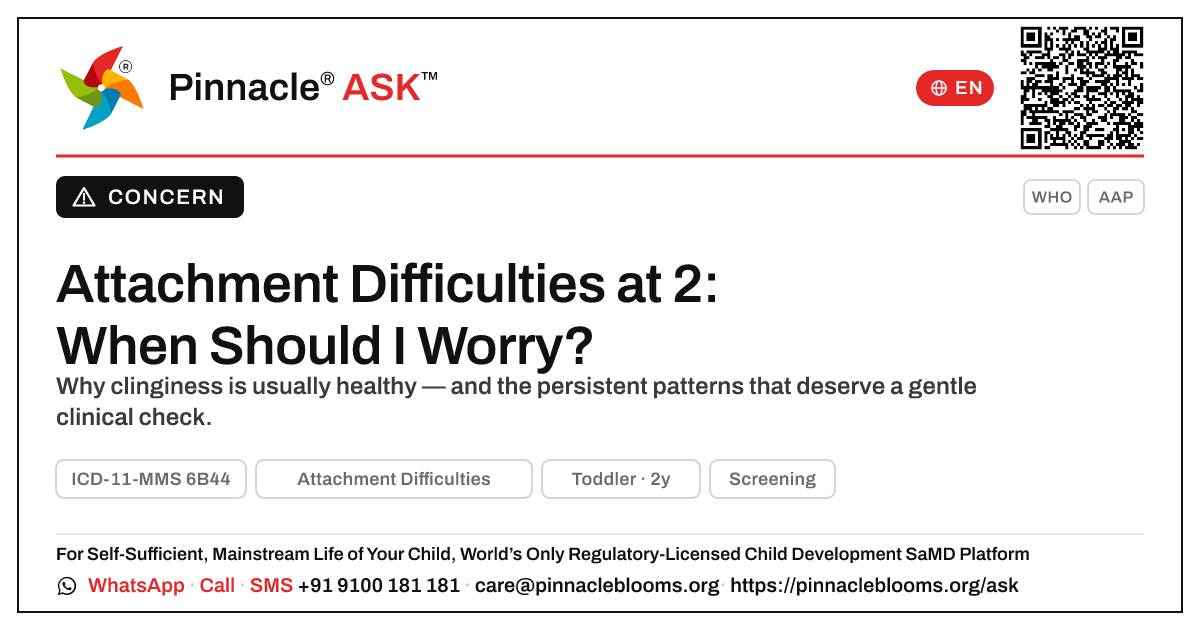
At two, clinginess, tantrums and separation protest are usually healthy signs of attachment, not difficulty. True Attachment Difficulties (ICD-11 6B44) are considered only when patterns are persistent, present across settings, and distressing — often after disrupted early care. A toddler who rarely seeks comfort, shows no preference for familiar carers, or stays flat and inconsolable deserves a gentle clinical check. Only a Pinnacle clinician can assess — never an online form.
In this answer 5 sections
If your two-year-old seems hard to comfort, or oddly unbothered by separations that once mattered, it is natural and loving to ask whether something deeper is going on.
In short
At two, a great deal of clinginess, tantrums, shyness with strangers and protest at separations is entirely normal — it is the busy work of a toddler learning that you are their safe base. Attachment Difficulties (ICD-11 6B44) are considered only when patterns are persistent, pervasive across people and settings, and clearly distressing — usually after a history of early neglect, frequent changes of carer, or unsettled early circumstances. These are concerns to observe gently, not a diagnosis, and the pattern of safe, responsive care can almost always be rebuilt.
What is normal at two — and what to watch
Most of what worries parents at this age is healthy development:
- Protesting separations, crying when you leave, checking back for you — these show a working attachment, not a broken one.
- Big tantrums and quick recovery when comforted are age-appropriate.
- Wariness of strangers is expected and protective.
Gentle concerns worth noting — especially if they last and appear across home, crèche and with grandparents — include:
- A child who rarely seeks comfort when hurt, frightened or upset
- No clear preference for familiar caregivers; equal, easy warmth towards strangers
- Comfort offered but the child stays inconsolable or emotionally "flat"
- Persistent fearfulness, watchfulness or sadness without obvious cause
- Marked withdrawal, or a striking absence of social smiling and shared joy
A single hard week, a new sibling, illness or a house move can all unsettle a toddler temporarily — context matters enormously.
When to seek a check
Consider a calm developmental check if these patterns are persistent (weeks, not days), present across more than one setting, and affecting your child's wellbeing or relationships — particularly where there has been disrupted early care. None of this is a verdict on your parenting; attachment is about the history of safety, and it responds beautifully to warm, predictable, responsive care.
The Pinnacle way
A clinical AbilityScore® and any diagnosis are formed only at a Pinnacle Blooms Network centre, under qualified clinician care — never from an online form or a checklist. Our therapists look at your child's whole story — emotional regulation, comfort-seeking, play and the relationships around them — and build a plan rooted in safety and connection. Gentle, relationship-based child psychology and behaviour support helps families strengthen the secure base every toddler needs.
Trusted sources
WHO ICD-11 (6B44, attachment-related conditions); American Academy of Pediatrics guidance on early relational health (healthychildren.org); WHO Nurturing Care Framework.
Next step — If these patterns feel familiar, the kindest move is an unhurried conversation with a clinician. Book a developmental check with a Pinnacle child psychologist.
CONNECT THE ANSWER TO YOUR CHILD’S DAY
Something to notice. Something to discuss.
What to notice
Watch for persistent patterns across home and other settings: a toddler who rarely seeks comfort when hurt or frightened, shows no clear preference for familiar caregivers, stays flat or inconsolable when comforted, or seems persistently fearful, watchful or withdrawn. Seek a check sooner where early care has been disrupted, or if mood, sleep or relationships are affected.
In everyday life
Build small, predictable moments of connection each day — the same bedtime cuddle, a warm hello, naming feelings out loud ("you seem a bit cross"). Consistency, more than grand gestures, is what helps a toddler feel safe.
Bring your observations and questions to your child’s professional. Choose activities that suit your child’s comfort, abilities and agreed plan.
Bring your questions to a first visitQuestions families ask
Is it normal for my 2-year-old to cry when I leave the room?
Yes — protesting separation and checking back for you are signs of a healthy, working attachment, not a difficulty. Most toddlers are reassured when you return and settle with familiar comfort. It becomes a concern only if a child consistently shows no preference for you or rarely seeks comfort at all.
What actually causes Attachment Difficulties?
They are linked to the history of safety in early care — for example frequent changes of carer, early neglect, or very unsettled circumstances — rather than to a single parenting choice. With consistent, warm, responsive care, attachment patterns can be strengthened over time.
Can a Pinnacle assessment tell the difference between a phase and a real concern?
Yes. A qualified clinician looks at your child's whole story across settings — comfort-seeking, emotional regulation, play and relationships — through a structured, clinician-administered assessment. This is never done from an online form or checklist.
FOLLOW THE SOURCE
References behind this answer.
- Organisation website · further readingWHO ICD-11 — attachment-related conditions
- Organisation website · further readingAAP healthychildren.org — early relational health
- Organisation website · further readingWHO Nurturing Care Framework
References are supplied with this answer. An organisation homepage offers further reading; it does not establish an independent review of this page.
Content attribution: SETU Consortium · Pinnacle Blooms Network.
PEOPLE, TOPICS & DEVELOPMENT
See the connections.
Browse the wider question collections connected with this answer’s audience, developmental area and stage.
FROM UNDERSTANDING TO PURPOSEFUL SUPPORT
One question. Your child’s whole life.
Your child’s self-sufficient, mainstream-included life is the purpose from the beginning. At Pinnacle, that purpose shapes what we understand, the goals we choose, the people we bring together, everyday practice and review.
Connect this question with the right support.
Start with your child’s strengths, your observations and what you want everyday life to become.
Make the next conversation useful.
Bring the situations you notice at home or school. We’ll explain a suitable service, centre and first visit, including availability and fees, before you decide.
How PinnacleAI® connects the journeyExplore the seven stages
- 1Understand abilities
A starting picture of your child’s capabilities.
- 2Choose meaningful goals
Readiness and a plan shaped around the child.
- 3Bring the right support together
Suitable therapies and people for those goals.
- 4Carry practice into everyday life
Guidance for family, home and school.
- 5Track and correct
Use observations to adjust the plan.
- 6Reassess and review
Decide what to continue, change or do next.
- 7Grow independence and participation
The child’s life gives each step its purpose.
Explore the whole PinnacleAI® system → · Participation at school and in the community →
PINNACLE’S EVIDENCE, OPEN TO YOU
Look at the evidence behind our work.
Read our research, inspect the original regulatory documents and check what each institutional measure means.
General information supports a conversation with an appropriately qualified professional. Advice, goals and support depend on the individual child.