
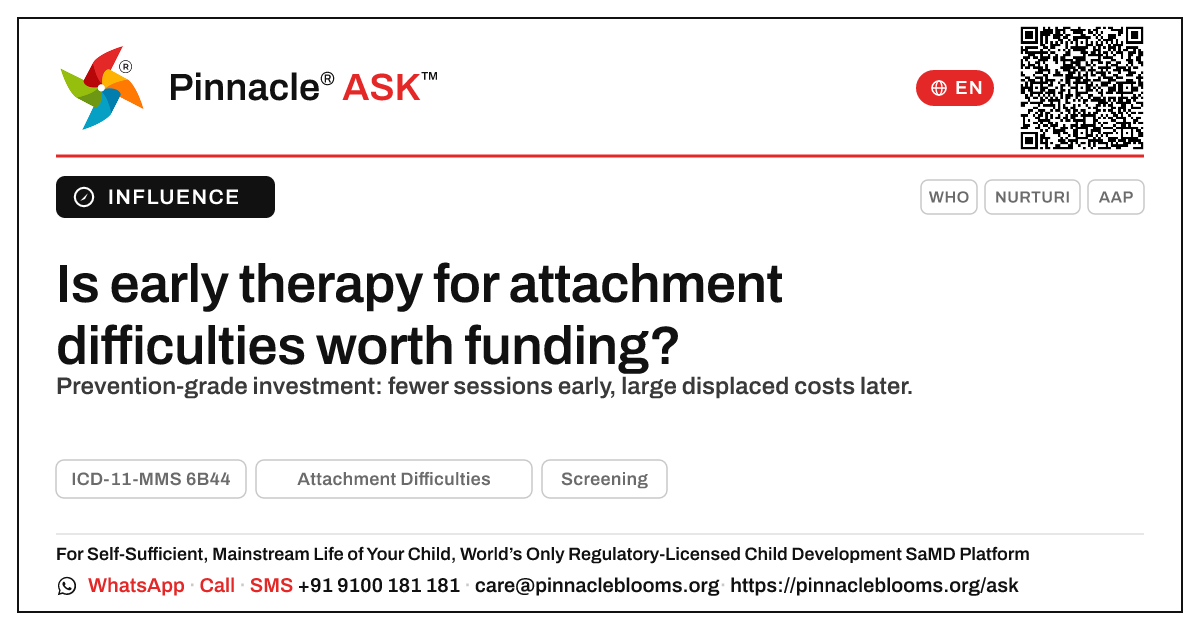
YOUR QUESTION. A CLEARER NEXT STEP.
Cost-effectiveness of early therapy for attachment difficulties
Early therapy for attachment difficulties in young children is highly cost-effective: caregiver-focused intervention during sensitive periods is low-cost and scalable, achieves durable change in fewer sessions than later treatment, and displaces much larger downstream education, mental-health and social-care costs. For payers it is a prevention-grade, outcome-measurable investment.
In this answer 4 sections
Payers ask a fair question: does funding early relational support actually pay back? For attachment difficulties in young children, the evidence says yes — earlier is cheaper, and far more effective.
In short
Early therapy for attachment difficulties is highly cost-effective because the developing brain is at its most responsive in the first years, when relational patterns are still forming and a relatively short course of caregiver-focused intervention can shift a child's trajectory. Investing early reduces the much larger downstream costs of school-age behavioural difficulties, mental-health service use and family breakdown. The economic logic is simple: a modest, time-limited investment during sensitive periods displaces years of higher-intensity, harder-won support later.
The economics, briefly
Attachment difficulties (ICD-11 6B44) respond best to interventions that strengthen the caregiver–child relationship rather than treating the child in isolation — which makes them comparatively low-cost to deliver and scalable across community settings. The cost-effectiveness case rests on three levers:
- Sensitive-period leverage — early relational change requires fewer sessions to achieve durable gains than the same change attempted later.
- Cost displacement — untreated attachment difficulties are associated with elevated demand on education, mental-health and social-care systems across childhood and adolescence; early intervention shifts spend left, where it is cheapest.
- Caregiver capability — because the parent or carer is the active agent of change, gains are sustained at home without continuous professional input, lowering long-run cost per outcome.
For a payer, this is a prevention-grade investment: the unit of spend is small, the window is time-limited, and the avoided costs compound over years.
The Pinnacle way
A clinical AbilityScore® and any diagnosis are established only at a Pinnacle Blooms Network centre, by qualified clinicians — never from an app or an online form. That governance is what makes outcomes measurable and reportable for payer partners. Across 70+ centres in 4 states, 700+ therapists and 25 million+ therapy sessions, every child's progress is tracked on a consistent measure, so funded programmes can be evaluated on real movement, not activity counts. Explore how we measure progress, how behavioural and relational therapy is delivered, and the attachment difficulties pathway.
Trusted sources
WHO ICD-11 classification of attachment difficulties; WHO and Nurturing Care Framework guidance on early childhood development as a high-return investment; AAP guidance on early relational health.
Next step — Payer and institutional partners can partner with Pinnacle to design and measure outcome-linked early-intervention programmes.
This is general information, not a diagnosis — individual assessment and diagnosis require an appropriately qualified healthcare professional.
CONNECT THE ANSWER TO YOUR CHILD’S DAY
Something to notice. Something to discuss.
What to notice
Watch whether relational gains are sustained at home without continuous professional input — durable caregiver-led change is the clearest signal of cost-effective intervention.
In everyday life
When evaluating an early-intervention programme, ask for outcomes tracked on a consistent measure over time, not session counts — sustained developmental movement is what justifies the spend.
Bring your observations and questions to your child’s professional. Choose activities that suit your child’s comfort, abilities and agreed plan.
Bring your questions to a first visitQuestions families ask
Why is early therapy for attachment difficulties more cost-effective than later treatment?
The early years are a sensitive period when relational patterns are still forming, so a short, caregiver-focused course of therapy can achieve durable change in fewer sessions than the same change attempted later — when difficulties are entrenched and require higher-intensity support.
Where do the savings come from for a payer?
Untreated attachment difficulties are associated with greater demand on education, mental-health and social-care systems across childhood. Early intervention displaces that spend to a cheaper, earlier window and reduces it overall, because gains are caregiver-led and sustained at home.
How are outcomes measured so a funded programme can be evaluated?
Progress is tracked on a consistent, clinician-administered structured assessment at Pinnacle centres. A clinical AbilityScore® and any diagnosis are formed only at a centre under qualified clinician care, never self-calculated, which makes outcomes reportable for payer partners.
FOLLOW THE SOURCE
References behind this answer.
- Source referenceWHO ICD-11: attachment difficulties (6B44)
- Organisation website · further readingNurturing Care Framework — early childhood as a high-return investment
- Organisation website · further readingAAP guidance on early relational health
References are supplied with this answer. An organisation homepage offers further reading; it does not establish an independent review of this page.
Content attribution: SETU Consortium · Pinnacle Blooms Network.
PEOPLE, TOPICS & DEVELOPMENT
See the connections.
Browse the wider question collections connected with this answer’s audience, developmental area and stage.
FROM UNDERSTANDING TO PURPOSEFUL SUPPORT
One question. Your child’s whole life.
Your child’s self-sufficient, mainstream-included life is the purpose from the beginning. At Pinnacle, that purpose shapes what we understand, the goals we choose, the people we bring together, everyday practice and review.
Connect this question with the right support.
Start with your child’s strengths, your observations and what you want everyday life to become.
Make the next conversation useful.
Bring the situations you notice at home or school. We’ll explain a suitable service, centre and first visit, including availability and fees, before you decide.
How PinnacleAI® connects the journeyExplore the seven stages
- 1Understand abilities
A starting picture of your child’s capabilities.
- 2Choose meaningful goals
Readiness and a plan shaped around the child.
- 3Bring the right support together
Suitable therapies and people for those goals.
- 4Carry practice into everyday life
Guidance for family, home and school.
- 5Track and correct
Use observations to adjust the plan.
- 6Reassess and review
Decide what to continue, change or do next.
- 7Grow independence and participation
The child’s life gives each step its purpose.
Explore the whole PinnacleAI® system → · Participation at school and in the community →
PINNACLE’S EVIDENCE, OPEN TO YOU
Look at the evidence behind our work.
Read our research, inspect the original regulatory documents and check what each institutional measure means.
General information supports a conversation with an appropriately qualified professional. Advice, goals and support depend on the individual child.