
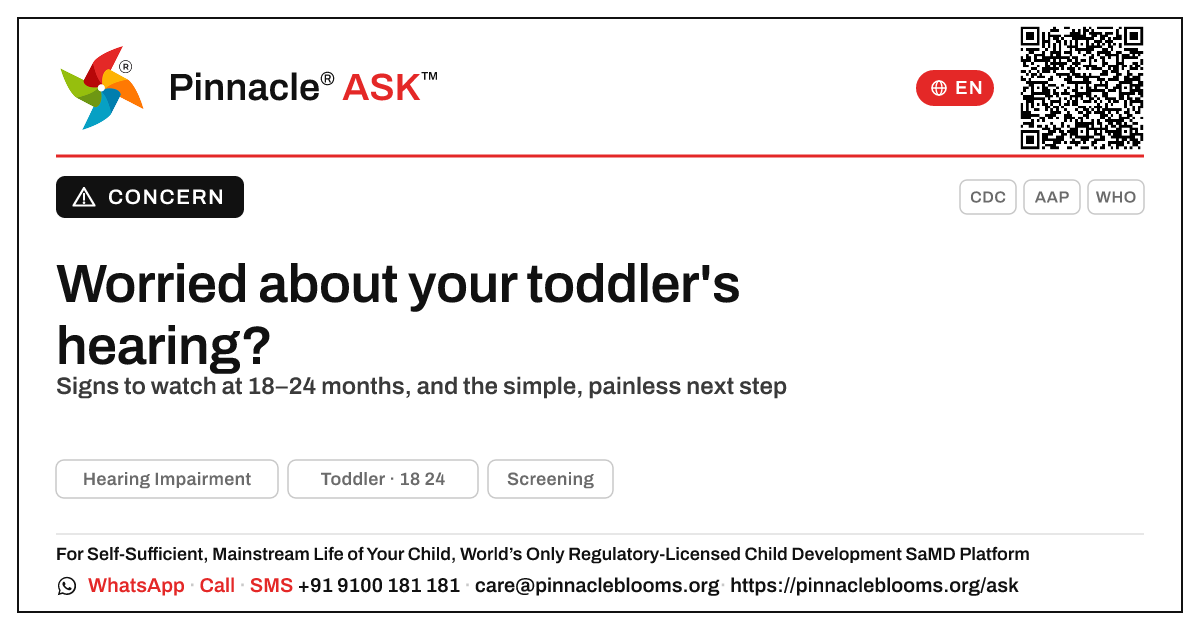
YOUR QUESTION. A CLEARER NEXT STEP.
When to worry about hearing in an 18–24-month-old
By 18–24 months a child should turn to your voice, respond to their name and use a few growing words. If your toddler misses everyday sounds, follows only gestures, or has very few words, ask for a hearing check — a fresh test is always reasonable, even after a newborn screen. Only a clinician can confirm anything.
In this answer 4 sections
If your little one isn't turning to your voice or picking up words the way you hoped, that worry deserves a clear, kind answer — and a simple next step.
In short
By 18–24 months, a child should respond to their name, follow simple spoken instructions, turn towards familiar sounds, and use a small but growing set of words. Worth checking soon if your toddler:
- Doesn't turn to your voice or to everyday sounds (the doorbell, a dog, the TV)
- Has very few or no words, or has stopped using words they once had
- Doesn't follow simple instructions like "give me the cup" without gestures
- Watches your face intently for cues but seems to miss sound itself
- Speaks unusually loudly or seems unbothered by loud noises
Worry is a reason to check — not a diagnosis. Hearing can change after a newborn screen (frequent ear infections are a common cause), so a fresh test is always reasonable.
The science, briefly
Hearing is the foundation of spoken language — the first two years are when the brain's listening pathways are most rapidly wired. Even mild or fluctuating hearing loss in this window can quietly delay words and understanding. This is why the CDC and IAP urge a hearing check whenever a parent has a concern, regardless of an earlier newborn screen. Identified early, outcomes are excellent: a simple, painless hearing test confirms what is happening, and support — when needed — works best when it starts young.
The Pinnacle way
No online form or article can diagnose hearing impairment — individual assessment and diagnosis require an appropriately qualified healthcare professional. Our team checks hearing first, then maps your child's listening and language against their own baseline, and where helpful pairs it with speech therapy — so you leave with clarity and a plan, not a label.
Trusted sources
WHO ICD-11; CDC — Learn the Signs. Act Early.; Indian Academy of Pediatrics; American Academy of Pediatrics (HealthyChildren.org).
Next step — The kindest thing to do with worry is to check. Book a hearing and language check with a Pinnacle clinician.
CONNECT THE ANSWER TO YOUR CHILD’S DAY
Something to notice. Something to discuss.
What to notice
Check sooner if your toddler stops using words they once had, doesn't startle or turn to loud sounds, has had repeated ear infections or ear-pulling, or relies entirely on watching your face to understand you.
In everyday life
Play a gentle listening game: from behind your child, softly call their name or shake a rattle to one side, then the other. A consistent turn towards the sound is a lovely sign their hearing and attention are linking up.
Bring your observations and questions to your child’s professional. Choose activities that suit your child’s comfort, abilities and agreed plan.
Bring your questions to a first visitQuestions families ask
My baby passed the newborn hearing screen — can hearing still be a problem now?
Yes. A newborn screen is reassuring but not a lifetime guarantee. Hearing can change after birth, often from frequent ear infections or fluid behind the eardrum. If you have a concern now, a fresh hearing test is always reasonable.
My toddler responds sometimes but not always — is that a worry?
Inconsistent responses can be normal toddler selective attention, but they can also signal mild or fluctuating hearing loss. If the pattern persists alongside few words, it's worth a simple check to be sure.
Will a hearing test hurt my child?
No. Hearing tests for toddlers are painless, play-based and quick. The clinician uses gentle sounds and watches your child's responses — many little ones find it rather fun.
FOLLOW THE SOURCE
References behind this answer.
- Source referenceCDC — Learn the Signs. Act Early.
- Organisation website · further readingAmerican Academy of Pediatrics (HealthyChildren.org)
- Source referenceWHO ICD-11
References are supplied with this answer. An organisation homepage offers further reading; it does not establish an independent review of this page.
Content attribution: SETU Consortium · Pinnacle Blooms Network.
PEOPLE, TOPICS & DEVELOPMENT
See the connections.
Browse the wider question collections connected with this answer’s audience, developmental area and stage.
FROM UNDERSTANDING TO PURPOSEFUL SUPPORT
One question. Your child’s whole life.
Your child’s self-sufficient, mainstream-included life is the purpose from the beginning. At Pinnacle, that purpose shapes what we understand, the goals we choose, the people we bring together, everyday practice and review.
Connect this question with the right support.
Start with your child’s strengths, your observations and what you want everyday life to become.
Make the next conversation useful.
Bring the situations you notice at home or school. We’ll explain a suitable service, centre and first visit, including availability and fees, before you decide.
How PinnacleAI® connects the journeyExplore the seven stages
- 1Understand abilities
A starting picture of your child’s capabilities.
- 2Choose meaningful goals
Readiness and a plan shaped around the child.
- 3Bring the right support together
Suitable therapies and people for those goals.
- 4Carry practice into everyday life
Guidance for family, home and school.
- 5Track and correct
Use observations to adjust the plan.
- 6Reassess and review
Decide what to continue, change or do next.
- 7Grow independence and participation
The child’s life gives each step its purpose.
Explore the whole PinnacleAI® system → · Participation at school and in the community →
PINNACLE’S EVIDENCE, OPEN TO YOU
Look at the evidence behind our work.
Read our research, inspect the original regulatory documents and check what each institutional measure means.
General information supports a conversation with an appropriately qualified professional. Advice, goals and support depend on the individual child.