
YOUR QUESTION. A CLEARER NEXT STEP.
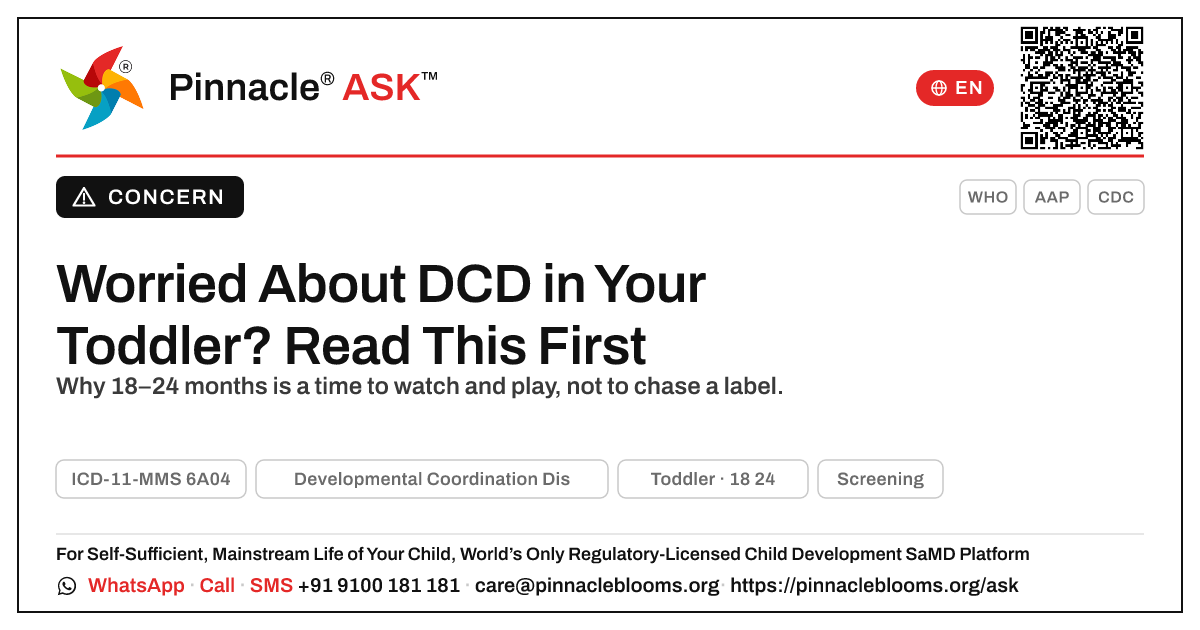
When to Worry About DCD at 18–24 Months
At 18–24 months, Developmental Coordination Disorder (ICD-11 6A04) cannot yet be diagnosed — toddler motor skills vary hugely and DCD is recognised from around age 5. For now, track broad motor milestones, support active play, and raise persistent concerns at a general developmental check rather than seeking a label. Only a Pinnacle clinician can assess, never an online form.
In this answer 5 sections
If your toddler trips often, struggles with a spoon, or seems a beat behind other children their age, it's natural to wonder — but at 18–24 months, this is a moment to gently watch, not to worry.
In short
At 18–24 months, Developmental Coordination Disorder (ICD-11 6A04) is not yet something that can be diagnosed — toddler motor skills naturally vary enormously, and a clumsy walker today is often a confident runner in a few months. DCD is recognised later, usually around age 5 and beyond, once a child has had a fair chance to practise everyday skills. For now, the kindest approach is to track motor milestones, support plenty of movement and play, and raise any persistent concerns at a general developmental check rather than chasing a label.
What is appropriate to watch at this age
Rather than DCD-specific signs, focus on the broad motor milestones toddlers typically reach. It's reasonable to mention these to your paediatrician if your child, by around 18–24 months, consistently:
- Is not yet walking independently by 18 months
- Rarely attempts to climb, squat to pick up a toy, or kick a ball
- Cannot hold or use a spoon or crayon at all, even messily
- Seems very floppy or very stiff, or strongly favours one side of the body
- Has lost a movement skill they had previously gained
A single area lagging is rarely a worry on its own — children develop at their own pace and in their own order. What matters more is the whole picture over time, and whether several areas seem persistently behind. These are conversation-starters, not verdicts.
When assessment becomes meaningful
A formal DCD picture needs a child old enough to attempt structured everyday tasks — dressing, drawing, using cutlery, navigating playground equipment — and to show that the difficulty is real, persistent, and out of step with their other abilities. That clarity usually emerges from the preschool years onward. Before then, a general developmental check is the right route: it catches any motor, speech or learning concern early, without prematurely pinning a label on a still-developing toddler.
The Pinnacle way
A clinical AbilityScore® and any diagnosis are formed only at a Pinnacle Blooms Network centre, under qualified clinician care — never from an online form or checklist. Our team looks at your child's whole developmental story across movement, play, communication and daily skills, and supports growth through gentle, play-based occupational therapy when it's genuinely needed. With 70+ centres across 4 states and 700+ therapists, an early, reassuring check is always within reach.
Trusted sources
WHO ICD-11 (6A04, Developmental motor coordination disorder); American Academy of Pediatrics developmental milestone guidance (healthychildren.org); CDC "Learn the Signs. Act Early." milestone resources (cdc.gov).
Next step — If your toddler's movement feels persistently behind, the calmest move is a friendly developmental check. Book a developmental check with a Pinnacle clinician.
This is general information, not a diagnosis — individual assessment and diagnosis require an appropriately qualified healthcare professional.
CONNECT THE ANSWER TO YOUR CHILD’S DAY
Something to notice. Something to discuss.
What to notice
Watch the whole motor picture over time rather than one skill: not walking independently by 18 months, rarely climbing or kicking, unable to hold a spoon or crayon at all, marked floppiness or stiffness, strong one-sided preference, or loss of a skill once gained. Raise persistent concerns at a developmental check.
In everyday life
Give your toddler plenty of safe, unstructured movement each day — climbing cushions, stacking blocks, scribbling with chunky crayons, scooping with a spoon. Practice through play, not pressure, is exactly how coordination grows at this age.
Bring your observations and questions to your child’s professional. Choose activities that suit your child’s comfort, abilities and agreed plan.
Bring your questions to a first visitQuestions families ask
Can Developmental Coordination Disorder be diagnosed in an 18-month-old?
No. At 18–24 months, motor skills vary widely from child to child, and DCD (ICD-11 6A04) is typically recognised from around age 5, once a child has had a fair chance to practise everyday skills. Before then, the right step is a general developmental check, not a DCD label.
What motor milestones should my toddler be reaching by 18–24 months?
Most toddlers are walking independently by 18 months, beginning to climb, squat to pick up toys, attempt to kick a ball, and hold a spoon or crayon — even messily. Children vary in order and pace, so it's the overall picture over time that matters most.
My toddler is clumsy and trips a lot — should I be worried?
Occasional clumsiness is completely normal as toddlers learn to move and balance. It becomes worth mentioning to a clinician only if several motor skills seem persistently behind, your child is very floppy or stiff, strongly favours one side, or has lost a skill they had before.
What should I do if I'm still concerned about my toddler's coordination?
Book a general developmental check with a clinician. They can look at the whole picture — movement, play, communication and daily skills — and reassure you or set up gentle, play-based support early if it's genuinely needed.
FOLLOW THE SOURCE
References behind this answer.
- Organisation website · further readingWHO ICD-11: Developmental motor coordination disorder
- Organisation website · further readingAAP HealthyChildren: developmental milestones
- Source referenceCDC Learn the Signs. Act Early.
References are supplied with this answer. An organisation homepage offers further reading; it does not establish an independent review of this page.
Content attribution: SETU Consortium · Pinnacle Blooms Network.
PEOPLE, TOPICS & DEVELOPMENT
See the connections.
Browse the wider question collections connected with this answer’s audience, developmental area and stage.
FROM UNDERSTANDING TO PURPOSEFUL SUPPORT
One question. Your child’s whole life.
Your child’s self-sufficient, mainstream-included life is the purpose from the beginning. At Pinnacle, that purpose shapes what we understand, the goals we choose, the people we bring together, everyday practice and review.
Connect this question with the right support.
Explore how the relevant service contributes to everyday abilities, then speak with us about your child.
Make the next conversation useful.
Bring the situations you notice at home or school. We’ll explain a suitable service, centre and first visit, including availability and fees, before you decide.
How PinnacleAI® connects the journeyExplore the seven stages
- 1Understand abilities
A starting picture of your child’s capabilities.
- 2Choose meaningful goals
Readiness and a plan shaped around the child.
- 3Bring the right support together
Suitable therapies and people for those goals.
- 4Carry practice into everyday life
Guidance for family, home and school.
- 5Track and correct
Use observations to adjust the plan.
- 6Reassess and review
Decide what to continue, change or do next.
- 7Grow independence and participation
The child’s life gives each step its purpose.
Explore the whole PinnacleAI® system → · Participation at school and in the community →
PINNACLE’S EVIDENCE, OPEN TO YOU
Look at the evidence behind our work.
Read our research, inspect the original regulatory documents and check what each institutional measure means.
General information supports a conversation with an appropriately qualified professional. Advice, goals and support depend on the individual child.