
YOUR QUESTION. A CLEARER NEXT STEP.
Worrying about dyscalculia at 12–18 months
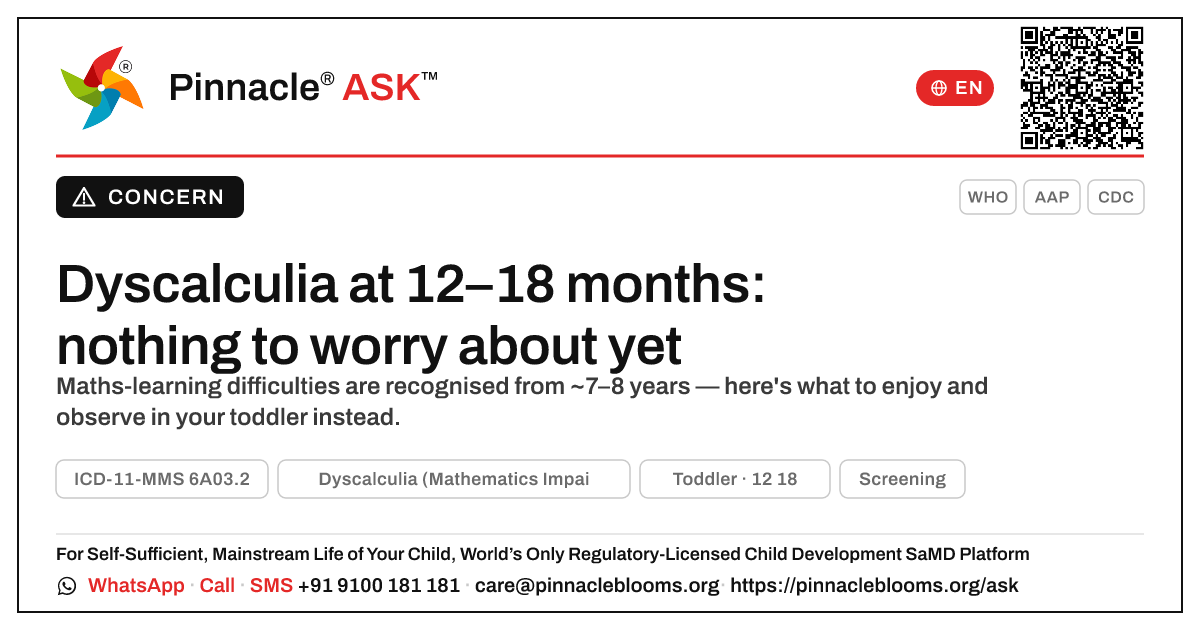
Dyscalculia cannot be identified in a 12-to-18-month-old — it is a specific maths-learning difficulty only meaningfully recognised from around 7–8 years, once a child engages with formal arithmetic. At toddler age there is no number skill to assess, so there is nothing to worry about on this front. Enjoy and gently observe broad early development — play, sorting, pointing, first words — and seek a general developmental check only if overall development feels off. Any assessment is by a Pinnacle clinician, never an online form.
In this answer 5 sections
If you're wondering whether your toddler's relationship with numbers is on track, take a gentle breath — this is a caring question, and the reassuring truth is that dyscalculia cannot be identified at this age.
In short
Dyscalculia (ICD-11 6A03.2) is a specific difficulty with understanding numbers and arithmetic, and it is only meaningfully recognised once a child is engaging with formal mathematics — usually around 7–8 years of age and not before. At 12–18 months, there is no number skill to assess and nothing to worry about on the dyscalculia front. What matters now is your toddler's broad early development — play, communication, problem-solving and joyful interaction — which lays the foundation for all later learning, including maths.
What is actually appropriate to notice at 12–18 months
Rather than maths, this is the age of pre-numeracy through play and connection. Lovely things to enjoy and gently observe:
- Object permanence — looking for a toy that's hidden, knowing things still exist when out of sight
- Sorting and stacking — fitting cups, stacking blocks, posting shapes
- Pointing and sharing attention — pointing at things to show you, following your point
- Understanding "more" — gesturing or vocalising for more food or play
- Imitating — copying your actions, banging, clapping, waving
- First words and gestures — a growing handful of words and lots of communicative babble
These everyday moments — not flashcards or counting drills — are how a toddler's brain builds the scaffolding for numbers later on.
When number-skill assessment becomes meaningful
Genuine dyscalculia screening waits until a child has had real, structured exposure to counting, number symbols and simple arithmetic — typically from around 7–8 years. Before then, a child who is slower with early counting is almost always simply developing at their own pace. If at any age something about your child's overall development feels off — communication, play, social connection or movement — that is always worth a general developmental check, regardless of maths.
The Pinnacle way
A clinical AbilityScore® and any diagnosis are formed only at a Pinnacle Blooms Network centre, under qualified clinician care — never from an online form or a checklist, and never for dyscalculia at toddler age. Our focus for a 12–18-month-old is the whole picture of early development, supported where needed by early intervention and occupational therapy. You can read more about how this difficulty is understood as children grow on our dyscalculia page.
Trusted sources
WHO ICD-11 (6A03.2, developmental learning disorder with impairment in mathematics); American Academy of Pediatrics developmental-milestone guidance (healthychildren.org); CDC "Learn the Signs. Act Early." milestones (cdc.gov).
Next step — There is nothing to worry about for dyscalculia at this age. If you'd simply like reassurance about your toddler's overall development, book a general developmental check with a Pinnacle clinician.
This is general information, not a diagnosis — individual assessment and diagnosis require an appropriately qualified healthcare professional.
CONNECT THE ANSWER TO YOUR CHILD’S DAY
Something to notice. Something to discuss.
What to notice
Dyscalculia is not assessable at this age — there's nothing maths-specific to watch for. Instead, enjoy early development: looking for hidden toys, stacking and sorting, pointing to share attention, gesturing for 'more', imitating you, and a growing handful of first words. Seek a general developmental check if overall communication, play, social connection or movement feels off.
In everyday life
Skip counting drills — instead weave numbers into play and routine: count steps as you climb, say 'one more' at snack time, sort blocks by colour, and narrate 'big' and 'little'. Warm, playful talk builds the brain foundations for later maths far better than flashcards.
Bring your observations and questions to your child’s professional. Choose activities that suit your child’s comfort, abilities and agreed plan.
Bring your questions to a first visitQuestions families ask
Can dyscalculia be diagnosed in a 12-to-18-month-old?
No. Dyscalculia (ICD-11 6A03.2) is a specific difficulty with numbers and arithmetic that can only be meaningfully recognised once a child engages with formal maths — usually from around 7–8 years. At toddler age there is no number skill to assess, so there is nothing to worry about on this front.
What number-related skills are normal at 12–18 months?
At this age children are building pre-numeracy through play, not counting: finding hidden toys, stacking and sorting, pointing to share attention, gesturing for 'more', and imitating you. These everyday moments lay the foundation for later maths.
When does dyscalculia screening become meaningful?
Typically from around 7–8 years, after a child has had real exposure to counting, number symbols and simple arithmetic. Before then, a slower-to-count child is almost always just developing at their own pace.
Should I do anything now to help my toddler with maths later?
Yes — but through play, not drills. Count steps aloud, say 'one more', sort by colour and shape, and use words like big, little, more and gone. Warm, playful interaction builds the brain foundations for numbers.
FOLLOW THE SOURCE
References behind this answer.
- Organisation website · further readingAAP HealthyChildren: developmental milestones for toddlers
- Source referenceCDC Learn the Signs. Act Early. milestones
References are supplied with this answer. An organisation homepage offers further reading; it does not establish an independent review of this page.
Content attribution: SETU Consortium · Pinnacle Blooms Network.
PEOPLE, TOPICS & DEVELOPMENT
See the connections.
Browse the wider question collections connected with this answer’s audience, developmental area and stage.
FROM UNDERSTANDING TO PURPOSEFUL SUPPORT
One question. Your child’s whole life.
Your child’s self-sufficient, mainstream-included life is the purpose from the beginning. At Pinnacle, that purpose shapes what we understand, the goals we choose, the people we bring together, everyday practice and review.
Connect this question with the right support.
Start with your child’s strengths, your observations and what you want everyday life to become.
Make the next conversation useful.
Bring the situations you notice at home or school. We’ll explain a suitable service, centre and first visit, including availability and fees, before you decide.
How PinnacleAI® connects the journeyExplore the seven stages
- 1Understand abilities
A starting picture of your child’s capabilities.
- 2Choose meaningful goals
Readiness and a plan shaped around the child.
- 3Bring the right support together
Suitable therapies and people for those goals.
- 4Carry practice into everyday life
Guidance for family, home and school.
- 5Track and correct
Use observations to adjust the plan.
- 6Reassess and review
Decide what to continue, change or do next.
- 7Grow independence and participation
The child’s life gives each step its purpose.
Explore the whole PinnacleAI® system → · Participation at school and in the community →
PINNACLE’S EVIDENCE, OPEN TO YOU
Look at the evidence behind our work.
Read our research, inspect the original regulatory documents and check what each institutional measure means.
General information supports a conversation with an appropriately qualified professional. Advice, goals and support depend on the individual child.