
YOUR QUESTION. A CLEARER NEXT STEP.
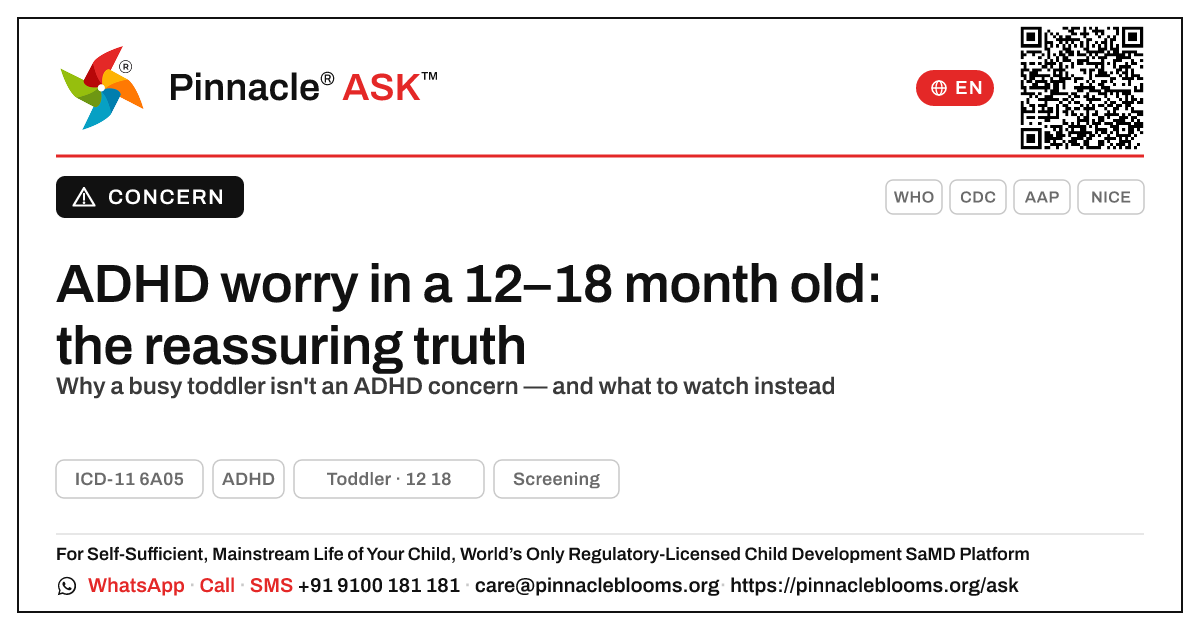
When should I worry about ADHD in a 12–18 month old?
At 12–18 months ADHD cannot be diagnosed, and high energy or short attention is normal toddler behaviour. Rather than ADHD signs, watch milestones — connection, communication, play and movement. A general developmental check, not ADHD screening, is the right next step, and only a clinician can assess.
In this answer 5 sections
If your bright, busy 12-to-18-month-old never seems to sit still, the worry is understandable — but here's the reassuring truth about ADHD at this age.
In short
At 12–18 months, ADHD is not something that can be diagnosed — and worrying that your toddler "has it" isn't clinically meaningful yet. Constant movement, short attention, climbing everything and quickly losing interest in toys are normal, healthy toddler behaviour — this is exactly how little ones at this age are built to explore and learn. ADHD is recognised only when patterns of inattention or overactivity are clearly beyond what's expected for age, persist across settings, and affect daily life — typically assessed from around school age.
What IS worth watching at this age
Rather than ADHD signs, watch your child's broader development:
- Connection — do they look at you, share smiles, follow your pointing, respond to their name?
- Communication — babbling, first words, gestures like waving or pointing
- Play & curiosity — exploring objects, simple back-and-forth games
- Movement — sitting, crawling, pulling to stand, early walking
If any of these seem delayed or your child loses skills they once had, that's worth a general developmental check — not because of ADHD, but to support whatever your child needs early.
The science, briefly
WHO ICD-11 (6A05) frames ADHD as a persistent pattern that interferes with functioning — criteria that simply cannot be reliably applied to a toddler still mastering walking and first words. International guidance (NICE NG87, the AAP) reserves ADHD diagnosis for older children. The kindest, most useful step now is monitoring developmental milestones, not screening for ADHD.
The Pinnacle way
Developmental measurement supports care planning; diagnosis requires an appropriately qualified healthcare professional., under qualified clinician care — never from an online form or a worry. If something feels off, our team focuses on your child's whole development against their own baseline, with gentle, play-based behaviour and developmental support where it helps. Learn more about ADHD across childhood when it becomes relevant.
Trusted sources
WHO ICD-11 (6A05); CDC Learn the Signs, Act Early; Indian Academy of Pediatrics; American Academy of Pediatrics (HealthyChildren.org); NICE NG87.
Next step — Let go of the ADHD worry for now and simply track milestones. If anything feels behind, book a general developmental check with a Pinnacle clinician.
This is general information, not a diagnosis — individual assessment and diagnosis require an appropriately qualified healthcare professional.
CONNECT THE ANSWER TO YOUR CHILD’S DAY
Something to notice. Something to discuss.
What to notice
At this age, watch development rather than ADHD: eye contact, responding to name, babbling and first words, pointing and waving, and movement milestones like pulling to stand and early walking. Seek a check sooner if your child loses skills they once had.
In everyday life
Channel your toddler's energy into short, joyful back-and-forth play — rolling a ball, naming what they touch, big pauses for them to respond. Ten minutes of this daily builds attention and connection naturally.
Bring your observations and questions to your child’s professional. Choose activities that suit your child’s comfort, abilities and agreed plan.
Bring your questions to a first visitQuestions families ask
Can ADHD be diagnosed in a 1-year-old?
No. ADHD is not diagnosed in toddlers. The pattern of inattention and overactivity that defines ADHD can only be reliably assessed when a child is older, typically around school age, when it can be judged against age expectations across settings.
My 15-month-old never sits still — is that ADHD?
Almost certainly not. Constant movement and exploration are exactly how healthy toddlers learn at this age. It is normal, not a sign of ADHD.
What should I watch instead at this age?
Watch broad development: does your child make eye contact, respond to their name, babble or say first words, point and wave, and reach movement milestones? Any delay, or loss of skills, is worth a general developmental check.
When does ADHD assessment become meaningful?
ADHD is usually assessed from around school age, when attention and activity can be measured against age expectations and shown to affect daily life across home and school.
FOLLOW THE SOURCE
References behind this answer.
- Source referenceWHO ICD-11 — Attention deficit hyperactivity disorder
- Source referenceCDC — Learn the Signs. Act Early.
- Organisation website · further readingAmerican Academy of Pediatrics (HealthyChildren.org)
- Source referenceNICE NG87 — ADHD diagnosis & management
References are supplied with this answer. An organisation homepage offers further reading; it does not establish an independent review of this page.
Content attribution: SETU Consortium · Pinnacle Blooms Network.
PEOPLE, TOPICS & DEVELOPMENT
See the connections.
Browse the wider question collections connected with this answer’s audience, developmental area and stage.
FROM UNDERSTANDING TO PURPOSEFUL SUPPORT
One question. Your child’s whole life.
Your child’s self-sufficient, mainstream-included life is the purpose from the beginning. At Pinnacle, that purpose shapes what we understand, the goals we choose, the people we bring together, everyday practice and review.
Connect this question with the right support.
Start with your child’s strengths, your observations and what you want everyday life to become.
Make the next conversation useful.
Bring the situations you notice at home or school. We’ll explain a suitable service, centre and first visit, including availability and fees, before you decide.
How PinnacleAI® connects the journeyExplore the seven stages
- 1Understand abilities
A starting picture of your child’s capabilities.
- 2Choose meaningful goals
Readiness and a plan shaped around the child.
- 3Bring the right support together
Suitable therapies and people for those goals.
- 4Carry practice into everyday life
Guidance for family, home and school.
- 5Track and correct
Use observations to adjust the plan.
- 6Reassess and review
Decide what to continue, change or do next.
- 7Grow independence and participation
The child’s life gives each step its purpose.
Explore the whole PinnacleAI® system → · Participation at school and in the community →
PINNACLE’S EVIDENCE, OPEN TO YOU
Look at the evidence behind our work.
Read our research, inspect the original regulatory documents and check what each institutional measure means.
General information supports a conversation with an appropriately qualified professional. Advice, goals and support depend on the individual child.