
YOUR QUESTION. A CLEARER NEXT STEP.
When should an ASHA or PHC worker escalate a child with ADHD signs?
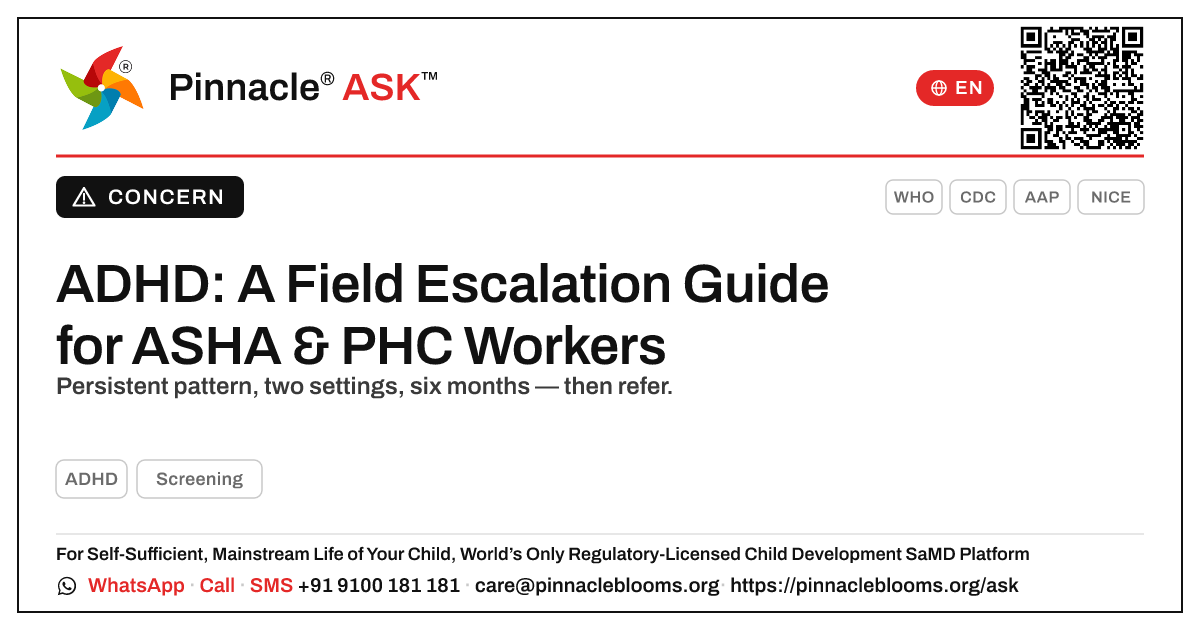
Escalate a school-age child (around 6+) when inattention, hyperactivity or impulsivity persists for 6+ months across two settings (home and school) and disrupts learning or relationships — confirmed by parent and teacher. Refer promptly if red flags suggest another cause. The worker notices and routes; only a clinician diagnoses.
In this answer 4 sections
An ASHA or PHC worker is often the first to notice a restless, inattentive child — and knowing exactly when to escalate is one of the most valuable judgements you make.
In short
ADHD is not diagnosed in the field, and never from a single restless day. Escalate to a medical officer or paediatrician when a child of school age (around 6 or older) shows a persistent pattern — present for at least six months, across more than one setting (home and school/anganwadi) — of inattention, hyperactivity or impulsivity that is clearly out of step with the child's age and is interfering with learning, friendships or family life. Below age 6, observe and support rather than label; high activity is developmentally normal in young children.
When to escalate — a field decision guide
Refer onward to the medical officer / PHC physician when you observe a sustained pattern (not an occasional bad day):
- Inattention — cannot stay with a task, loses things repeatedly, doesn't seem to listen, easily distracted, struggling at school despite trying
- Hyperactivity — constant fidgeting, cannot stay seated when expected, always "on the go"
- Impulsivity — interrupts, cannot wait turns, acts before thinking, frequent accidents
- Two or more settings — the difficulty appears both at home and at school/anganwadi, reported by parent and teacher
- Six months or longer, and clearly affecting learning or relationships
Escalate promptly (don't wait) if there are red flags suggesting another cause — new-onset behaviour change, suspected seizures or staring spells, hearing or vision concerns, signs of distress, self-harm or unsafe impulsivity. These need a medical review first, as several conditions mimic ADHD.
What the worker does not do: diagnose, label the child to the family, or start any treatment. Your role is to notice the pattern, reassure the family, and route to the right clinician.
The Pinnacle way
ADHD (ICD-11 6A05) is confirmed only by a qualified clinician, never in the field and never from a checklist. At Pinnacle Blooms Network, a clinical AbilityScore® and any diagnosis are formed only at a Pinnacle Blooms Network centre under qualified clinician care, after ruling out other causes. For a child you've flagged, a structured child-development assessment gives the family clarity and a plan — not a label. With 70+ centres across 4 states and 700+ therapists, onward support is close at hand.
Trusted sources
WHO ICD-11 (6A05, attention deficit hyperactivity disorder); CDC — Learn the Signs. Act Early.; Indian Academy of Pediatrics; American Academy of Pediatrics (HealthyChildren.org); NICE NG87 on ADHD diagnosis and management.
Next step — When the pattern fits, refer with confidence. Book a developmental assessment so a Pinnacle clinician can give the family answers.
This is general information, not a diagnosis — individual assessment and diagnosis require an appropriately qualified healthcare professional.
CONNECT THE ANSWER TO YOUR CHILD’S DAY
Something to notice. Something to discuss.
What to notice
Escalate sooner, without waiting six months, if behaviour changed suddenly, there are staring spells or suspected seizures, hearing or vision concerns, or any unsafe or self-harming impulsivity — these need a medical review first.
In everyday life
When counselling the family, suggest simple structure at home: predictable routines, short clear one-step instructions, and praising effort immediately. These help every child and cost nothing while assessment is arranged.
Bring your observations and questions to your child’s professional. Choose activities that suit your child’s comfort, abilities and agreed plan.
Bring your questions to a first visitQuestions families ask
Can an ASHA worker diagnose ADHD?
No. An ASHA or PHC worker observes patterns and refers; only a qualified clinician can diagnose ADHD after a structured assessment that rules out other causes. Labelling a child in the field is never appropriate.
At what age should ADHD signs be escalated?
Generally from school age, around 6 years, when behaviour can be reliably compared to age expectations across settings. Below 6, high activity is often developmentally normal — observe and support rather than label.
What if the signs appeared suddenly?
Sudden behaviour change, staring spells, or new inattention warrant prompt medical review rather than routine ADHD referral, as conditions such as seizures, hearing loss or distress can mimic ADHD.
FOLLOW THE SOURCE
References behind this answer.
- Source referenceWHO ICD-11 — Attention deficit hyperactivity disorder
- Source referenceCDC — Learn the Signs. Act Early.
- Organisation website · further readingAmerican Academy of Pediatrics — HealthyChildren.org
- Source referenceNICE NG87 — ADHD diagnosis and management
References are supplied with this answer. An organisation homepage offers further reading; it does not establish an independent review of this page.
Content attribution: SETU Consortium · Pinnacle Blooms Network.
PEOPLE, TOPICS & DEVELOPMENT
See the connections.
Browse the wider question collections connected with this answer’s audience, developmental area and stage.
FROM UNDERSTANDING TO PURPOSEFUL SUPPORT
One question. Your child’s whole life.
Your child’s self-sufficient, mainstream-included life is the purpose from the beginning. At Pinnacle, that purpose shapes what we understand, the goals we choose, the people we bring together, everyday practice and review.
Connect this question with the right support.
Start with your child’s strengths, your observations and what you want everyday life to become.
Make the next conversation useful.
Bring the situations you notice at home or school. We’ll explain a suitable service, centre and first visit, including availability and fees, before you decide.
How PinnacleAI® connects the journeyExplore the seven stages
- 1Understand abilities
A starting picture of your child’s capabilities.
- 2Choose meaningful goals
Readiness and a plan shaped around the child.
- 3Bring the right support together
Suitable therapies and people for those goals.
- 4Carry practice into everyday life
Guidance for family, home and school.
- 5Track and correct
Use observations to adjust the plan.
- 6Reassess and review
Decide what to continue, change or do next.
- 7Grow independence and participation
The child’s life gives each step its purpose.
Explore the whole PinnacleAI® system → · Participation at school and in the community →
PINNACLE’S EVIDENCE, OPEN TO YOU
Look at the evidence behind our work.
Read our research, inspect the original regulatory documents and check what each institutional measure means.
General information supports a conversation with an appropriately qualified professional. Advice, goals and support depend on the individual child.