
YOUR QUESTION. A CLEARER NEXT STEP.
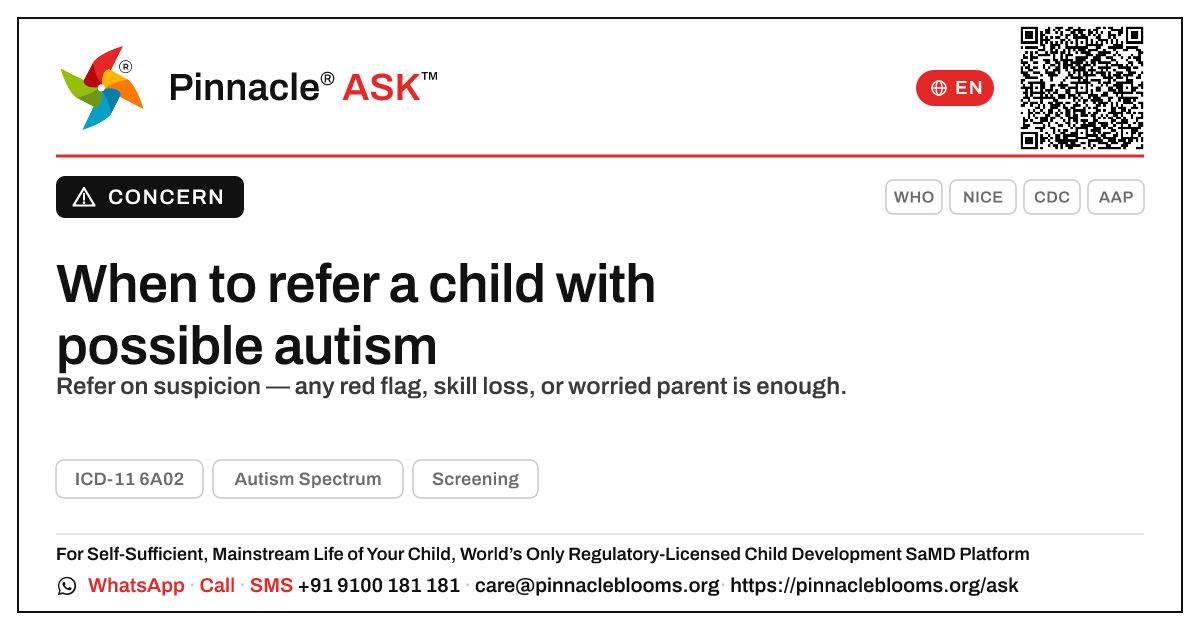
When to refer a child with possible autism to a specialist
Refer on suspicion, not certainty. Any recognised red flag, any loss of skills at any age, or a worried parent is reason enough to refer for specialist assessment. Screen hearing first. A referral opens the door to early support — only a clinician diagnoses.
In this answer 5 sections
You are often the first person a worried family talks to — and your timely referral can change a child's whole trajectory.
In short
Refer without waiting if a child shows any of the recognised red flags, if a parent reports a loss of skills (regression) at any age, or simply if your own developmental gut feeling says something is not right. In autism, you do not wait to be certain — you refer on suspicion, because early assessment and early support carry the strongest evidence for good outcomes. A referral is not a diagnosis; it is a door to clarity.
What to watch — refer if you see these
- By 12 months — no babbling, pointing or other gestures; no response to own name
- By 16 months — no single words
- By 18 months — not pointing to share interest; little eye contact; not following a point
- By 24 months — no meaningful two-word phrases (not just imitating)
- Any age — loss of previously gained speech, babble or social skills (regress = refer urgently)
- Any age — limited social smiling, reduced shared attention, strong repetitive behaviours, intense distress at routine change, or a parent who is worried
Also screen hearing first — undetected hearing loss can mimic these signs.
The science, briefly
WHO classifies autism spectrum disorder under ICD-11 6A02. NICE (CG128) and the CDC's Learn the Signs. Act Early. programme both endorse referral on suspicion rather than delay, and IAP guidance supports developmental surveillance at every well-child contact. Parental concern is one of the most reliable early signals in the evidence — take it seriously.
The Pinnacle way
No diagnosis or AbilityScore® is ever made from a form, a phone call or this page — a clinical AbilityScore® and any diagnosis are formed only at a Pinnacle Blooms Network centre, under a qualified clinician. Once you refer, families reach structured assessment and, where needed, autism therapy and speech therapy early — when it counts most.
Trusted sources
WHO ICD-11 (6A02); NICE CG128 on autism recognition; CDC Learn the Signs. Act Early.; Indian Academy of Pediatrics; NIMHANS autism resources.
Next step — When in doubt, refer. Connect a family to a Pinnacle assessment today.
CONNECT THE ANSWER TO YOUR CHILD’S DAY
Something to notice. Something to discuss.
What to notice
Refer urgently if a child loses words, babble or social skills they once had. Refer if there is no name response or gesture by 12 months, no words by 16 months, no pointing to share by 18 months, or no two-word phrases by 24 months — or whenever a parent is worried.
In everyday life
Trust parental concern and document it plainly. At every well-child visit, ask one open question — 'Is there anything about how your child plays, talks or responds that you wonder about?' — and act on the answer.
Bring your observations and questions to your child’s professional. Choose activities that suit your child’s comfort, abilities and agreed plan.
Bring your questions to a first visitQuestions families ask
Should I wait until I'm sure before referring?
No. In autism you refer on suspicion, not certainty. Early assessment carries the strongest evidence for good outcomes, and a referral is simply a door to clarity — never a diagnosis. When in doubt, refer.
What is the single most urgent red flag?
Loss of previously gained skills — speech, babble or social behaviours — at any age. Regression warrants prompt referral. Always screen hearing too, as undetected hearing loss can mimic these signs.
How much weight should I give to what the parent says?
A great deal. Parental concern is one of the most reliable early signals in the evidence. If a parent is worried, that alone is reason enough to refer for specialist assessment.
FOLLOW THE SOURCE
References behind this answer.
- Source referenceWHO ICD-11 — Autism spectrum disorder
- Source referenceNICE CG128 — Autism recognition and referral
- Source referenceCDC — Learn the Signs. Act Early.
- Organisation website · further readingAmerican Academy of Pediatrics — HealthyChildren.org
References are supplied with this answer. An organisation homepage offers further reading; it does not establish an independent review of this page.
Content attribution: SETU Consortium · Pinnacle Blooms Network.
PEOPLE, TOPICS & DEVELOPMENT
See the connections.
Browse the wider question collections connected with this answer’s audience, developmental area and stage.
FROM UNDERSTANDING TO PURPOSEFUL SUPPORT
One question. Your child’s whole life.
Your child’s self-sufficient, mainstream-included life is the purpose from the beginning. At Pinnacle, that purpose shapes what we understand, the goals we choose, the people we bring together, everyday practice and review.
Connect this question with the right support.
Explore how the relevant service contributes to everyday abilities, then speak with us about your child.
Make the next conversation useful.
Bring the situations you notice at home or school. We’ll explain a suitable service, centre and first visit, including availability and fees, before you decide.
How PinnacleAI® connects the journeyExplore the seven stages
- 1Understand abilities
A starting picture of your child’s capabilities.
- 2Choose meaningful goals
Readiness and a plan shaped around the child.
- 3Bring the right support together
Suitable therapies and people for those goals.
- 4Carry practice into everyday life
Guidance for family, home and school.
- 5Track and correct
Use observations to adjust the plan.
- 6Reassess and review
Decide what to continue, change or do next.
- 7Grow independence and participation
The child’s life gives each step its purpose.
Explore the whole PinnacleAI® system → · Participation at school and in the community →
PINNACLE’S EVIDENCE, OPEN TO YOU
Look at the evidence behind our work.
Read our research, inspect the original regulatory documents and check what each institutional measure means.
General information supports a conversation with an appropriately qualified professional. Advice, goals and support depend on the individual child.