
YOUR QUESTION. A CLEARER NEXT STEP.
When to Investigate Language Mixing in a Young Child
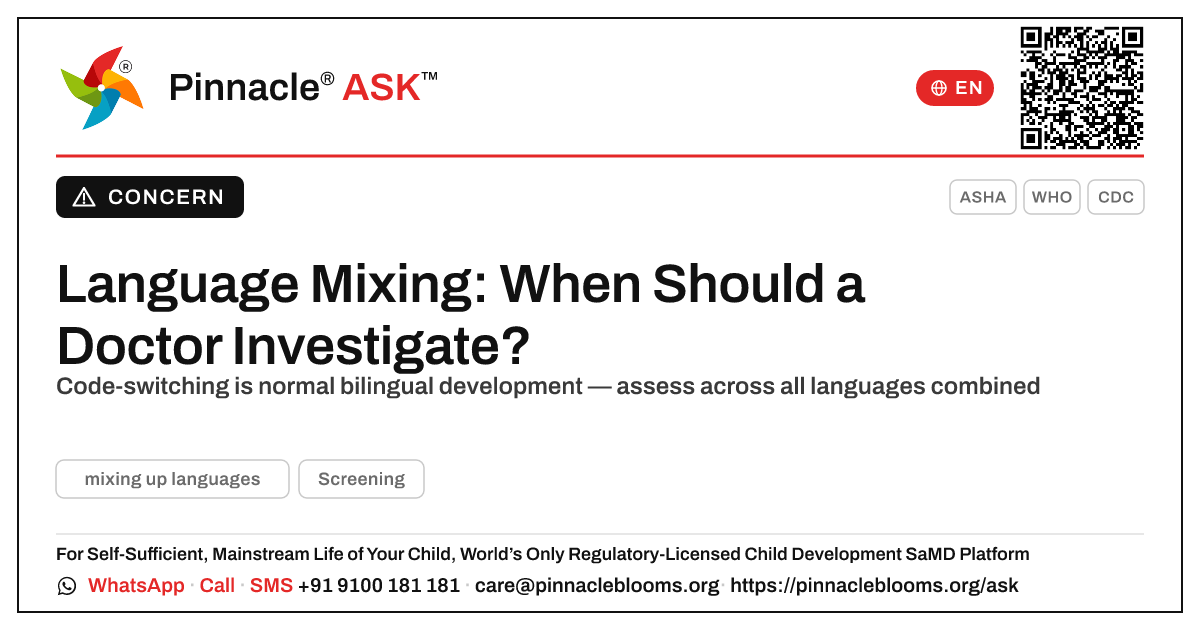
Mixing languages (code-switching) is a normal, expected feature of bilingual acquisition and is not itself a disorder. A doctor should investigate only when mixing accompanies genuine delay across BOTH/all of the child's languages — low total conceptual vocabulary, weak comprehension, regression, or reduced communicative intent — assessed by pooling all languages rather than judging any one in isolation.
In this answer 5 sections
Code-mixing in a multilingual home is one of the most predictable, healthy features of bilingual acquisition — the question is when it signals something beyond typical dual-language development.
In short
In young children exposed to two or more languages, mixing words and grammar across languages (code-switching) is a normal, expected stage of bilingual acquisition, not a marker of disorder or confusion. Investigation is warranted only when mixing is accompanied by a genuine language delay across both languages — limited total vocabulary, late or absent word combinations, or weak comprehension when both languages are pooled — rather than mixing in isolation. The discriminating clinical principle: assess the child's conceptual (total) vocabulary and comprehension across all languages combined, not performance in any single language.
The science: distinguishing typical bilingualism from disorder
Code-mixing reflects the child drawing fluently on a shared lexical-conceptual store and is influenced by the input pattern at home (parental mixing, language dominance, exposure ratio). It does not delay acquisition and is not a red flag in itself.
Genuine concern arises when red flags co-occur — and crucially, a true language disorder presents in both/all languages, since a disorder is intrinsic to the child rather than to a language:
- Total conceptual vocabulary below expectation when both languages are counted together (e.g. markedly fewer than ~50 words with no two-word combinations by ~24 months).
- Comprehension deficits evident even in the dominant language with adequate exposure.
- Plateau or regression in either language, or loss of previously acquired words.
- Reduced communicative intent — limited gesture, joint attention, pointing or social use of language, independent of which language is used.
- Family history of speech-language disorder, or parental concern that persists despite consistent rich input.
Mixing alone, with age-appropriate total vocabulary and intact comprehension, requires reassurance and routine monitoring — not referral.
When to refer
Refer for structured speech-language assessment when delay is documented across the child's combined languages, when comprehension is affected, when there is regression, or when reduced social communication accompanies the language profile. Assessment must sample all languages the child uses and weigh exposure history; monolingual norms applied to a bilingual child will over-identify. Reassure families that maintaining the home language is protective and need not be dropped.
The Pinnacle way
A clinical AbilityScore® and any diagnosis are formed only at a Pinnacle Blooms Network centre, under qualified clinician care — never from a single observation of language mixing. Our speech therapy team conducts bilingual-aware evaluation, sampling every language a child uses and computing conceptual vocabulary across them before drawing any conclusion. Families can begin with a developmental screen that respects the child's full linguistic repertoire.
Trusted sources
ASHA (asha.org) clinical guidance on bilingual language acquisition and the distinction between language difference and language disorder; WHO ICD-11 framework for developmental language disorder; CDC (cdc.gov) developmental-milestone and early-identification resources.
Next step — When language delay spans both languages or comprehension is affected, book a bilingual-aware speech-language assessment with a Pinnacle clinician rather than waiting.
This is general information, not a diagnosis — individual assessment and diagnosis require an appropriately qualified healthcare professional.
CONNECT THE ANSWER TO YOUR CHILD’S DAY
Something to notice. Something to discuss.
What to notice
Refer when language mixing co-occurs with low total conceptual vocabulary across all languages, comprehension deficits even in the dominant language, plateau or regression, loss of acquired words, or reduced gesture, joint attention and communicative intent. Mixing with age-appropriate combined vocabulary and intact comprehension warrants reassurance and monitoring, not referral.
In everyday life
When taking a bilingual history, ask the family to estimate the child's vocabulary across all languages combined, not separately — a single shared count gives a far truer picture than judging either language alone.
Bring your observations and questions to your child’s professional. Choose activities that suit your child’s comfort, abilities and agreed plan.
Bring your questions to a first visitQuestions families ask
Is mixing two languages a sign of a speech disorder?
No. Code-mixing is a normal, well-documented stage of bilingual acquisition reflecting a shared lexical-conceptual store. It is not a marker of confusion or disorder. Concern arises only when delay or comprehension deficits appear across all of the child's languages combined.
How do you tell a language difference from a language disorder in a bilingual child?
A true disorder is intrinsic to the child and presents in both/all languages, not just one. Assess conceptual (total) vocabulary and comprehension pooled across every language the child uses, weigh exposure history, and avoid applying monolingual norms, which over-identify bilingual children.
Should families stop using the home language to help the child?
No. Maintaining the home language is protective and supports overall language and identity. There is no evidence that dropping a language improves outcomes; bilingual-aware assessment and support are preferred.
When is referral clearly indicated?
Refer when combined vocabulary is below expectation, comprehension is weak even in the dominant language, there is plateau or regression with loss of acquired words, or reduced gesture, joint attention and communicative intent accompany the picture.
FOLLOW THE SOURCE
References behind this answer.
- Source referenceASHA — Learning two languages and bilingual development
- Organisation website · further readingWHO ICD-11 — developmental language disorder framework
- Source referenceCDC — developmental milestones and early identification
References are supplied with this answer. An organisation homepage offers further reading; it does not establish an independent review of this page.
Content attribution: SETU Consortium · Pinnacle Blooms Network.
PEOPLE, TOPICS & DEVELOPMENT
See the connections.
Browse the wider question collections connected with this answer’s audience, developmental area and stage.
FROM UNDERSTANDING TO PURPOSEFUL SUPPORT
One question. Your child’s whole life.
Your child’s self-sufficient, mainstream-included life is the purpose from the beginning. At Pinnacle, that purpose shapes what we understand, the goals we choose, the people we bring together, everyday practice and review.
Connect this question with the right support.
Explore how the relevant service contributes to everyday abilities, then speak with us about your child.
Make the next conversation useful.
Bring the situations you notice at home or school. We’ll explain a suitable service, centre and first visit, including availability and fees, before you decide.
How PinnacleAI® connects the journeyExplore the seven stages
- 1Understand abilities
A starting picture of your child’s capabilities.
- 2Choose meaningful goals
Readiness and a plan shaped around the child.
- 3Bring the right support together
Suitable therapies and people for those goals.
- 4Carry practice into everyday life
Guidance for family, home and school.
- 5Track and correct
Use observations to adjust the plan.
- 6Reassess and review
Decide what to continue, change or do next.
- 7Grow independence and participation
The child’s life gives each step its purpose.
Explore the whole PinnacleAI® system → · Participation at school and in the community →
PINNACLE’S EVIDENCE, OPEN TO YOU
Look at the evidence behind our work.
Read our research, inspect the original regulatory documents and check what each institutional measure means.
General information supports a conversation with an appropriately qualified professional. Advice, goals and support depend on the individual child.