
YOUR QUESTION. A CLEARER NEXT STEP.
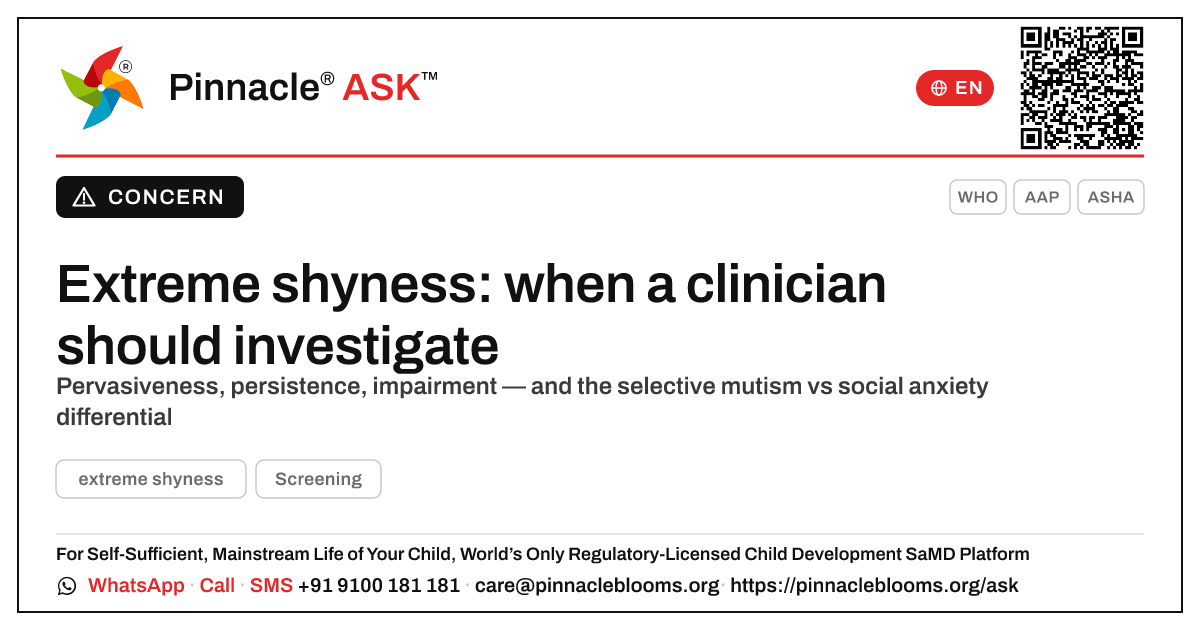
When to investigate extreme shyness in a young child
Shyness is a common, healthy temperament trait; investigate only when reticence is pervasive across settings, persistent beyond an adjustment period, and functionally impairing. Targeted assessment is warranted for selective mutism (speech failure in specific settings ≥1 month) and social anxiety disorder, with a differential covering hearing loss, language disorder and autism spectrum conditions. Behavioural inhibition is a recognised antecedent of later anxiety, so early low-pressure support is preventive.
In this answer 5 sections
Most young children are slow to warm up to new people and places — but a clinician's eye can tell ordinary temperament from something that warrants a closer look.
In short
Shyness is a common, healthy temperament trait in early childhood and usually needs no intervention. Investigate when reticence is pervasive across settings, persistent beyond the expected adjustment period, and functionally impairing — interfering with play, peer relationships, feeding/toileting away from home, or language and social development. Two patterns deserve targeted assessment: selective mutism (consistent failure to speak in specific social settings despite speaking elsewhere, ≥1 month, not limited to the first month of school) and social anxiety disorder, plus a differential that includes hearing loss, language disorder, and autism spectrum conditions.
When investigation is warranted
Use a threshold framed around pervasiveness, persistence and impairment rather than the shyness itself:
- Cross-situational consistency — withdrawal or mutism not just with strangers but at preschool, with extended family, or in structured settings where the child is otherwise familiar.
- Duration — symptoms persisting beyond a normal settling-in window (selective mutism: speech failure ≥1 month, excluding the first month of a new setting).
- Functional impact — impaired peer interaction, inability to ask for help/toilet/eat away from home, or educational participation affected.
- Developmental red flags — limited expressive language across all settings, poor response to name, reduced joint attention, or regression — flagging a possible communication or autism-spectrum differential rather than temperament.
- Somatic and avoidance features — anticipatory distress, tantrums or somatic complaints around social exposure, suggesting an anxiety mechanism.
First-line work-up: confirm hearing (audiology), characterise receptive/expressive language, and screen for autism spectrum features. Differentiate normative behavioural inhibition from selective mutism (ICD-11 6B06) and social anxiety disorder (ICD-11 6B04).
When to refer
Refer for structured developmental and communication assessment when reticence is pervasive, durable beyond adjustment, and impairing — or when language/social red flags accompany it. Behavioural inhibition is a recognised antecedent of later anxiety, so early, low-pressure intervention is preventive, not premature.
The Pinnacle way
A clinical AbilityScore® and any diagnosis are formed only at a Pinnacle Blooms Network centre under qualified clinician care — through structured, clinician-administered observation across settings, never an online checklist. Where communication is implicated, our speech therapy team supports graded verbal participation and selective-mutism-informed approaches. Explore our wider home of developmental resources for the social domain.
Trusted sources
WHO ICD-11 entries for selective mutism and social anxiety disorder; American Academy of Pediatrics (aap.org) and healthychildren.org guidance on temperament, behavioural inhibition and developmental surveillance; ASHA (asha.org) resources on selective mutism and the speech-language differential.
Next step — When shyness crosses into impairment or carries language flags, book a developmental screen with a Pinnacle clinician for a calm, structured review.
This is general information, not a diagnosis — individual assessment and diagnosis require an appropriately qualified healthcare professional.
CONNECT THE ANSWER TO YOUR CHILD’S DAY
Something to notice. Something to discuss.
What to notice
Investigate when withdrawal is consistent across settings, persists beyond a normal settling-in window, and impairs peer play, education or self-care. Flag selective mutism (speech failure in specific settings ≥1 month) and social anxiety; differentiate from hearing loss, language disorder and autism. Confirm audiology and language as first-line work-up.
In everyday life
Advise carers to document where the child speaks freely versus where speech or interaction drops off — this cross-setting map quickly distinguishes shyness from selective mutism.
Bring your observations and questions to your child’s professional. Choose activities that suit your child’s comfort, abilities and agreed plan.
Bring your questions to a first visitQuestions families ask
Is shyness the same as social anxiety in young children?
No. Shyness is a common temperament trait that is usually non-impairing and resolves with familiarity. Social anxiety disorder involves persistent, marked distress and avoidance that impairs functioning. The distinction rests on pervasiveness, duration and functional impact, not the reticence alone.
How does selective mutism differ from extreme shyness?
Selective mutism is a consistent failure to speak in specific social situations despite speaking normally elsewhere, lasting at least one month and not limited to the first month of a new setting. It is an anxiety-spectrum condition warranting structured assessment, whereas ordinary shyness does not prevent speech where the child is comfortable.
What should be excluded before attributing reticence to temperament?
Confirm hearing via audiology, characterise receptive and expressive language across all settings, and screen for autism spectrum features. Limited language everywhere, poor joint attention or regression points to a communication or developmental differential rather than shyness.
FOLLOW THE SOURCE
References behind this answer.
- Organisation website · further readingWHO ICD-11: selective mutism (6B06) and social anxiety disorder (6B04)
- Organisation website · further readingAAP healthychildren.org — temperament and behavioural inhibition
- Organisation website · further readingASHA — selective mutism and the speech-language differential
References are supplied with this answer. An organisation homepage offers further reading; it does not establish an independent review of this page.
Content attribution: SETU Consortium · Pinnacle Blooms Network.
PEOPLE, TOPICS & DEVELOPMENT
See the connections.
Browse the wider question collections connected with this answer’s audience, developmental area and stage.
FROM UNDERSTANDING TO PURPOSEFUL SUPPORT
One question. Your child’s whole life.
Your child’s self-sufficient, mainstream-included life is the purpose from the beginning. At Pinnacle, that purpose shapes what we understand, the goals we choose, the people we bring together, everyday practice and review.
Connect this question with the right support.
Start with your child’s strengths, your observations and what you want everyday life to become.
Make the next conversation useful.
Bring the situations you notice at home or school. We’ll explain a suitable service, centre and first visit, including availability and fees, before you decide.
How PinnacleAI® connects the journeyExplore the seven stages
- 1Understand abilities
A starting picture of your child’s capabilities.
- 2Choose meaningful goals
Readiness and a plan shaped around the child.
- 3Bring the right support together
Suitable therapies and people for those goals.
- 4Carry practice into everyday life
Guidance for family, home and school.
- 5Track and correct
Use observations to adjust the plan.
- 6Reassess and review
Decide what to continue, change or do next.
- 7Grow independence and participation
The child’s life gives each step its purpose.
Explore the whole PinnacleAI® system → · Participation at school and in the community →
PINNACLE’S EVIDENCE, OPEN TO YOU
Look at the evidence behind our work.
Read our research, inspect the original regulatory documents and check what each institutional measure means.
General information supports a conversation with an appropriately qualified professional. Advice, goals and support depend on the individual child.