
YOUR QUESTION. A CLEARER NEXT STEP.
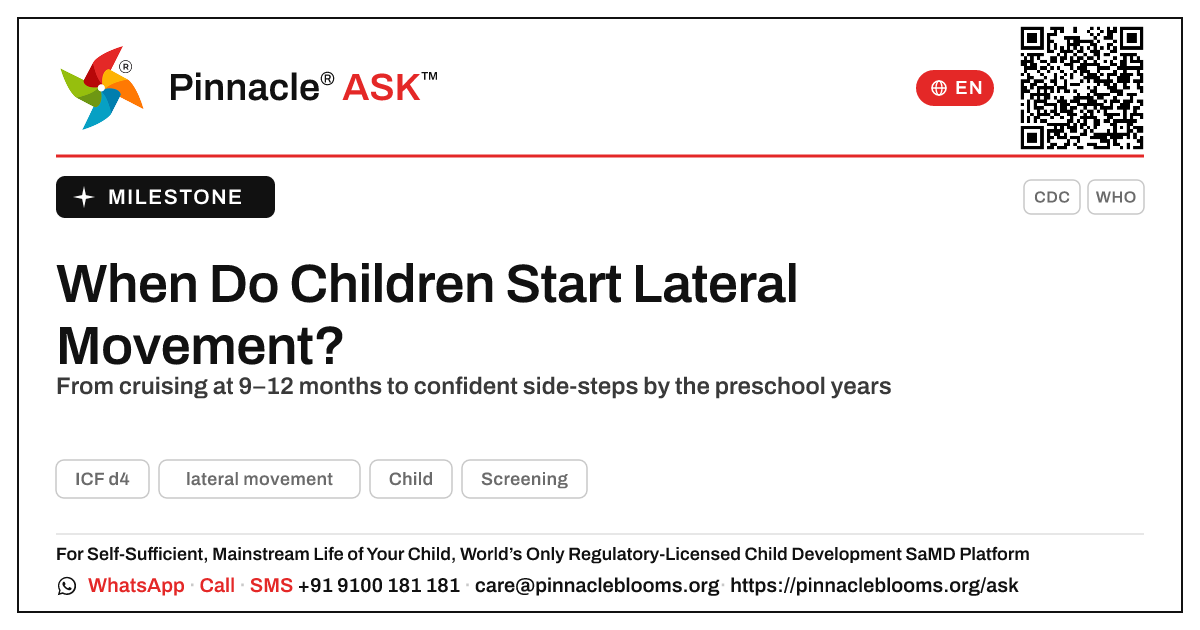
When do children usually start lateral movement?
Children often begin lateral (sideways) movement by cruising along furniture around 9–12 months, then refine side-stepping, shuffling and lateral hops through the toddler and preschool years (roughly 3–7), reflecting maturing balance and coordination. Ranges are wide and normal.
In this answer 5 sections
Watching your little one shuffle sideways along the sofa is one of those quiet, wonderful signs that balance is blooming.
In short
Lateral (sideways) movement usually begins late in the first year — many babies start cruising sideways along furniture around 9–12 months, well before they walk forward independently. By the toddler and preschool years (roughly 3–7 years), children refine sideways stepping, side-shuffling and lateral hops as their balance matures. There's a wide, healthy range — these are guides, not deadlines.
How lateral movement unfolds
Moving sideways asks more of a child than walking forwards: it needs balance, hip strength and the body's sense of where it is in space.
- 9–12 months — cruising sideways along furniture, taking weight through the legs
- 18–24 months — stepping sideways with support, squatting and recovering
- 2–3 years — side-stepping confidently, beginning to navigate around obstacles
- 4–5 years — sideways gallops and shuffles in play and games
- 6–7 years — coordinated lateral hops and quick changes of direction, as captured in motor screens like the BOT-2
The science
Lateral movement is a marker of dynamic balance and bilateral coordination — both shaped by the vestibular system and core stability. Sideways motion makes a child shift weight from one leg to the other while staying upright, which is why it appears a little later than forward walking and keeps refining for years.
The Pinnacle way
Every child moves on their own timeline. Developmental measurement supports care planning; diagnosis requires an appropriately qualified healthcare professional. under qualified clinician care — never from an online guide. If sideways movement seems delayed or unsteady, our team can help.
- Occupational Therapy for balance and coordination
- What is the AbilityScore®
- Lateral movement milestones
Trusted sources
Aligned with CDC developmental milestone guidance and the WHO ICF framework (activity domain d4, mobility), alongside paediatric motor-proficiency screens.
Next step — if you'd like reassurance about your child's balance and movement, book a developmental check on WhatsApp: +91 91001 81181.
This is general information, not a diagnosis — individual assessment and diagnosis require an appropriately qualified healthcare professional.
CONNECT THE ANSWER TO YOUR CHILD’S DAY
Something to notice. Something to discuss.
What to notice
Seek a developmental check if your child cannot step or shuffle sideways with support well beyond expected ages, seems very unsteady changing direction, frequently falls sideways, or appears to lose movement skills they once had.
In everyday life
Turn sideways movement into play: hold hands and 'crab walk' together along a line of cushions, or shuffle side-to-side to music — it builds balance and core strength naturally.
Bring your observations and questions to your child’s professional. Choose activities that suit your child’s comfort, abilities and agreed plan.
Bring your questions to a first visitQuestions families ask
At what age do babies start moving sideways?
Many babies begin sideways movement by cruising along furniture around 9 to 12 months, taking weight through their legs and shuffling side to side before they walk forward independently.
Why does sideways movement come later than walking forward?
Moving sideways needs more balance, hip strength and body awareness, so it tends to appear a little later than forward walking and keeps refining through the preschool years.
When should I be concerned about my child's sideways movement?
Consider a developmental check if your child remains very unsteady changing direction, cannot side-step with support well beyond the expected ages, or seems to lose skills once gained. A clinician can reassure or guide you.
FOLLOW THE SOURCE
References behind this answer.
- Source referenceCDC developmental milestones
- Source referenceWHO ICF mobility domain (d4)
References are supplied with this answer. An organisation homepage offers further reading; it does not establish an independent review of this page.
Content attribution: SETU Consortium · Pinnacle Blooms Network.
PEOPLE, TOPICS & DEVELOPMENT
See the connections.
Browse the wider question collections connected with this answer’s audience, developmental area and stage.
FROM UNDERSTANDING TO PURPOSEFUL SUPPORT
One question. Your child’s whole life.
Your child’s self-sufficient, mainstream-included life is the purpose from the beginning. At Pinnacle, that purpose shapes what we understand, the goals we choose, the people we bring together, everyday practice and review.
Connect this question with the right support.
Start with your child’s strengths, your observations and what you want everyday life to become.
Make the next conversation useful.
Bring the situations you notice at home or school. We’ll explain a suitable service, centre and first visit, including availability and fees, before you decide.
How PinnacleAI® connects the journeyExplore the seven stages
- 1Understand abilities
A starting picture of your child’s capabilities.
- 2Choose meaningful goals
Readiness and a plan shaped around the child.
- 3Bring the right support together
Suitable therapies and people for those goals.
- 4Carry practice into everyday life
Guidance for family, home and school.
- 5Track and correct
Use observations to adjust the plan.
- 6Reassess and review
Decide what to continue, change or do next.
- 7Grow independence and participation
The child’s life gives each step its purpose.
Explore the whole PinnacleAI® system → · Participation at school and in the community →
PINNACLE’S EVIDENCE, OPEN TO YOU
Look at the evidence behind our work.
Read our research, inspect the original regulatory documents and check what each institutional measure means.
General information supports a conversation with an appropriately qualified professional. Advice, goals and support depend on the individual child.