
YOUR QUESTION. A CLEARER NEXT STEP.
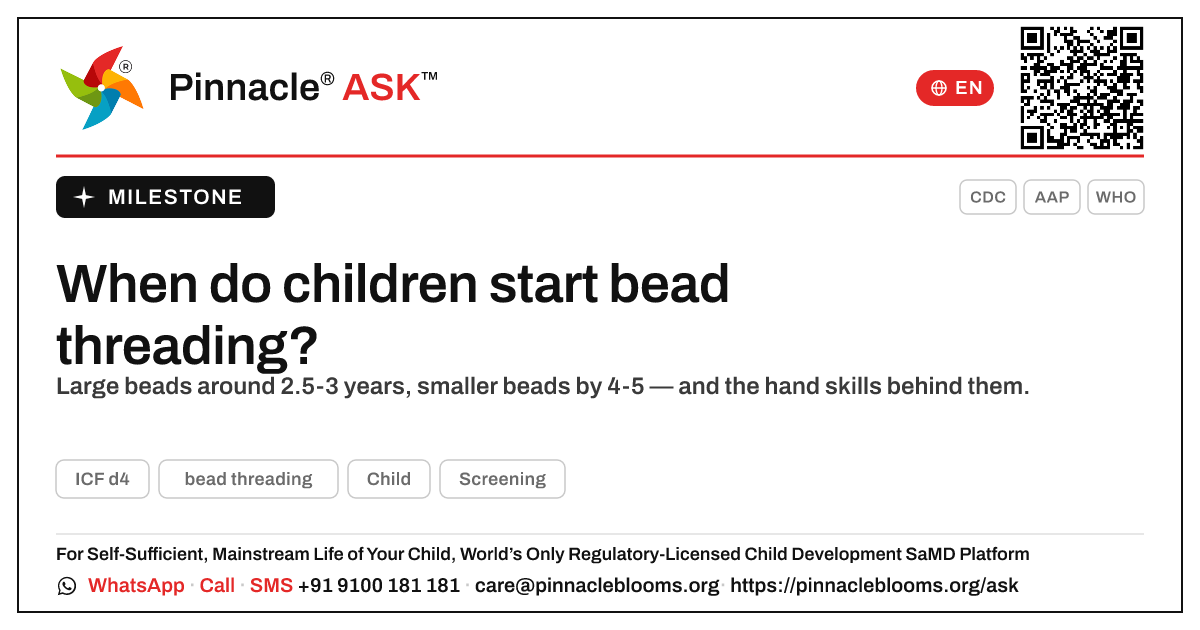
When do children usually start bead threading?
Most children start threading large beads onto a stiff lace around 2.5 to 3 years, and string smaller beads with control by 4 to 5 years. It draws on bilateral coordination, pincer grasp and hand-eye tracking, so a few months' variation is normal. A gentle check helps if fine-motor difficulty persists alongside other delays by around 4.
In this answer 5 sections
Those wobbly first beads sliding onto a string are tiny triumphs of two hands learning to work as a team.
In short
Most children begin threading large beads onto a stiff lace or pipe-cleaner around 2.5 to 3 years, and string several smaller beads with growing control by 4 to 5 years. It's a fine-motor and hand-eye coordination skill, so a range of a few months either side is perfectly normal. By around 5, many children can thread small beads neatly and even make a simple pattern.
How the skill grows
Bead threading sits in the ICF activity domain (d4, mobility and hand use) and draws on several abilities maturing together:
- 2.5–3 years — pushes a chunky bead onto a firm lace or pipe-cleaner, often two hands helping each other.
- 3–4 years — threads 3–4 medium beads onto a string with a stiffened tip; grip steadies.
- 4–5 years — strings smaller beads in sequence, beginning to copy a colour or shape pattern.
The magic underneath is bilateral coordination (one hand holds, one hand threads), a refined pincer grasp, and the visual tracking to line bead-hole to lace. These same hands are getting ready for buttons, cutlery and, later, a pencil.
When to check in
Threading varies widely, so it's the whole picture that matters. A gentle check is worth it if, by around 4, a child shows little interest in or difficulty with small-object handling alongside other fine-motor delays — say, trouble holding a crayon or feeding themselves. Occupational therapy can make these hand skills playful and strong.
The Pinnacle way
A clinical AbilityScore® and any diagnosis are formed only at a Pinnacle Blooms Network centre, under qualified clinician care. Explore bead threading and how it builds toward everyday hand skills with our team.
Trusted sources
Guided by CDC developmental milestone resources, AAP/HealthyChildren guidance on fine-motor play, and WHO ICF activity framing.
Next step — if you'd like a friendly developmental check, reach our team on WhatsApp at +91 91001 81181.
This is general information, not a diagnosis — individual assessment and diagnosis require an appropriately qualified healthcare professional.
CONNECT THE ANSWER TO YOUR CHILD’S DAY
Something to notice. Something to discuss.
What to notice
By around 4, little interest in or difficulty handling small objects alongside other fine-motor delays (struggling with a crayon or self-feeding) is worth a gentle developmental check.
In everyday life
Start big: offer chunky wooden beads and a stiff pipe-cleaner or shoelace. Let your child hold the lace and you guide the bead at first, then swap. Pasta tubes on string work just as well.
Bring your observations and questions to your child’s professional. Choose activities that suit your child’s comfort, abilities and agreed plan.
Bring your questions to a first visitQuestions families ask
At what age can a child thread beads?
Most children begin pushing large beads onto a stiff lace or pipe-cleaner around 2.5 to 3 years, and string several smaller beads with good control by 4 to 5 years. A few months' variation either way is normal.
Is bead threading a fine-motor skill?
Yes. It combines a refined pincer grasp, bilateral coordination (one hand holds, one hand threads) and hand-eye tracking — the same abilities that prepare hands for buttons, cutlery and pencil control.
When should I be concerned about bead threading?
It's the whole picture that matters, not threading alone. If by around 4 your child shows difficulty handling small objects along with other fine-motor delays, a gentle developmental check is worthwhile.
FOLLOW THE SOURCE
References behind this answer.
- Source referenceCDC developmental milestones
- Organisation website · further readingAAP HealthyChildren fine-motor guidance
- Organisation website · further readingWHO ICF activity framework (d4)
References are supplied with this answer. An organisation homepage offers further reading; it does not establish an independent review of this page.
Content attribution: SETU Consortium · Pinnacle Blooms Network.
PEOPLE, TOPICS & DEVELOPMENT
See the connections.
Browse the wider question collections connected with this answer’s audience, developmental area and stage.
FROM UNDERSTANDING TO PURPOSEFUL SUPPORT
One question. Your child’s whole life.
Your child’s self-sufficient, mainstream-included life is the purpose from the beginning. At Pinnacle, that purpose shapes what we understand, the goals we choose, the people we bring together, everyday practice and review.
Connect this question with the right support.
Start with your child’s strengths, your observations and what you want everyday life to become.
Make the next conversation useful.
Bring the situations you notice at home or school. We’ll explain a suitable service, centre and first visit, including availability and fees, before you decide.
How PinnacleAI® connects the journeyExplore the seven stages
- 1Understand abilities
A starting picture of your child’s capabilities.
- 2Choose meaningful goals
Readiness and a plan shaped around the child.
- 3Bring the right support together
Suitable therapies and people for those goals.
- 4Carry practice into everyday life
Guidance for family, home and school.
- 5Track and correct
Use observations to adjust the plan.
- 6Reassess and review
Decide what to continue, change or do next.
- 7Grow independence and participation
The child’s life gives each step its purpose.
Explore the whole PinnacleAI® system → · Participation at school and in the community →
PINNACLE’S EVIDENCE, OPEN TO YOU
Look at the evidence behind our work.
Read our research, inspect the original regulatory documents and check what each institutional measure means.
General information supports a conversation with an appropriately qualified professional. Advice, goals and support depend on the individual child.