
YOUR QUESTION. A CLEARER NEXT STEP.
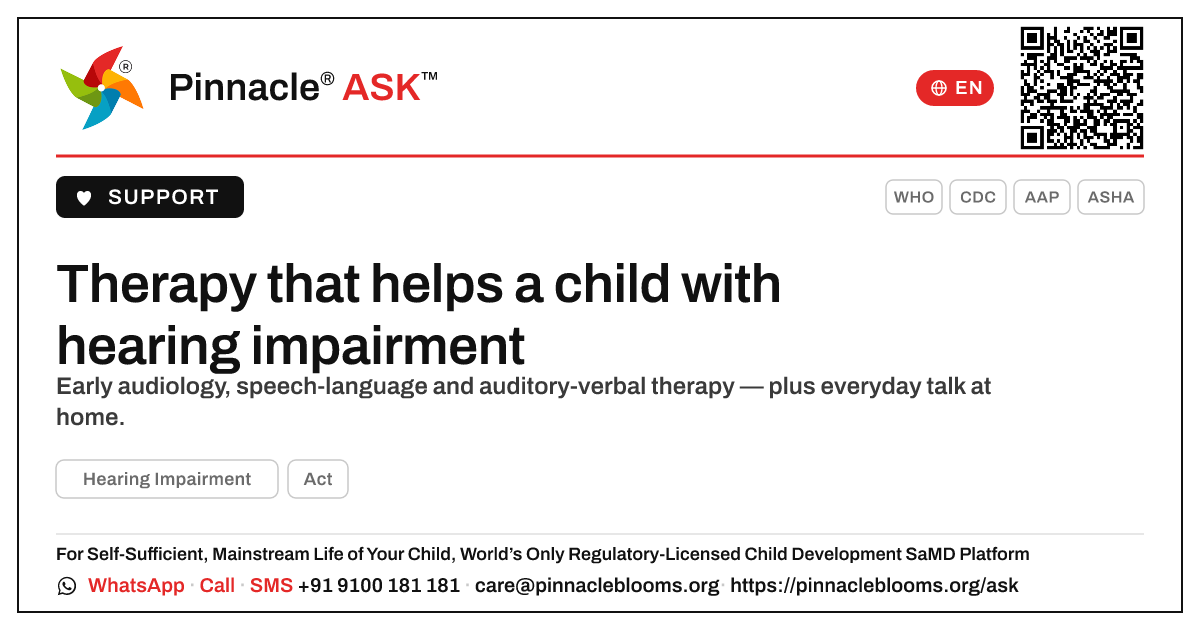
What therapy helps a child with hearing impairment?
Children with hearing impairment benefit most from early, combined support: well-fitted hearing devices through audiology, plus speech-language and auditory-verbal therapy, with strong parent coaching at home. The earlier it begins, the more naturally listening and language develop. Developmental measurement supports care planning; diagnosis requires an appropriately qualified healthcare professional.
In this answer 4 sections
When a child cannot hear clearly, the world of words can feel far away — but with the right support, that distance closes faster than most parents expect.
In short
The most powerful therapy for a child with hearing impairment is early, consistent communication support — typically speech and language therapy working alongside audiology (hearing aids or cochlear implants) and auditory-verbal or listening-and-spoken-language therapy. The earlier amplification and therapy begin, the more naturally a child develops listening, speech and language. Family-centred, everyday practice at home is just as important as the therapy room.
What helps, and why
A child's brain is most ready to build language in the first years of life. Once hearing is supported by well-fitted devices, therapy teaches the child to use that sound:
- Speech-language therapy builds vocabulary, sentence-making and clear speech sounds.
- Auditory-verbal / auditory training helps the child learn to listen and attach meaning to sound.
- Parent coaching turns mealtimes, bath-time and play into language-rich moments.
- Total / visual communication (sign, gestures, visual cues) can run alongside spoken language depending on your child's needs.
- Educational support ensures classrooms are accessible and confidence stays high.
The combination is chosen for your child — there is no single fixed path.
The Pinnacle way
Developmental measurement supports care planning; diagnosis requires an appropriately qualified healthcare professional., under qualified clinician care — never from an app or a form. Our therapists pair audiological clarity with rich communication practice, so your child grows toward confident, independent connection. Explore Hearing Impairment support, our Speech Therapy programme, and how the AbilityScore® works.
Trusted sources
WHO ICD-11 on hearing loss; CDC developmental milestones; the American Academy of Pediatrics on early hearing detection and intervention; ASHA guidance on childhood hearing and language.
Next step — Book a developmental check at your nearest Pinnacle centre to map your child's listening and language starting point.
This is general information, not a diagnosis — individual assessment and diagnosis require an appropriately qualified healthcare professional.
CONNECT THE ANSWER TO YOUR CHILD’S DAY
Something to notice. Something to discuss.
What to notice
Watch whether your child responds to soft sounds and their name, babbles or uses words for their age, turns toward speech, and stays engaged when devices are worn. Any plateau or loss of listening or speech skills deserves prompt review.
In everyday life
Make sound meaningful all day: narrate what you do, face your child when you speak, reduce background noise, and pause to let them respond — devices work best when paired with rich, everyday talk.
Bring your observations and questions to your child’s professional. Choose activities that suit your child’s comfort, abilities and agreed plan.
Bring your questions to a first visitQuestions families ask
When should therapy for hearing impairment start?
As early as possible. Once hearing is identified and devices are fitted, listening and language therapy in the early years gives the best foundation, because the young brain is most ready to build communication then.
Will my child learn to speak?
Many children with hearing impairment develop strong spoken language, especially with early amplification and consistent therapy. Some families also use sign and visual communication alongside speech — the plan is shaped around your child.
What is auditory-verbal therapy?
It is an approach that teaches a child to make sense of sound through listening, helping them attach meaning to what they hear and develop spoken language, with parents coached as active partners.
FOLLOW THE SOURCE
References behind this answer.
- Source referenceWHO ICD-11 on hearing loss
- Source referenceCDC — Learn the Signs. Act Early.
- Organisation website · further readingAAP — HealthyChildren.org
- Organisation website · further readingASHA — hearing and language guidance
References are supplied with this answer. An organisation homepage offers further reading; it does not establish an independent review of this page.
Content attribution: SETU Consortium · Pinnacle Blooms Network.
PEOPLE, TOPICS & DEVELOPMENT
See the connections.
Browse the wider question collections connected with this answer’s audience, developmental area and stage.
FROM UNDERSTANDING TO PURPOSEFUL SUPPORT
One question. Your child’s whole life.
Your child’s self-sufficient, mainstream-included life is the purpose from the beginning. At Pinnacle, that purpose shapes what we understand, the goals we choose, the people we bring together, everyday practice and review.
Connect this question with the right support.
Start with your child’s strengths, your observations and what you want everyday life to become.
Make the next conversation useful.
Bring the situations you notice at home or school. We’ll explain a suitable service, centre and first visit, including availability and fees, before you decide.
How PinnacleAI® connects the journeyExplore the seven stages
- 1Understand abilities
A starting picture of your child’s capabilities.
- 2Choose meaningful goals
Readiness and a plan shaped around the child.
- 3Bring the right support together
Suitable therapies and people for those goals.
- 4Carry practice into everyday life
Guidance for family, home and school.
- 5Track and correct
Use observations to adjust the plan.
- 6Reassess and review
Decide what to continue, change or do next.
- 7Grow independence and participation
The child’s life gives each step its purpose.
Explore the whole PinnacleAI® system → · Participation at school and in the community →
PINNACLE’S EVIDENCE, OPEN TO YOU
Look at the evidence behind our work.
Read our research, inspect the original regulatory documents and check what each institutional measure means.
General information supports a conversation with an appropriately qualified professional. Advice, goals and support depend on the individual child.