
YOUR QUESTION. A CLEARER NEXT STEP.
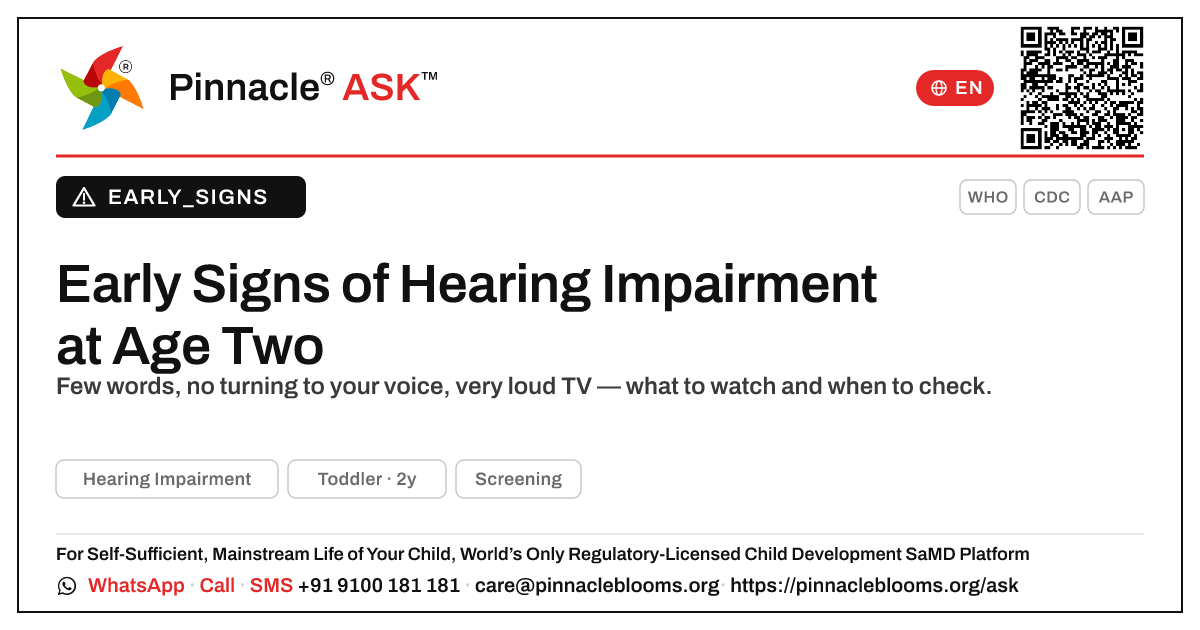
Early Signs of Hearing Impairment in a 2-Year-Old
By two, watch for few or no clear words, not turning to your voice or everyday sounds, wanting the TV very loud, and frequent ear infections. These don't confirm hearing loss, but a pattern is reason for a prompt hearing check — early action protects fast-growing toddler language.
In this answer 5 sections
By two, most toddlers are soaking up words and turning to your voice across the room — so when sound seems not to land, it's worth a gentle, timely check.
In short
By two years, a hearing difficulty often shows as a quiet patch in language and listening: few or no clear words, not turning to your voice or to everyday sounds, and needing the television very loud. None of these confirm a problem on their own — but if you notice a pattern, a simple hearing check brings clarity and peace of mind.
Signs worth watching at two
Listening and sound
- Doesn't turn or respond when you call from behind or across the room
- Seems not to notice everyday sounds — the doorbell, a barking dog, a phone
- Wants the TV or music far louder than feels comfortable
- Responds only when looking straight at your face (lip-reading the situation)
Talking and understanding
- Few or no clear single words, and not yet joining two words together
- Speech that is hard to understand, or that isn't growing month on month
- Doesn't follow simple instructions without gestures or pointing
- Was babbling as a baby but has gone quieter
Everyday clues
- Frequent ear infections, ear-tugging, or recent colds with blocked ears
- Startles when someone appears whom they didn't hear coming
Why early matters
The toddler years are when language is built fastest, and clear hearing is the foundation under it. Some hearing loss is temporary — fluid behind the eardrum after colds — and very treatable; some is permanent and helped greatly by early support. Either way, an early check protects speech and language development at the very moment it matters most. "Wait and see" is not the right move when a pattern is clear.
The Pinnacle way
A clinical AbilityScore® and any diagnosis are formed only at a Pinnacle Blooms Network centre under qualified clinician care — a hearing check itself is done through audiology and ENT. We support your child's communication journey alongside that medical care, with India's largest developmental-therapy network: 4.95 lakh+ families served across 70+ centres.
Trusted sources
Aligned with WHO guidance on childhood hearing, the CDC "Learn the Signs. Act Early." milestones, the Indian Academy of Pediatrics, and the American Academy of Pediatrics (HealthyChildren.org).
Next step — if any of these sound familiar, book a developmental and hearing check today. Reach our team on WhatsApp: +91 91001 81181.
This is general information, not a diagnosis — individual assessment and diagnosis require an appropriately qualified healthcare professional.
CONNECT THE ANSWER TO YOUR CHILD’S DAY
Something to notice. Something to discuss.
What to notice
Act promptly if your toddler has stopped using words they once had, isn't joining two words, or had repeated ear infections — these warrant a same-week hearing check rather than waiting.
In everyday life
Try a quiet game: with your child facing away, call their name softly or jingle keys. If they consistently don't turn to soft everyday sounds, note it and mention it at your check.
Bring your observations and questions to your child’s professional. Choose activities that suit your child’s comfort, abilities and agreed plan.
Bring your questions to a first visitQuestions families ask
My 2-year-old hears some sounds but not others — is that still hearing loss?
It can be. Some hearing loss affects only certain pitches or only quieter sounds, so a child may turn to a loud bang but miss soft speech. If responses are patchy or only happen when your child sees your face, a hearing check is the clear next step.
Could frequent ear infections be the cause?
Yes — fluid behind the eardrum after colds or ear infections is a common cause of temporary hearing loss in toddlers, and it is very treatable. A hearing check and ENT review can tell whether this is the reason.
My toddler had a newborn hearing screen that was fine. Can hearing still change?
Yes. A clear newborn screen is reassuring but hearing can change later from infections, illness or other causes. If you now notice signs, it's worth a fresh check regardless of the earlier result.
FOLLOW THE SOURCE
References behind this answer.
- Organisation website · further readingWHO — Childhood hearing health
- Source referenceCDC — Learn the Signs. Act Early.
- Organisation website · further readingAAP — HealthyChildren.org
References are supplied with this answer. An organisation homepage offers further reading; it does not establish an independent review of this page.
Content attribution: SETU Consortium · Pinnacle Blooms Network.
PEOPLE, TOPICS & DEVELOPMENT
See the connections.
Browse the wider question collections connected with this answer’s audience, developmental area and stage.
FROM UNDERSTANDING TO PURPOSEFUL SUPPORT
One question. Your child’s whole life.
Your child’s self-sufficient, mainstream-included life is the purpose from the beginning. At Pinnacle, that purpose shapes what we understand, the goals we choose, the people we bring together, everyday practice and review.
Connect this question with the right support.
Start with your child’s strengths, your observations and what you want everyday life to become.
Make the next conversation useful.
Bring the situations you notice at home or school. We’ll explain a suitable service, centre and first visit, including availability and fees, before you decide.
How PinnacleAI® connects the journeyExplore the seven stages
- 1Understand abilities
A starting picture of your child’s capabilities.
- 2Choose meaningful goals
Readiness and a plan shaped around the child.
- 3Bring the right support together
Suitable therapies and people for those goals.
- 4Carry practice into everyday life
Guidance for family, home and school.
- 5Track and correct
Use observations to adjust the plan.
- 6Reassess and review
Decide what to continue, change or do next.
- 7Grow independence and participation
The child’s life gives each step its purpose.
Explore the whole PinnacleAI® system → · Participation at school and in the community →
PINNACLE’S EVIDENCE, OPEN TO YOU
Look at the evidence behind our work.
Read our research, inspect the original regulatory documents and check what each institutional measure means.
General information supports a conversation with an appropriately qualified professional. Advice, goals and support depend on the individual child.