
YOUR QUESTION. A CLEARER NEXT STEP.
What conditions often occur alongside hearing impairment?
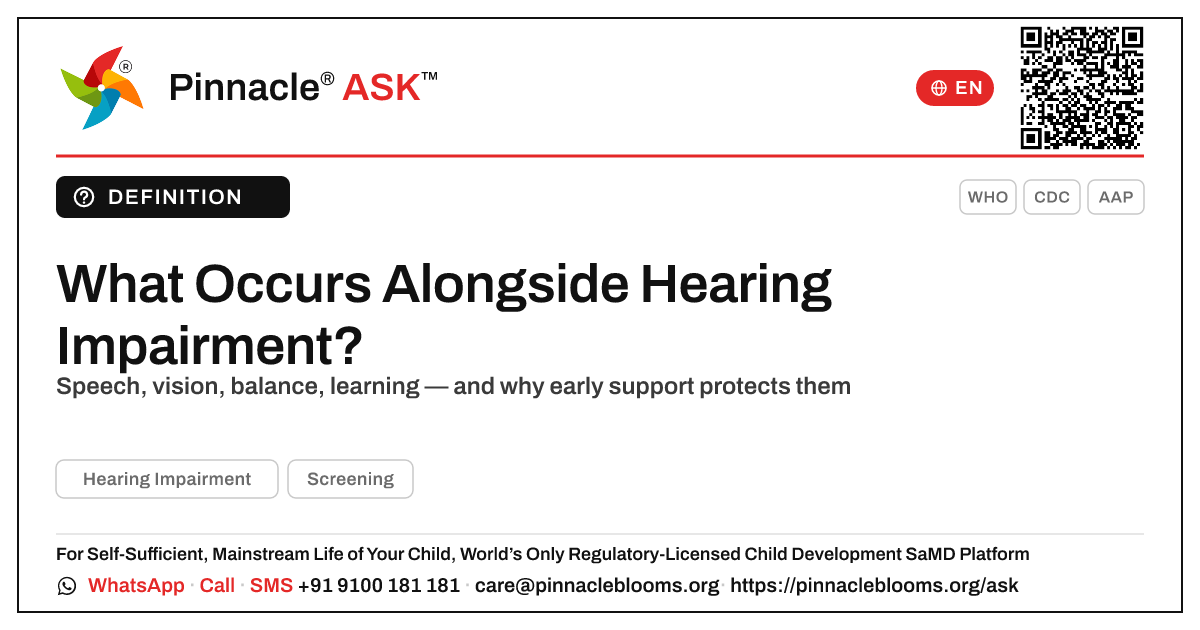
Hearing impairment commonly co-occurs with speech and language delay, vision differences, balance and motor challenges, learning and attention differences, and sometimes syndromic conditions. These are areas to monitor, not inevitabilities — early hearing support often protects the rest. Developmental measurement supports care planning; diagnosis requires an appropriately qualified healthcare professional.
In this answer 5 sections
When a child has hearing difficulties, families often wonder whether other areas of development might need attention too — and asking that question early is one of the kindest things you can do.
In short
Hearing impairment frequently travels alongside other developmental areas — most commonly speech and language delay, because hearing is how children learn to talk. It can also occur with vision differences, balance and motor coordination challenges, learning and attention differences, and as part of certain genetic or syndromic conditions. These are not inevitable — they are simply areas worth keeping a gentle eye on, because supporting hearing early often protects the rest.
Conditions that commonly co-occur
- Speech and language delay — the most common companion, since clear hearing is the foundation for learning words, sounds and conversation.
- Vision differences — hearing and sight are sometimes affected together, so a vision check is routinely recommended.
- Balance and motor coordination — the inner ear governs balance, so some children with hearing differences walk or steady themselves a little later.
- Learning and attention differences — when sound is harder to access, focus, reading and classroom learning can need extra support.
- Social and emotional development — missing the back-and-forth of everyday talk can make connecting and regulating feel harder, which support readily addresses.
- Syndromic links — a minority of hearing differences form part of a wider genetic picture, which is why a paediatric review matters.
Why early support changes the picture
The brain's language pathways are most receptive in the early years. When hearing is identified and supported promptly — and when speech, listening and learning are nurtured alongside — many of these co-occurring difficulties are reduced or prevented entirely. The aim is never a list of worries; it is a clear, joined-up plan.
The Pinnacle way
A clinical AbilityScore® and any diagnosis are formed only at a Pinnacle Blooms Network centre, under qualified clinician care — never from an online form or an app. Our teams look at hearing together with communication, learning and play, so nothing is missed. From there, focused speech therapy and a family-friendly plan help your child connect and thrive.
Trusted sources
WHO ICD-11 framework on functioning and hearing; CDC developmental milestones guidance; Indian Academy of Pediatrics; American Academy of Pediatrics (HealthyChildren.org) on hearing and early communication.
Next step — Worried about more than just hearing? Book a developmental screen with a Pinnacle clinician for a clear, joined-up picture.
This is general information, not a diagnosis — individual assessment and diagnosis require an appropriately qualified healthcare professional.
CONNECT THE ANSWER TO YOUR CHILD’S DAY
Something to notice. Something to discuss.
What to notice
Watch whether your child responds to their name and everyday sounds, is learning new words on track, makes eye contact and enjoys back-and-forth play, and walks and balances steadily. Any persistent gap across these areas is worth a gentle developmental check.
In everyday life
Talk, sing and read to your child face-to-face at close range every day — clear, repeated, expressive speech supports listening, language and connection all at once, whatever your child's hearing level.
Bring your observations and questions to your child’s professional. Choose activities that suit your child’s comfort, abilities and agreed plan.
Bring your questions to a first visitQuestions families ask
Does hearing impairment always cause speech delay?
Not always — but because children learn to talk by hearing, speech and language delay is the most common companion to hearing difficulties. The earlier hearing is supported, the more likely speech develops well, so prompt action matters far more than worry.
Should my child with hearing loss also have a vision check?
Yes. Hearing and vision are sometimes affected together, and good sight helps a child compensate and learn. A routine vision check is sensibly recommended for any child with a hearing difference.
Can a child with hearing impairment have learning or attention difficulties too?
Some children do, often because reduced access to sound makes focus, reading and classroom learning harder. With early support these challenges are frequently reduced — which is why a joined-up developmental review is valuable.
FOLLOW THE SOURCE
References behind this answer.
- Source referenceWHO ICD-11
- Source referenceCDC — Learn the Signs. Act Early.
- Organisation website · further readingAmerican Academy of Pediatrics (HealthyChildren.org)
References are supplied with this answer. An organisation homepage offers further reading; it does not establish an independent review of this page.
Content attribution: SETU Consortium · Pinnacle Blooms Network.
PEOPLE, TOPICS & DEVELOPMENT
See the connections.
Browse the wider question collections connected with this answer’s audience, developmental area and stage.
FROM UNDERSTANDING TO PURPOSEFUL SUPPORT
One question. Your child’s whole life.
Your child’s self-sufficient, mainstream-included life is the purpose from the beginning. At Pinnacle, that purpose shapes what we understand, the goals we choose, the people we bring together, everyday practice and review.
Connect this question with the right support.
Start with your child’s strengths, your observations and what you want everyday life to become.
Make the next conversation useful.
Bring the situations you notice at home or school. We’ll explain a suitable service, centre and first visit, including availability and fees, before you decide.
How PinnacleAI® connects the journeyExplore the seven stages
- 1Understand abilities
A starting picture of your child’s capabilities.
- 2Choose meaningful goals
Readiness and a plan shaped around the child.
- 3Bring the right support together
Suitable therapies and people for those goals.
- 4Carry practice into everyday life
Guidance for family, home and school.
- 5Track and correct
Use observations to adjust the plan.
- 6Reassess and review
Decide what to continue, change or do next.
- 7Grow independence and participation
The child’s life gives each step its purpose.
Explore the whole PinnacleAI® system → · Participation at school and in the community →
PINNACLE’S EVIDENCE, OPEN TO YOU
Look at the evidence behind our work.
Read our research, inspect the original regulatory documents and check what each institutional measure means.
General information supports a conversation with an appropriately qualified professional. Advice, goals and support depend on the individual child.