
YOUR QUESTION. A CLEARER NEXT STEP.
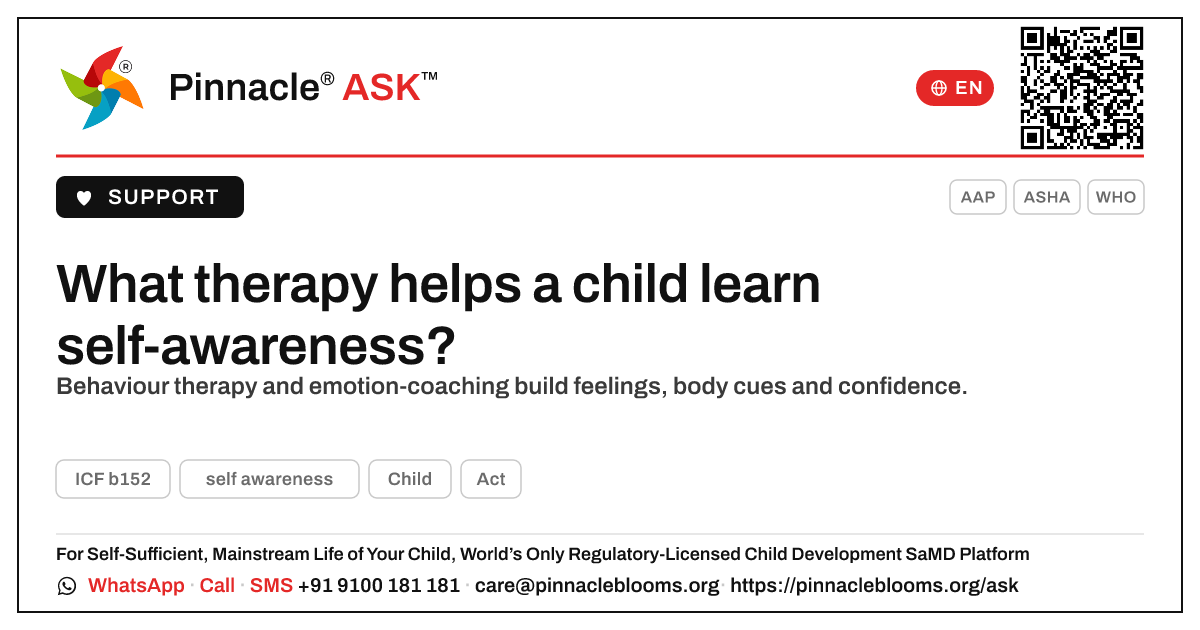
What therapy helps a child learn self-awareness?
Self-awareness in young children is supported through behaviour therapy and emotion-coaching woven into play — naming feelings, noticing body cues and reflecting on choices, with caregivers and teachers practising the same gentle strategies daily. AbilityScore® is part of Pinnacle’s developmental assessment. Diagnosis, where needed, requires an appropriately qualified healthcare professional.
In this answer 5 sections
When a child can name what they feel and notice what makes them tick, the whole world becomes a little easier to navigate.
In short
Self-awareness — knowing your own feelings, body signals, strengths and needs — grows best through behaviour therapy and emotional-skills coaching, gently woven into daily play and routines. For children aged 3–7, therapists use mirrors, feeling charts, naming-the-emotion games and reflective talk so a child slowly learns to spot "I feel angry" or "I need a break" before it overwhelms them. This is a skill that builds steadily with warm, patient practice — not something to fix.
The therapy that helps
- Behaviour therapy — the core support. Therapists help a child notice the link between feelings, body cues and actions, label emotions, and choose calmer responses, all through play your child enjoys.
- Emotion-coaching and reflective talk — naming feelings out loud ("your fists are tight — are you cross?") builds the inner vocabulary self-awareness depends on.
- Mirror, drawing and story play — children learn to recognise their own faces, choices and preferences, the building blocks of "this is me".
- Working with caregivers and teachers — small, repeatable strategies at home and in class turn every day into gentle practice; teachers often help using shared feeling-check routines.
The aim is a child who can pause, notice and tell you what is happening inside — the foundation of confidence and friendship.
When to seek a check
Seek a developmental check if your child struggles to recognise or name feelings well beyond their peers, has frequent meltdowns with no warning, or finds it very hard to see how their actions affect others — so support can start early.
The Pinnacle way
AbilityScore® is part of Pinnacle’s developmental assessment. Diagnosis, where needed, requires an appropriately qualified healthcare professional — never from an app or form. From there your child receives a tailored emotional-development plan. Learn more about self awareness, explore behaviour therapy, and see how we map strengths with the AbilityScore®.
Trusted sources
WHO ICF (b152, emotional functions); American Academy of Pediatrics (HealthyChildren.org) on social-emotional development; ASHA guidance on social communication skills.
Next step — Want to help your child understand their own feelings? Book a developmental check with a Pinnacle clinician.
This is general information, not a diagnosis — individual assessment and diagnosis require an appropriately qualified healthcare professional.
CONNECT THE ANSWER TO YOUR CHILD’S DAY
Something to notice. Something to discuss.
What to notice
Watch for a child who struggles to recognise or name feelings well beyond their peers, has frequent meltdowns with little warning, or finds it very hard to notice how their actions affect others.
In everyday life
Narrate feelings out loud during the day — "your shoulders dropped, you look tired" or "big smile, you're proud!" — so your child slowly builds a vocabulary for what's happening inside.
Bring your observations and questions to your child’s professional. Choose activities that suit your child’s comfort, abilities and agreed plan.
Bring your questions to a first visitQuestions families ask
At what age can a child start learning self-awareness?
Self-awareness begins emerging from around age 2–3, when children start recognising themselves and naming simple feelings. Between 3 and 7 it grows quickly with warm, playful practice, so this is an ideal window for gentle support.
Which therapy is best for building self-awareness?
Behaviour therapy combined with emotion-coaching is the core support — using feeling games, mirror and story play, and reflective talk to help a child notice and name what they feel before it overwhelms them.
Can I help my child's self-awareness at home?
Yes. Naming feelings out loud, talking about your own emotions calmly, and using simple feeling charts all build the inner vocabulary self-awareness depends on. Teachers can reinforce the same routines at school.
FOLLOW THE SOURCE
References behind this answer.
- Organisation website · further readingAAP HealthyChildren.org — social-emotional development
- Organisation website · further readingASHA — social communication skills
- Organisation website · further readingWHO ICF — emotional functions
References are supplied with this answer. An organisation homepage offers further reading; it does not establish an independent review of this page.
Content attribution: SETU Consortium · Pinnacle Blooms Network.
PEOPLE, TOPICS & DEVELOPMENT
See the connections.
Browse the wider question collections connected with this answer’s audience, developmental area and stage.
FROM UNDERSTANDING TO PURPOSEFUL SUPPORT
One question. Your child’s whole life.
Your child’s self-sufficient, mainstream-included life is the purpose from the beginning. At Pinnacle, that purpose shapes what we understand, the goals we choose, the people we bring together, everyday practice and review.
Connect this question with the right support.
Start with your child’s strengths, your observations and what you want everyday life to become.
Make the next conversation useful.
Bring the situations you notice at home or school. We’ll explain a suitable service, centre and first visit, including availability and fees, before you decide.
How PinnacleAI® connects the journeyExplore the seven stages
- 1Understand abilities
A starting picture of your child’s capabilities.
- 2Choose meaningful goals
Readiness and a plan shaped around the child.
- 3Bring the right support together
Suitable therapies and people for those goals.
- 4Carry practice into everyday life
Guidance for family, home and school.
- 5Track and correct
Use observations to adjust the plan.
- 6Reassess and review
Decide what to continue, change or do next.
- 7Grow independence and participation
The child’s life gives each step its purpose.
Explore the whole PinnacleAI® system → · Participation at school and in the community →
PINNACLE’S EVIDENCE, OPEN TO YOU
Look at the evidence behind our work.
Read our research, inspect the original regulatory documents and check what each institutional measure means.
General information supports a conversation with an appropriately qualified professional. Advice, goals and support depend on the individual child.