
YOUR QUESTION. A CLEARER NEXT STEP.
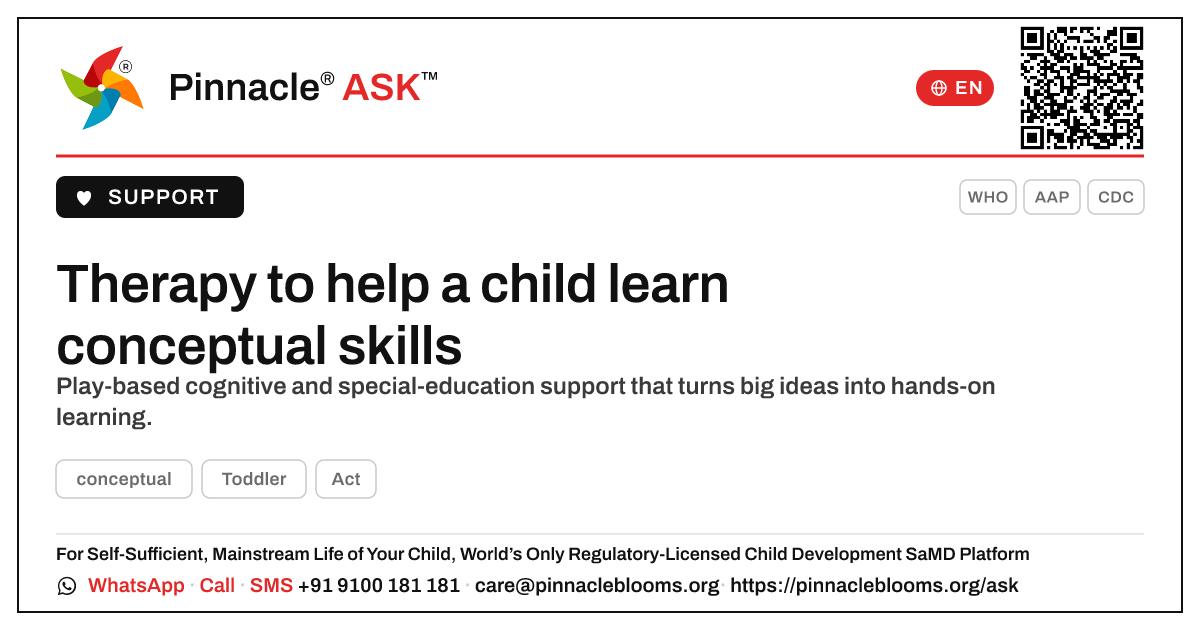
What therapy helps a child learn conceptual skills?
Conceptual skills — ideas like size, colour, number, time and same-versus-different — are built through play-based cognitive and special-education support that teaches thinking step by step, with language woven in. AbilityScore® is part of Pinnacle’s developmental assessment. Diagnosis, where needed, requires an appropriately qualified healthcare professional.
In this answer 5 sections
When the world is full of "big and small", "same and different", "before and after" — the right play turns these invisible ideas into something your child can see, sort and master.
In short
Conceptual skills — understanding ideas like size, colour, number, time, categories, cause-and-effect and same-versus-different — grow best through cognitive and special-education support that teaches thinking through play. For children aged 3–7, this means hands-on sorting, matching, counting and pretend games, often guided by a special educator or occupational therapist, with language woven in so words and ideas grow together. With patient, playful practice, most children steadily build the mental "toolkit" they need for learning.
The support that helps
- Special education / cognitive support — a special educator breaks big ideas into small, learnable steps: sorting by colour before sorting by category, matching pairs before grouping sets, naming "more" and "less" with real objects.
- Play-based learning — concepts stick when they are felt. Stacking cups teach size; lining up toys teaches sequence; "what happens next" stories teach cause-and-effect.
- Language-rich teaching — because ideas live in words, therapists name concepts aloud as a child acts them out, so understanding and vocabulary grow side by side.
- Parent and teacher coaching — the most powerful learning happens in everyday routines, so families and educators are given simple games to repeat at home and in class.
The goal is not drilling facts, but helping your child think flexibly — the foundation for school, problem-solving and confidence.
When to seek a check
Seek a developmental check if your child finds it much harder than peers to grasp basic ideas like colours, sizes or counting, struggles to follow simple two-step instructions, or seems not to learn from everyday play and repetition.
The Pinnacle way
AbilityScore® is part of Pinnacle’s developmental assessment. Diagnosis, where needed, requires an appropriately qualified healthcare professional — never from an app or online form. From there your child receives a precise developmental and cognitive profile and a plan built by educators who understand how thinking grows, through our special education support. Learn more about building conceptual skills at every age.
Trusted sources
WHO and UNICEF Nurturing Care guidance on early learning; American Academy of Pediatrics (HealthyChildren.org) on cognitive milestones; CDC developmental milestone guidance for ages 3–5.
Next step — Want to help your child's thinking skills bloom? Book a developmental assessment with a Pinnacle clinician.
This is general information, not a diagnosis — individual assessment and diagnosis require an appropriately qualified healthcare professional.
CONNECT THE ANSWER TO YOUR CHILD’S DAY
Something to notice. Something to discuss.
What to notice
Watch if your child finds it much harder than peers to grasp basic ideas like colours, sizes or counting, struggles to follow simple two-step instructions, or doesn't seem to learn from everyday play and repetition.
In everyday life
Turn everyday moments into concept games — sort socks by colour, count steps as you climb, or ask "which is bigger?" at snack time, naming each idea aloud as your child does it.
Bring your observations and questions to your child’s professional. Choose activities that suit your child’s comfort, abilities and agreed plan.
Bring your questions to a first visitQuestions families ask
At what age do conceptual skills usually develop?
Many basic concepts — like colours, sizes and simple counting — emerge between ages 3 and 5, growing steadily through play and conversation. Children develop at their own pace, so gentle, repeated everyday practice matters more than rushing.
Who provides conceptual-skills support?
Special educators and occupational therapists are central, often working alongside speech and language therapists because ideas and words grow together. Parents and teachers are coached so learning continues in daily routines.
Can I help my child build concepts at home?
Yes — everyday play is the best teacher. Sorting, matching, counting real objects, pretend play and "what happens next" stories all build conceptual thinking without any pressure.
FOLLOW THE SOURCE
References behind this answer.
- Organisation website · further readingWHO & UNICEF Nurturing Care Framework — early learning
- Organisation website · further readingAAP HealthyChildren.org — cognitive milestones
- Source referenceCDC — developmental milestones (ages 3–5)
References are supplied with this answer. An organisation homepage offers further reading; it does not establish an independent review of this page.
Content attribution: SETU Consortium · Pinnacle Blooms Network.
PEOPLE, TOPICS & DEVELOPMENT
See the connections.
Browse the wider question collections connected with this answer’s audience, developmental area and stage.
FROM UNDERSTANDING TO PURPOSEFUL SUPPORT
One question. Your child’s whole life.
Your child’s self-sufficient, mainstream-included life is the purpose from the beginning. At Pinnacle, that purpose shapes what we understand, the goals we choose, the people we bring together, everyday practice and review.
Connect this question with the right support.
Start with your child’s strengths, your observations and what you want everyday life to become.
Make the next conversation useful.
Bring the situations you notice at home or school. We’ll explain a suitable service, centre and first visit, including availability and fees, before you decide.
How PinnacleAI® connects the journeyExplore the seven stages
- 1Understand abilities
A starting picture of your child’s capabilities.
- 2Choose meaningful goals
Readiness and a plan shaped around the child.
- 3Bring the right support together
Suitable therapies and people for those goals.
- 4Carry practice into everyday life
Guidance for family, home and school.
- 5Track and correct
Use observations to adjust the plan.
- 6Reassess and review
Decide what to continue, change or do next.
- 7Grow independence and participation
The child’s life gives each step its purpose.
Explore the whole PinnacleAI® system → · Participation at school and in the community →
PINNACLE’S EVIDENCE, OPEN TO YOU
Look at the evidence behind our work.
Read our research, inspect the original regulatory documents and check what each institutional measure means.
General information supports a conversation with an appropriately qualified professional. Advice, goals and support depend on the individual child.