
YOUR QUESTION. A CLEARER NEXT STEP.
What Often Occurs Alongside Motor Planning Difficulties?
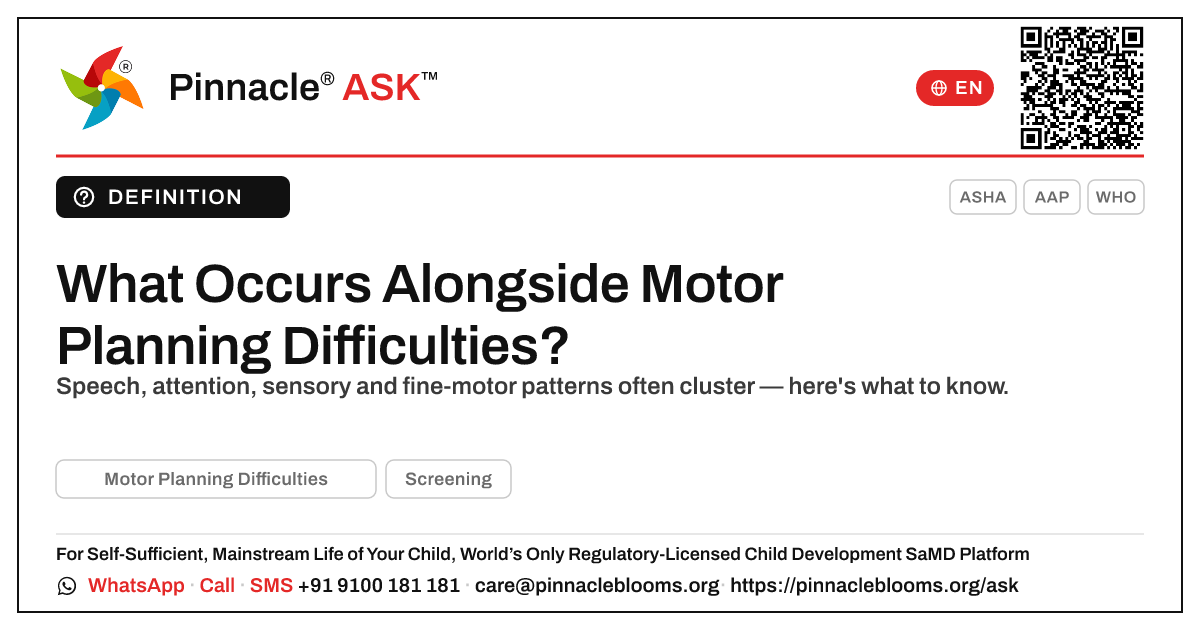
Motor planning difficulties often co-occur with speech and language difficulties (including apraxia), ADHD, sensory processing differences, autism profiles, and fine-motor or handwriting struggles. These are patterns clinicians watch for, not certainties — and each is supportable. A clinical assessment and any diagnosis are formed only at a Pinnacle Blooms Network centre.
In this answer 5 sections
When a child finds it hard to plan and sequence new movements, that pattern rarely travels alone — and knowing its companions helps you support the whole child.
In short
Motor planning difficulties (often described as dyspraxia or a developmental coordination challenge) frequently appear alongside other developmental differences rather than on their own. The most common companions are speech sound and language difficulties, attention and regulation challenges (ADHD), sensory processing differences, autism spectrum profiles, and fine-motor and handwriting struggles that show up at school. None of these is automatic — they are patterns clinicians watch for, and each is supportable.
Conditions that often co-occur
- Speech and language difficulties — including childhood apraxia of speech, where planning the movements of the mouth and tongue is hard, mirroring the body-level planning challenge.
- ADHD and attention/regulation differences — planning a sequence of actions is harder when focus and impulse control are still developing.
- Sensory processing differences — a child unsure of where their body is in space (proprioception, balance) finds planning new movements doubly hard.
- Autism spectrum profiles — motor coordination and praxis differences are commonly described alongside social-communication differences.
- Fine-motor and handwriting difficulties — buttons, scissors, pencil control and self-care steps often lag together.
- Learning and organisational challenges — sequencing, getting started on tasks, and remembering multi-step instructions can overlap at school age.
Why this matters for support
Because these patterns cluster, the most helpful first step is a single, joined-up developmental look — not a series of separate worries. A clinician can map which strands are present and how strong each is, so therapy targets the whole child rather than one symptom. This is why we always begin with a structured profile rather than a label.
The Pinnacle way
A clinical AbilityScore® and any diagnosis are formed only at a Pinnacle Blooms Network centre, by qualified clinicians — never from an article, app or online form. From there your family gets a clear baseline and a plan you can follow. Explore more about motor planning difficulties, how occupational therapy builds coordination step by step, and what the AbilityScore is and how it is established.
Trusted sources
WHO International Classification of Functioning, Disability and Health (ICF) and ICD-11 framing of developmental coordination; American Academy of Pediatrics guidance on developmental surveillance; ASHA guidance on childhood apraxia of speech and co-occurring communication differences.
Next step — Curious where your child stands across movement, speech and attention together? Book a developmental check with a Pinnacle clinician.
This is general information, not a diagnosis — individual assessment and diagnosis require an appropriately qualified healthcare professional.
CONNECT THE ANSWER TO YOUR CHILD’S DAY
Something to notice. Something to discuss.
What to notice
Watch whether difficulty with new or multi-step movements appears alongside delayed speech, trouble sitting still or focusing, strong reactions to textures or sounds, or struggles with buttons, scissors and pencils — clustering patterns are worth a developmental check.
In everyday life
Break new physical tasks into small, named steps and let your child rehearse them slowly — saying each step aloud ('first foot, then jump') supports both motor planning and language at once.
Bring your observations and questions to your child’s professional. Choose activities that suit your child’s comfort, abilities and agreed plan.
Bring your questions to a first visitQuestions families ask
Is motor planning difficulty the same as dyspraxia?
They overlap closely. 'Dyspraxia' and 'developmental coordination disorder' are terms often used for difficulty planning and carrying out coordinated movements. The exact term and any diagnosis are established by a qualified clinician after a structured assessment.
Does having motor planning difficulty mean my child also has autism or ADHD?
No. These conditions can co-occur, but motor planning difficulties also exist entirely on their own. A clinician can map which patterns, if any, are present so support is tailored to your individual child.
Why is speech often affected too?
Speaking involves planning and sequencing the fine movements of the mouth, tongue and breath. Childhood apraxia of speech is a planning difficulty at the level of speech, which is why it can appear alongside body-level motor planning challenges.
FOLLOW THE SOURCE
References behind this answer.
- Source referenceASHA — Childhood Apraxia of Speech
- Source referenceAAP HealthyChildren — Developmental Differences
- Organisation website · further readingWHO ICD-11
References are supplied with this answer. An organisation homepage offers further reading; it does not establish an independent review of this page.
Content attribution: SETU Consortium · Pinnacle Blooms Network.
PEOPLE, TOPICS & DEVELOPMENT
See the connections.
Browse the wider question collections connected with this answer’s audience, developmental area and stage.
FROM UNDERSTANDING TO PURPOSEFUL SUPPORT
One question. Your child’s whole life.
Your child’s self-sufficient, mainstream-included life is the purpose from the beginning. At Pinnacle, that purpose shapes what we understand, the goals we choose, the people we bring together, everyday practice and review.
Connect this question with the right support.
Explore how the relevant service contributes to everyday abilities, then speak with us about your child.
Make the next conversation useful.
Bring the situations you notice at home or school. We’ll explain a suitable service, centre and first visit, including availability and fees, before you decide.
How PinnacleAI® connects the journeyExplore the seven stages
- 1Understand abilities
A starting picture of your child’s capabilities.
- 2Choose meaningful goals
Readiness and a plan shaped around the child.
- 3Bring the right support together
Suitable therapies and people for those goals.
- 4Carry practice into everyday life
Guidance for family, home and school.
- 5Track and correct
Use observations to adjust the plan.
- 6Reassess and review
Decide what to continue, change or do next.
- 7Grow independence and participation
The child’s life gives each step its purpose.
Explore the whole PinnacleAI® system → · Participation at school and in the community →
PINNACLE’S EVIDENCE, OPEN TO YOU
Look at the evidence behind our work.
Read our research, inspect the original regulatory documents and check what each institutional measure means.
General information supports a conversation with an appropriately qualified professional. Advice, goals and support depend on the individual child.