
YOUR QUESTION. A CLEARER NEXT STEP.
Tourette Syndrome: ICD-11 Definition and Early-Childhood Features
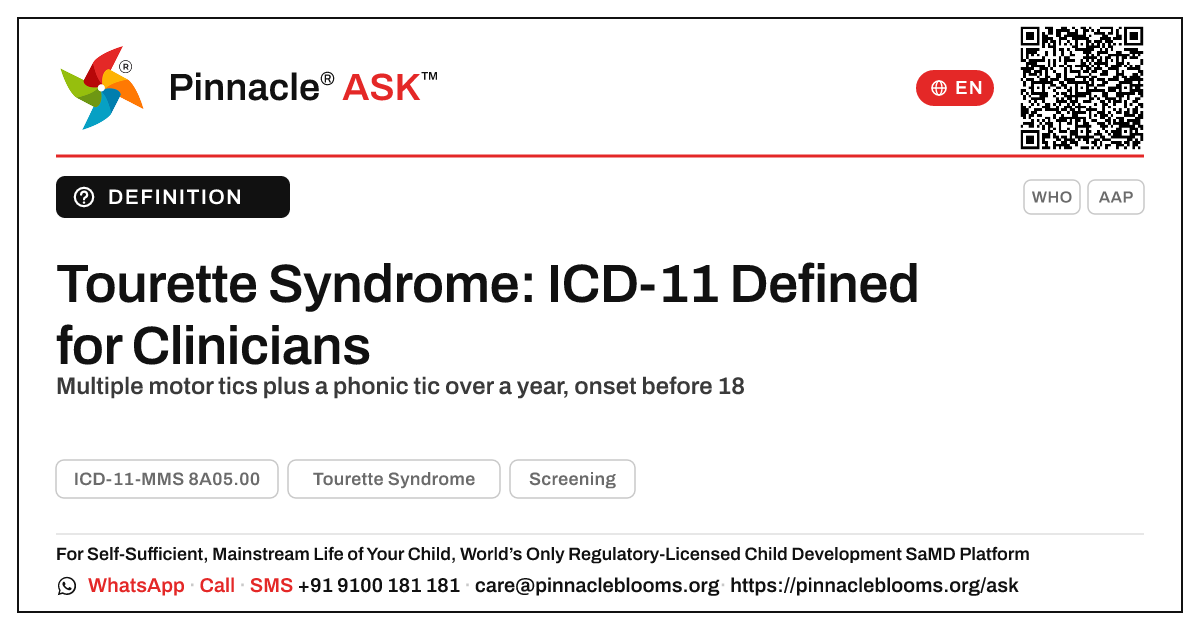
Tourette Syndrome (ICD-11 8A05.00) requires multiple motor tics plus at least one phonic tic, persisting over a year, with onset before 18 — usually emerging at 4–8 years. Tics wax and wane, follow a premonitory urge, and frequently co-occur with ADHD and OCD.
In this answer 4 sections
A child who blinks, sniffs and clears the throat in shifting combinations is rarely being difficult — they may be describing a tic disorder.
In short
Tourette Syndrome (ICD-11 8A05.00) is a chronic tic disorder defined by multiple motor tics and at least one phonic (vocal) tic, present for more than one year, with onset before age 18 — typically emerging between 4 and 8 years. Tics are sudden, rapid, recurrent, non-rhythmic movements or vocalisations; they need not occur concurrently. It is classified among neurodevelopmental disorders, reflecting its developmental, often familial, basis.
ICD-11 features in early childhood
- Motor tics first: simple motor tics — eye-blinking, facial grimacing, head jerks, shoulder shrugs — usually precede phonic tics (sniffing, throat-clearing, grunting) by months to years.
- Waxing and waning: severity fluctuates; tics often worsen with excitement, fatigue or stress and may transiently suppress with effort, followed by rebound.
- Premonitory urge: an uncomfortable sensory precursor relieved by the tic — frequently under-reported by young children.
- High comorbidity: ADHD and OCD/obsessive-compulsive features commonly co-occur and often shape functional impact more than the tics themselves.
- Exclude tics due to substances, Sydenham chorea or other neurological conditions.
The Pinnacle way
Developmental measurement supports care planning; diagnosis requires an appropriately qualified healthcare professional., under qualified clinician care — never from a checklist or an app. Our teams profile co-occurring attention and regulation needs alongside the tic presentation itself, supporting families through behavioural therapy and a structured developmental baseline.
Trusted sources
WHO ICD-11 (8A05.00, Tourette syndrome); WHO neurodevelopmental disorders framework; AAP guidance on tic disorders in childhood.
Next step — Refer a child with persistent multi-site tics for a structured developmental and comorbidity assessment at a Pinnacle centre.
This is general information, not a diagnosis — individual assessment and diagnosis require an appropriately qualified healthcare professional.
CONNECT THE ANSWER TO YOUR CHILD’S DAY
Something to notice. Something to discuss.
What to notice
Multiple motor tics with at least one phonic tic persisting beyond a year, waxing-and-waning course, premonitory urge, and co-occurring ADHD or OCD features.
In everyday life
Document tic type, sites, frequency and triggers over several weeks before referral — the waxing-and-waning course means a single clinic snapshot can mislead.
Bring your observations and questions to your child’s professional. Choose activities that suit your child’s comfort, abilities and agreed plan.
Bring your questions to a first visitQuestions families ask
How is Tourette Syndrome distinguished from a transient tic disorder?
Tourette Syndrome requires both multiple motor tics and at least one phonic tic persisting for more than one year. Provisional (transient) tic disorders involve tics present for under a year, and chronic motor or vocal tic disorder involves only one tic type.
At what age do tics usually first appear?
Motor tics typically emerge between 4 and 8 years, often starting with eye-blinking or facial movements. Phonic tics usually follow months to years later. Onset must be before age 18 for the diagnosis.
Why screen for ADHD and OCD in a child with tics?
ADHD and obsessive-compulsive features co-occur frequently with Tourette Syndrome and often drive functional impairment more than the tics themselves, so identifying them shapes management priorities.
FOLLOW THE SOURCE
References behind this answer.
- Organisation website · further readingWHO ICD-11: Tourette syndrome
- Organisation website · further readingAmerican Academy of Pediatrics: tic disorders
References are supplied with this answer. An organisation homepage offers further reading; it does not establish an independent review of this page.
Content attribution: SETU Consortium · Pinnacle Blooms Network.
PEOPLE, TOPICS & DEVELOPMENT
See the connections.
Browse the wider question collections connected with this answer’s audience, developmental area and stage.
FROM UNDERSTANDING TO PURPOSEFUL SUPPORT
One question. Your child’s whole life.
Your child’s self-sufficient, mainstream-included life is the purpose from the beginning. At Pinnacle, that purpose shapes what we understand, the goals we choose, the people we bring together, everyday practice and review.
Connect this question with the right support.
Start with your child’s strengths, your observations and what you want everyday life to become.
Make the next conversation useful.
Bring the situations you notice at home or school. We’ll explain a suitable service, centre and first visit, including availability and fees, before you decide.
How PinnacleAI® connects the journeyExplore the seven stages
- 1Understand abilities
A starting picture of your child’s capabilities.
- 2Choose meaningful goals
Readiness and a plan shaped around the child.
- 3Bring the right support together
Suitable therapies and people for those goals.
- 4Carry practice into everyday life
Guidance for family, home and school.
- 5Track and correct
Use observations to adjust the plan.
- 6Reassess and review
Decide what to continue, change or do next.
- 7Grow independence and participation
The child’s life gives each step its purpose.
Explore the whole PinnacleAI® system → · Participation at school and in the community →
PINNACLE’S EVIDENCE, OPEN TO YOU
Look at the evidence behind our work.
Read our research, inspect the original regulatory documents and check what each institutional measure means.
General information supports a conversation with an appropriately qualified professional. Advice, goals and support depend on the individual child.