
YOUR QUESTION. A CLEARER NEXT STEP.
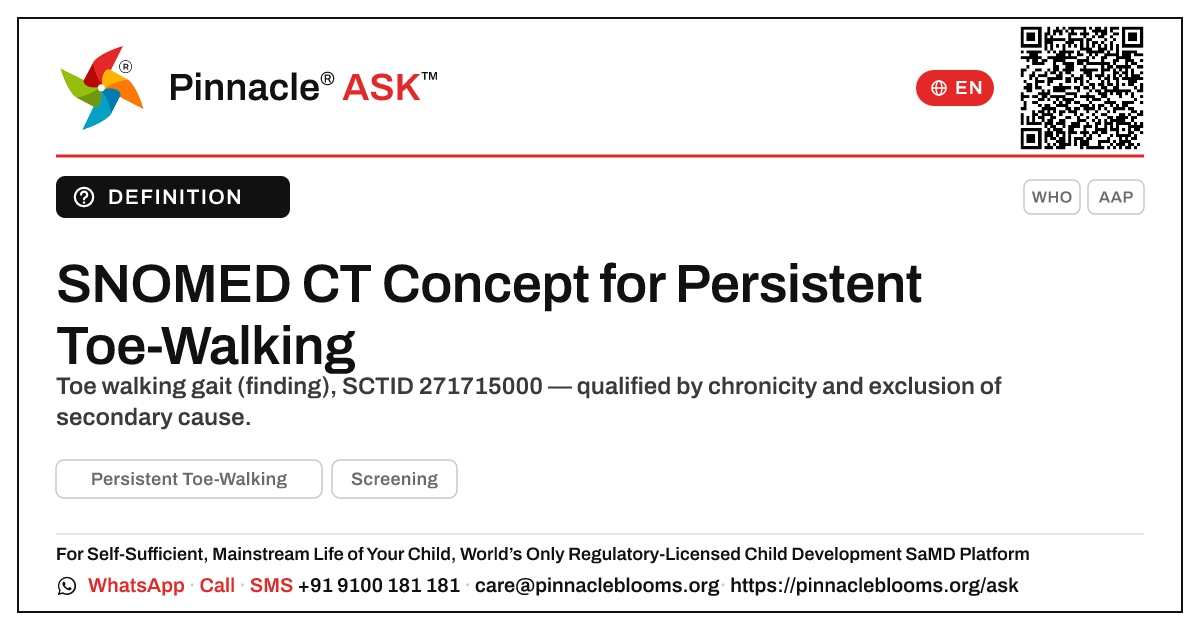
SNOMED CT Concept for Persistent Toe-Walking
In SNOMED CT, toe-walking maps to the clinical-finding concept Toe walking gait (finding), SCTID 271715000. Persistent (idiopathic) toe-walking is this gait finding qualified by chronicity and exclusion of a neurological, orthopaedic or syndromic cause. Always verify the SCTID against your current national edition, as concept status is release-dependent.
In this answer 5 sections
Coding persistent toe-walking accurately starts with the right SNOMED CT concept — and knowing where it sits relative to gait and developmental findings.
In short
In SNOMED CT, toe-walking is represented by the clinical-finding concept Toe walking gait (finding) — SCTID 271715000 — which captures the observable gait pattern of weight-bearing through the forefoot with absent or reduced heel strike. Persistent toe-walking is not a separate pre-coordinated concept; it is the same gait finding qualified by chronicity and the exclusion of an identifiable neurological, orthopaedic or syndromic cause (i.e. so-called idiopathic toe-walking). Always verify the SCTID against your current national edition (SNOMED CT-IN / the relevant release), as concept status and descriptions are release-dependent.
Using the concept in practice
When documenting, distinguish the finding (the gait pattern) from the clinical reasoning (idiopathic vs secondary):
- Gait finding — Toe walking gait (finding), 271715000.
- Persistence/idiopathy — record as a qualified or post-coordinated expression, noting duration, bilaterality, and a negative work-up for cerebral palsy, tethered cord, muscular dystrophy or autism-spectrum-related sensory patterns.
- Differential context — toe-walking can be a secondary sign; SNOMED CT links it conceptually to broader gait abnormality and neurological findings, so the surrounding documentation matters as much as the single SCTID.
For cross-mapping, the ICD-11 functioning context is gait/mobility-related; confirm the current mapping in your terminology server rather than assuming a 1:1 equivalence.
When to refer
Idiopathic persistent toe-walking is a diagnosis of exclusion. Refer for assessment where there is unilateral toe-walking, regression, tightening of the gastrocsoleus with reduced ankle dorsiflexion, delayed motor milestones, or associated speech, sensory or social-communication differences — patterns that warrant a structured developmental review rather than gait observation alone.
The Pinnacle way
A clinical AbilityScore® and any diagnosis are formed only at a Pinnacle Blooms Network centre, under qualified clinician care — never from a code or an online form. Where toe-walking coincides with sensory-processing or motor-coordination patterns, our occupational and physiotherapy pathways and a full developmental review at Pinnacle place the gait finding in its proper clinical context.
Trusted sources
SNOMED International terminology framework; WHO ICD-11 for functioning and gait/mobility context; American Academy of Pediatrics guidance on motor-development surveillance. Verify all codes against your current national release.
Next step — Seeing persistent toe-walking alongside developmental concerns? Partner with a Pinnacle clinician for a structured assessment.
This is general information, not a diagnosis — individual assessment and diagnosis require an appropriately qualified healthcare professional.
CONNECT THE ANSWER TO YOUR CHILD’S DAY
Something to notice. Something to discuss.
What to notice
Unilateral toe-walking, loss of ankle dorsiflexion with gastrocsoleus tightness, motor regression, or associated speech/sensory differences — these point away from idiopathic and warrant referral.
In everyday life
Document the gait finding separately from the clinical reasoning (idiopathic vs secondary) and always confirm the SCTID against your current national SNOMED CT release before billing or exchange.
Bring your observations and questions to your child’s professional. Choose activities that suit your child’s comfort, abilities and agreed plan.
Bring your questions to a first visitQuestions families ask
What is the SNOMED CT concept ID for toe-walking?
Toe-walking is represented by Toe walking gait (finding), SCTID 271715000. There is no separate pre-coordinated concept for 'persistent' or 'idiopathic' toe-walking — these are captured by qualifying the gait finding with chronicity and a negative work-up. Always verify the SCTID against your current national edition.
Is persistent toe-walking a distinct SNOMED CT concept?
No. Persistent (idiopathic) toe-walking uses the same gait finding concept, qualified by duration, bilaterality and the exclusion of neurological, orthopaedic or syndromic causes. It is documented through post-coordination or accompanying clinical notes rather than a unique SCTID.
When should persistent toe-walking be referred for assessment?
Refer where toe-walking is unilateral, associated with motor regression, reduced ankle dorsiflexion, delayed milestones, or co-occurring speech, sensory or social-communication differences. Idiopathic toe-walking is a diagnosis of exclusion, so secondary causes must be ruled out.
FOLLOW THE SOURCE
References behind this answer.
- Organisation website · further readingWHO ICD-11 — functioning and gait/mobility context
- Organisation website · further readingAmerican Academy of Pediatrics — motor-development surveillance
References are supplied with this answer. An organisation homepage offers further reading; it does not establish an independent review of this page.
Content attribution: SETU Consortium · Pinnacle Blooms Network.
PEOPLE, TOPICS & DEVELOPMENT
See the connections.
Browse the wider question collections connected with this answer’s audience, developmental area and stage.
FROM UNDERSTANDING TO PURPOSEFUL SUPPORT
One question. Your child’s whole life.
Your child’s self-sufficient, mainstream-included life is the purpose from the beginning. At Pinnacle, that purpose shapes what we understand, the goals we choose, the people we bring together, everyday practice and review.
Connect this question with the right support.
Start with your child’s strengths, your observations and what you want everyday life to become.
Make the next conversation useful.
Bring the situations you notice at home or school. We’ll explain a suitable service, centre and first visit, including availability and fees, before you decide.
How PinnacleAI® connects the journeyExplore the seven stages
- 1Understand abilities
A starting picture of your child’s capabilities.
- 2Choose meaningful goals
Readiness and a plan shaped around the child.
- 3Bring the right support together
Suitable therapies and people for those goals.
- 4Carry practice into everyday life
Guidance for family, home and school.
- 5Track and correct
Use observations to adjust the plan.
- 6Reassess and review
Decide what to continue, change or do next.
- 7Grow independence and participation
The child’s life gives each step its purpose.
Explore the whole PinnacleAI® system → · Participation at school and in the community →
PINNACLE’S EVIDENCE, OPEN TO YOU
Look at the evidence behind our work.
Read our research, inspect the original regulatory documents and check what each institutional measure means.
General information supports a conversation with an appropriately qualified professional. Advice, goals and support depend on the individual child.