
YOUR QUESTION. A CLEARER NEXT STEP.
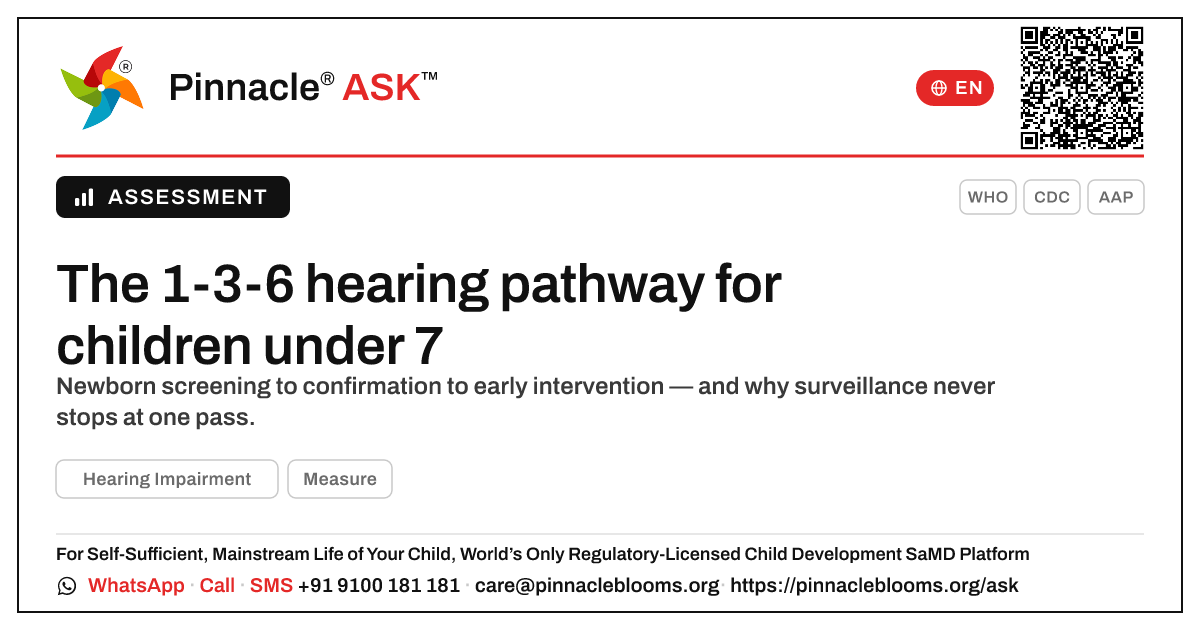
Screening and diagnostic pathway for hearing impairment under 7
For under-7s, follow the 1-3-6 cascade: newborn hearing screening by 1 month, diagnostic audiological confirmation by 3 months, and early intervention by 6 months — with ongoing surveillance and risk-factor monitoring at every well-child visit, since a passed newborn screen does not exclude later-onset loss.
In this answer 4 sections
The single most reversible cause of developmental delay is the one we can detect at birth — undiagnosed hearing loss.
In short
For children under 7, the recommended pathway is a 1-3-6 cascade: universal newborn hearing screening by 1 month, diagnostic audiological confirmation by 3 months, and early intervention enrolment by 6 months. Beyond the newborn period, surveillance continues at every well-child visit with risk-factor monitoring and prompt referral whenever screening fails or parental or clinician concern arises — hearing loss is never excluded on a single pass.
The pathway, by stage
Newborn (0–1 month): Objective physiological screening — OAE and/or automated ABR — before discharge or by one month. A two-stage screen reduces false referrals.
Confirmation (by 3 months): Any non-pass is referred for diagnostic audiology — frequency-specific ABR, tympanometry/middle-ear analysis and behavioural audiometry as age permits — to confirm type, degree and laterality. Do not delay for repeat screens once a clear referral is triggered.
Intervention (by 6 months): Confirmed loss routes to amplification fitting, candidacy review (including cochlear implant assessment) and family-centred communication and language support.
Ongoing surveillance (to age 7): Periodic screening at well-child contacts; heightened vigilance with risk indicators — NICU >5 days, hyperbilirubinaemia, ototoxic exposure, craniofacial anomalies, syndromic features, recurrent otitis media or family history. Acquired and late-onset loss means a passed newborn screen is not a lifetime clearance. Always investigate speech-language delay for an audiological cause first.
The Pinnacle way
A clinical AbilityScore® and any diagnosis are established only at a Pinnacle Blooms Network centre, under qualified clinician care — our pathway complements, never replaces, diagnostic audiology. We co-manage the language consequences of confirmed loss through coordinated hearing-impairment support and speech therapy, with progress tracked via a clinician-administered AbilityScore®. Across 70+ centres and 700+ therapists, we partner with referring clinicians on the 1-3-6 timeline.
Trusted sources
WHO ICD-11 hearing-loss classification; CDC Learn the Signs / EHDI principles; Indian Academy of Pediatrics newborn screening guidance; AAP via HealthyChildren.org.
Next step — Refer a child with a failed screen or unexplained language delay for coordinated audiological-developmental support at your nearest Pinnacle centre.
This is general information, not a diagnosis — individual assessment and diagnosis require an appropriately qualified healthcare professional.
CONNECT THE ANSWER TO YOUR CHILD’S DAY
Something to notice. Something to discuss.
What to notice
Failed or non-pass newborn screen, no startle to loud sound, absent babble by 9–12 months, unexplained speech-language delay, recurrent otitis media, or any parental concern about responsiveness to sound.
In everyday life
Investigate hearing as a first-line cause in any child presenting with speech-language delay — a passed newborn screen does not rule out acquired or late-onset loss.
Bring your observations and questions to your child’s professional. Choose activities that suit your child’s comfort, abilities and agreed plan.
Bring your questions to a first visitQuestions families ask
What is the 1-3-6 rule for newborn hearing?
Screen by 1 month of age, confirm any non-pass with diagnostic audiology by 3 months, and enrol confirmed cases in early intervention by 6 months. Meeting these timelines protects the critical window for language acquisition.
Does a passed newborn screen rule out hearing loss?
No. Acquired, progressive and late-onset losses occur after birth, so periodic surveillance continues through well-child visits to age 7 — and any unexplained speech-language delay warrants audiological reassessment regardless of newborn results.
Which children need heightened audiological vigilance?
Those with NICU stay over 5 days, hyperbilirubinaemia requiring exchange, ototoxic exposure, craniofacial or syndromic features, recurrent otitis media, or a family history of childhood hearing loss.
FOLLOW THE SOURCE
References behind this answer.
- Source referenceWHO ICD-11 hearing-loss classification
- Source referenceCDC — Learn the Signs. Act Early.
- Organisation website · further readingAmerican Academy of Pediatrics (HealthyChildren.org)
References are supplied with this answer. An organisation homepage offers further reading; it does not establish an independent review of this page.
Content attribution: SETU Consortium · Pinnacle Blooms Network.
PEOPLE, TOPICS & DEVELOPMENT
See the connections.
Browse the wider question collections connected with this answer’s audience, developmental area and stage.
FROM UNDERSTANDING TO PURPOSEFUL SUPPORT
One question. Your child’s whole life.
Your child’s self-sufficient, mainstream-included life is the purpose from the beginning. At Pinnacle, that purpose shapes what we understand, the goals we choose, the people we bring together, everyday practice and review.
Connect this question with the right support.
Start with your child’s strengths, your observations and what you want everyday life to become.
Make the next conversation useful.
Bring the situations you notice at home or school. We’ll explain a suitable service, centre and first visit, including availability and fees, before you decide.
How PinnacleAI® connects the journeyExplore the seven stages
- 1Understand abilities
A starting picture of your child’s capabilities.
- 2Choose meaningful goals
Readiness and a plan shaped around the child.
- 3Bring the right support together
Suitable therapies and people for those goals.
- 4Carry practice into everyday life
Guidance for family, home and school.
- 5Track and correct
Use observations to adjust the plan.
- 6Reassess and review
Decide what to continue, change or do next.
- 7Grow independence and participation
The child’s life gives each step its purpose.
Explore the whole PinnacleAI® system → · Participation at school and in the community →
PINNACLE’S EVIDENCE, OPEN TO YOU
Look at the evidence behind our work.
Read our research, inspect the original regulatory documents and check what each institutional measure means.
General information supports a conversation with an appropriately qualified professional. Advice, goals and support depend on the individual child.