
YOUR QUESTION. A CLEARER NEXT STEP.
ICD-11 Classification for Visual Impairment (9D90)
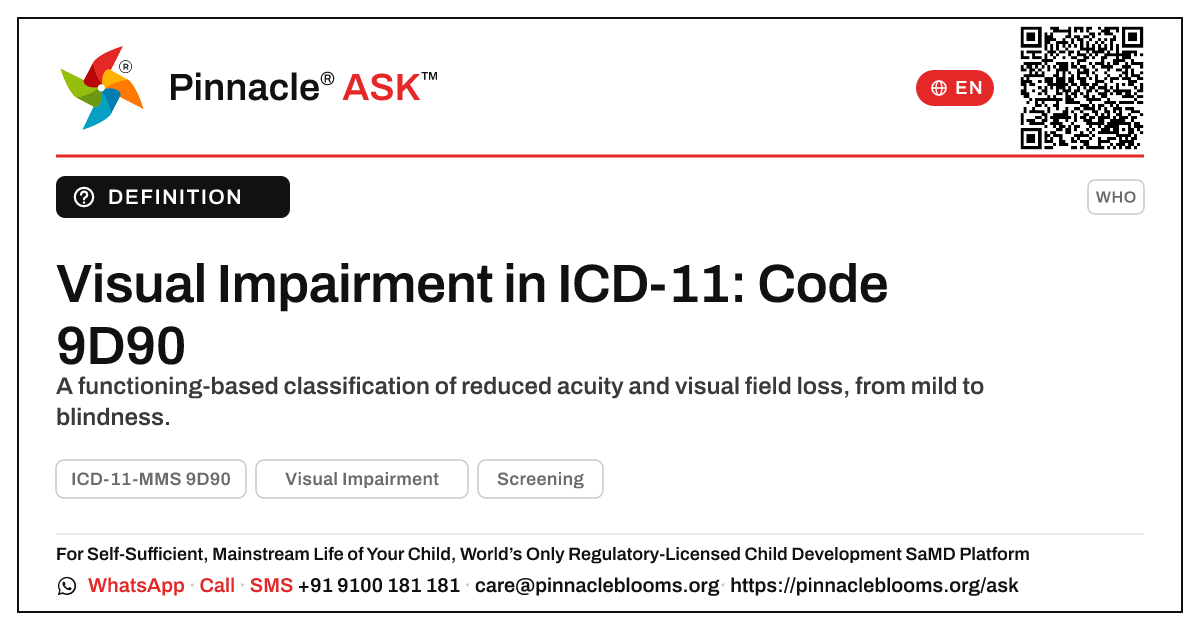
In ICD-11-MMS, Visual Impairment is classified at 9D90 within the visual system chapter. It is a functioning-based category grading reduced acuity and visual field loss — mild, moderate, severe and blindness — applied to the better eye with best correction, and paired separately with the underlying aetiological diagnosis.
In this answer 5 sections
When a child's vision limits how they explore, learn and connect, precise classification is the first step to coordinated support.
In short
In ICD-11-MMS, Visual Impairment is coded at 9D90, sitting within the chapter on diseases of the visual system. It is a functioning-based classification that grades reduced visual acuity and visual field loss — ranging from mild and moderate impairment through severe impairment to blindness — applied to the better eye with best available correction. The category captures the functional consequence of an underlying ocular or neurological cause, which is coded separately, rather than the disease mechanism itself.
The classification, briefly
ICD-11 defines visual impairment by presenting or best-corrected distance and near visual acuity and by visual field extent, broadly aligning with WHO severity bands:
- Mild — visual acuity worse than 6/12
- Moderate — worse than 6/18
- Severe — worse than 6/60
- Blindness — worse than 3/60, or a visual field constricted to within 10 degrees
Because ICD-11 is built on the WHO framework of functioning, 9D90 describes the impact on the child's everyday function and is intended to be paired with the aetiological diagnosis (for example, cortical/cerebral visual impairment, refractive error, retinal or optic-nerve pathology) and, where relevant, ICF descriptors. For the developing child, early visual impairment is developmentally significant: it shapes motor, language, social and cognitive trajectories, so functional classification should drive a habilitation plan, not sit in isolation.
When to refer
Any suspected reduced fixation, abnormal eye movements, photophobia, or failure to make and hold eye contact warrants prompt paediatric ophthalmology and developmental review. Early, accurate classification enables vision stimulation, environmental adaptation and multidisciplinary developmental support to begin without delay.
The Pinnacle way
AbilityScore® is part of Pinnacle’s developmental assessment. Diagnosis, where needed, requires an appropriately qualified healthcare professional — never from a code or an online form. We translate a functional classification like 9D90 into a working developmental profile, then a plan the family can follow. Explore how we work, our occupational therapy for vision-affected development, and what the AbilityScore is and how it is calculated.
Trusted sources
WHO ICD-11 for Mortality and Morbidity Statistics (visual system chapter); WHO guidance on vision and severity bands; WHO ICF framework of functioning.
Next step — Refer a child with suspected visual impairment for a coordinated developmental review — partner with a Pinnacle centre.
This is general information, not a diagnosis — individual assessment and diagnosis require an appropriately qualified healthcare professional.
CONNECT THE ANSWER TO YOUR CHILD’S DAY
Something to notice. Something to discuss.
What to notice
Reduced or absent fixation, abnormal or roving eye movements, photophobia, failure to follow faces or objects, and delayed reach-for-vision milestones — each warrants prompt ophthalmology and developmental referral.
In everyday life
When documenting, pair the 9D90 functional grade with the aetiological diagnosis and severity band so the habilitation plan reflects both cause and functional impact.
Bring your observations and questions to your child’s professional. Choose activities that suit your child’s comfort, abilities and agreed plan.
Bring your questions to a first visitQuestions families ask
What is the ICD-11 code for Visual Impairment?
Visual Impairment is classified at code 9D90 in ICD-11-MMS, within the chapter on diseases of the visual system.
How does ICD-11 grade visual impairment severity?
It uses presenting or best-corrected visual acuity and visual field, broadly aligned with WHO bands: mild (worse than 6/12), moderate (worse than 6/18), severe (worse than 6/60) and blindness (worse than 3/60 or a field within 10 degrees), applied to the better eye.
Does 9D90 describe the cause of the visual impairment?
No. 9D90 captures the functional impact. The underlying ocular or neurological cause — such as cortical visual impairment, refractive error or retinal pathology — is coded separately and should accompany the functional classification.
FOLLOW THE SOURCE
References behind this answer.
- Organisation website · further readingWHO ICD-11 for Mortality and Morbidity Statistics
- Organisation website · further readingWHO guidance on vision and visual impairment
References are supplied with this answer. An organisation homepage offers further reading; it does not establish an independent review of this page.
Content attribution: SETU Consortium · Pinnacle Blooms Network.
PEOPLE, TOPICS & DEVELOPMENT
See the connections.
Browse the wider question collections connected with this answer’s audience, developmental area and stage.
FROM UNDERSTANDING TO PURPOSEFUL SUPPORT
One question. Your child’s whole life.
Your child’s self-sufficient, mainstream-included life is the purpose from the beginning. At Pinnacle, that purpose shapes what we understand, the goals we choose, the people we bring together, everyday practice and review.
Connect this question with the right support.
Start with your child’s strengths, your observations and what you want everyday life to become.
Make the next conversation useful.
Bring the situations you notice at home or school. We’ll explain a suitable service, centre and first visit, including availability and fees, before you decide.
How PinnacleAI® connects the journeyExplore the seven stages
- 1Understand abilities
A starting picture of your child’s capabilities.
- 2Choose meaningful goals
Readiness and a plan shaped around the child.
- 3Bring the right support together
Suitable therapies and people for those goals.
- 4Carry practice into everyday life
Guidance for family, home and school.
- 5Track and correct
Use observations to adjust the plan.
- 6Reassess and review
Decide what to continue, change or do next.
- 7Grow independence and participation
The child’s life gives each step its purpose.
Explore the whole PinnacleAI® system → · Participation at school and in the community →
PINNACLE’S EVIDENCE, OPEN TO YOU
Look at the evidence behind our work.
Read our research, inspect the original regulatory documents and check what each institutional measure means.
General information supports a conversation with an appropriately qualified professional. Advice, goals and support depend on the individual child.