
YOUR QUESTION. A CLEARER NEXT STEP.
ICD-11 Classification for School Readiness Gap
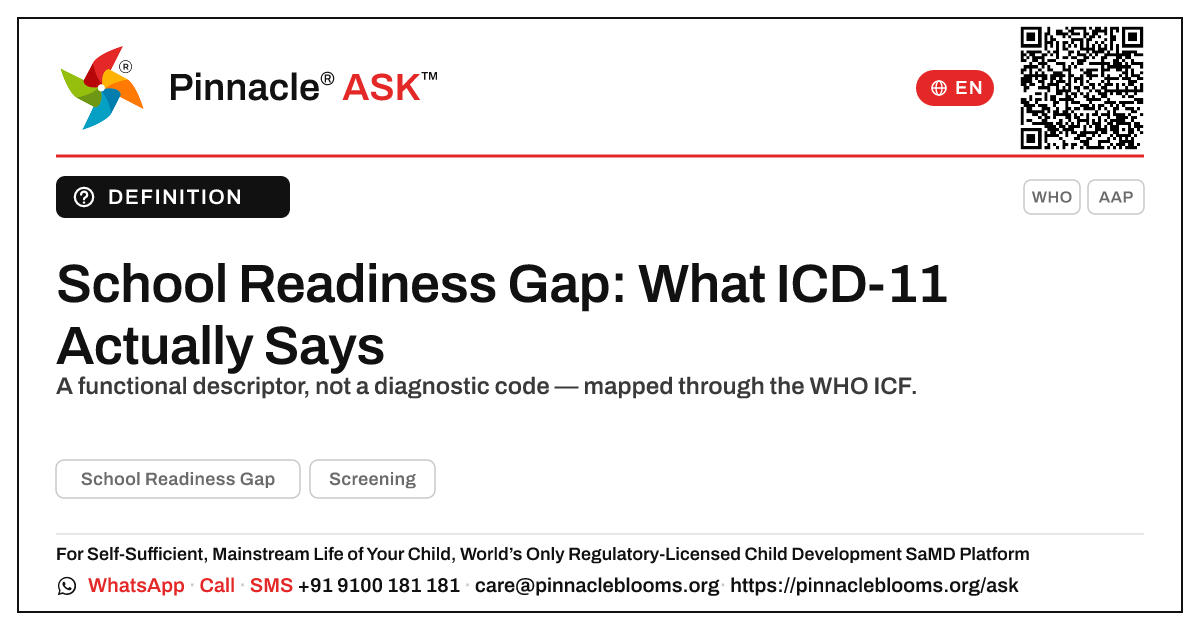
"School Readiness Gap" is a functional descriptor, not an ICD-11 diagnostic code. It is best mapped through the WHO ICF as a participation/functioning construct, with any underlying condition (e.g. developmental language disorder, ADHD) coded separately under ICD-11 if identified. Treat it as a screening flag warranting structured developmental profiling, not a label.
In this answer 5 sections
"School Readiness Gap" reads like a diagnosis on a referral letter — but it is a functional descriptor, not an ICD-11 disease code, and that distinction matters for your patient pathway.
In short
There is no ICD-11 diagnostic code for "School Readiness Gap" — it is not a recognised disease entity. It is a functional descriptor characterising a child who has not yet reached the developmental, language, motor, attentional and self-regulation thresholds expected for formal schooling. In the WHO architecture it is best mapped through the ICF (functioning and participation) rather than a single ICD-11 stem code, with any underlying clinical condition coded separately if one is identified.
Why it sits outside the ICD-11 morbidity index
ICD-11 codes pathology and health conditions; school readiness is a participation-and-functioning construct, which is the domain of the ICF (International Classification of Functioning, Disability and Health). A readiness gap may be entirely developmental and self-resolving, or it may be a presenting signal of a codeable condition — for example a Developmental speech or language disorder (ICD-11 block 6A01), a Disorder of intellectual development (6A00), ADHD (6A05), or Coordination developmental disorder (6A04). The clinical task is to determine whether the gap is a normal-variant maturational lag or a marker of an underlying, separately-codeable condition.
How to use this in clinic
- Treat "school readiness gap" as a screening flag, not a label — document the functional domains involved (language, pre-literacy, fine-motor, attention, self-care, social-emotional regulation).
- Establish whether thresholds reflect maturational variation or persistent, cross-setting impairment.
- Where an underlying condition is suspected, code that condition per ICD-11; describe the participation limitation via ICF qualifiers.
- Avoid premature diagnostic labelling before ~6 years for specific learning constructs; favour structured profiling and monitoring.
The Pinnacle way
A clinical AbilityScore® and any diagnosis are formed only at a Pinnacle Blooms Network centre, under qualified clinician care — never from an online form or a descriptor like this. Our structured developmental profiling maps a child across communication, cognition, motor, social-emotional and self-care domains, giving you a measurable baseline for school-readiness support and a shared pathway from first concern to independence. Referring clinicians receive a domain-level functional profile, not a single label.
Trusted sources
WHO ICD-11 for Mortality and Morbidity Statistics; WHO International Classification of Functioning, Disability and Health (ICF); American Academy of Pediatrics developmental surveillance guidance.
Next step — Refer a child with a readiness concern for a clinician-led developmental profile at a Pinnacle centre to clarify whether a codeable condition underlies the gap.
This is general information, not a diagnosis — individual assessment and diagnosis require an appropriately qualified healthcare professional.
CONNECT THE ANSWER TO YOUR CHILD’S DAY
Something to notice. Something to discuss.
What to notice
Persistent, cross-setting delays in language, pre-literacy, fine-motor control, attention or self-regulation that do not narrow with time — these distinguish a true underlying condition from normal maturational variation.
In everyday life
When documenting a readiness concern, record the specific functional domains affected rather than a single 'not ready' verdict — it directs referral and intervention far more usefully.
Bring your observations and questions to your child’s professional. Choose activities that suit your child’s comfort, abilities and agreed plan.
Bring your questions to a first visitQuestions families ask
Is there a specific ICD-11 code for School Readiness Gap?
No. ICD-11 does not contain a diagnostic code for "School Readiness Gap". It is a functional descriptor of a participation gap, best represented through the WHO ICF, with any underlying clinical condition coded separately under ICD-11.
How should a clinician code a child presenting with a readiness gap?
Determine whether an underlying condition exists — for example a developmental speech or language disorder, a disorder of intellectual development, ADHD or developmental coordination disorder — and code that per ICD-11. Use ICF qualifiers to describe the participation limitation itself.
When does a school readiness gap warrant formal assessment?
When delays in language, pre-literacy, motor, attentional or self-regulation domains persist across settings and do not narrow with maturation. Structured developmental profiling clarifies whether the gap reflects normal variation or a codeable condition.
FOLLOW THE SOURCE
References behind this answer.
- Organisation website · further readingWHO ICD-11 for Mortality and Morbidity Statistics
- Organisation website · further readingAmerican Academy of Pediatrics — developmental surveillance
References are supplied with this answer. An organisation homepage offers further reading; it does not establish an independent review of this page.
Content attribution: SETU Consortium · Pinnacle Blooms Network.
PEOPLE, TOPICS & DEVELOPMENT
See the connections.
Browse the wider question collections connected with this answer’s audience, developmental area and stage.
FROM UNDERSTANDING TO PURPOSEFUL SUPPORT
One question. Your child’s whole life.
Your child’s self-sufficient, mainstream-included life is the purpose from the beginning. At Pinnacle, that purpose shapes what we understand, the goals we choose, the people we bring together, everyday practice and review.
Connect this question with the right support.
Explore how the relevant service contributes to everyday abilities, then speak with us about your child.
Make the next conversation useful.
Bring the situations you notice at home or school. We’ll explain a suitable service, centre and first visit, including availability and fees, before you decide.
How PinnacleAI® connects the journeyExplore the seven stages
- 1Understand abilities
A starting picture of your child’s capabilities.
- 2Choose meaningful goals
Readiness and a plan shaped around the child.
- 3Bring the right support together
Suitable therapies and people for those goals.
- 4Carry practice into everyday life
Guidance for family, home and school.
- 5Track and correct
Use observations to adjust the plan.
- 6Reassess and review
Decide what to continue, change or do next.
- 7Grow independence and participation
The child’s life gives each step its purpose.
Explore the whole PinnacleAI® system → · Participation at school and in the community →
PINNACLE’S EVIDENCE, OPEN TO YOU
Look at the evidence behind our work.
Read our research, inspect the original regulatory documents and check what each institutional measure means.
General information supports a conversation with an appropriately qualified professional. Advice, goals and support depend on the individual child.