
YOUR QUESTION. A CLEARER NEXT STEP.
Non-Verbal / Minimally Verbal vs Oppositional Defiant Disorder in young children
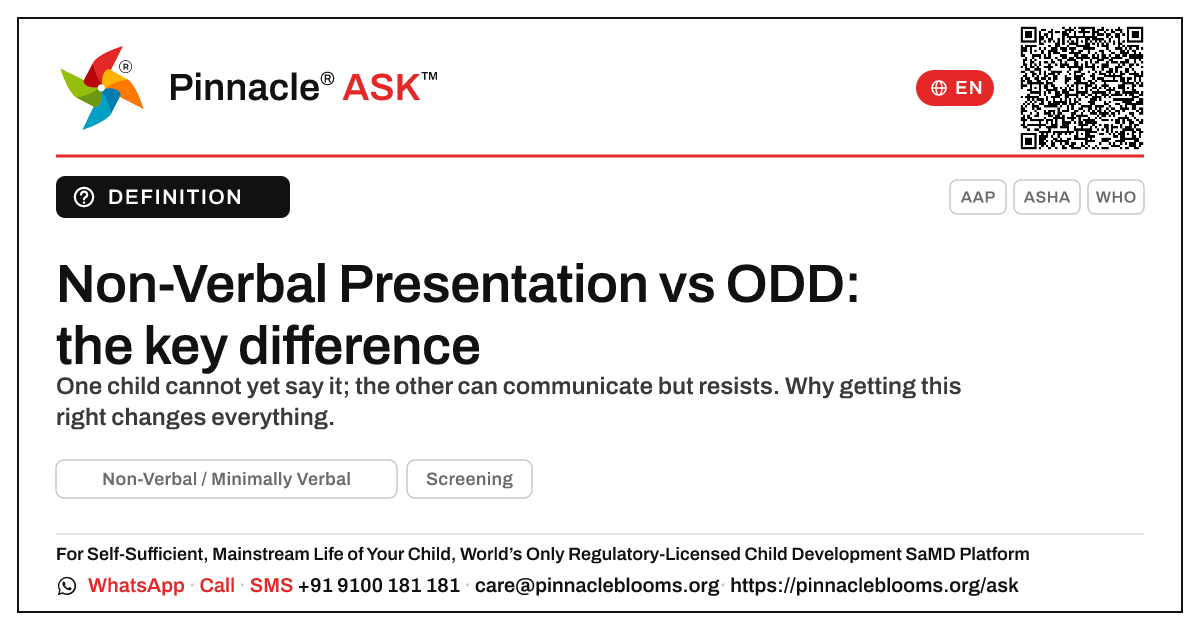
A non-verbal or minimally verbal presentation describes a child with very few or no spoken words — communication is still developing. Oppositional Defiant Disorder is a persistent pattern of angry, defiant behaviour in a child who can already understand and communicate. One is a child who cannot yet say; the other is a child who can communicate but is resistant and dysregulated. They can look alike in a meltdown, but supporting communication first often eases behaviour that was mistaken for defiance.
In this answer 5 sections
When a young child isn't talking and seems to push back against everything, it's natural to wonder — is this about words they don't yet have, or behaviour they're choosing? The answer changes everything about how you help.
In short
A non-verbal or minimally verbal presentation means a child has very few or no spoken words for their age — communication itself is still developing. Oppositional Defiant Disorder (ODD) is a pattern of persistently angry, defiant or argumentative behaviour towards adults, in a child who can understand and communicate. The simplest way to hold the difference: one is about a child who cannot yet say, the other about a child who can communicate but is dysregulated and resistant. They can look similar in a meltdown, but they call for very different support.
How they differ in everyday life
A non-verbal / minimally verbal child may seem to "refuse" instructions, but often they simply haven't understood the language, can't ask for what they want, or are frustrated at not being understood. Their distress usually eases when communication is supported — through gestures, pictures, choices or AAC tools. You'll often see them trying to connect, pointing, leading you by the hand, or melting down precisely because words won't come.
A child whose behaviour fits an ODD pattern typically has age-appropriate language and comprehension. The defiance is directed and relational — deliberate arguing, refusing rules they clearly understand, blaming others, and an angry, irritable mood that persists over months across settings. The behaviour is the difficulty itself, rather than a symptom of not being able to communicate.
The overlap is real and important: many children who can't yet talk become frustrated and "behavioural" simply because expressing themselves is so hard. Labelling that as defiance can miss the true need. This is why a careful look at communication first matters so much in the early years — behaviour is often the visible tip of an unmet communication need.
When to seek a review
Consider a developmental review if your child has very few words by around 18–24 months, isn't combining words by 2, seems not to understand simple instructions, or relies on pulling and pointing more than peers. Separately, seek guidance if angry, defiant behaviour is frequent, lasts beyond a typical "terrible twos" phase, shows up across home and other settings, and is straining relationships. A good assessment untangles which is which — and frequently finds that supporting communication eases the behaviour dramatically.
The Pinnacle way
This is general guidance, not a diagnosis — a clinical AbilityScore® and any diagnosis are formed only at a Pinnacle Blooms Network centre, under qualified clinician care, never from an app or checklist. Our team begins by understanding how your child communicates before reading anything into behaviour — our speech therapy and behavioural support work side by side. You can read more about a non-verbal or minimally verbal presentation and how we build communication.
Trusted sources
WHO ICD-11 framing of communication and behavioural presentations; the American Academy of Pediatrics and HealthyChildren guidance on early language milestones and behaviour in young children; ASHA on language development and alternative communication supports.
Next step — If you're unsure whether it's words or behaviour at the root, book a developmental review — understanding your child's communication first is the kindest and most accurate place to start.
CONNECT THE ANSWER TO YOUR CHILD’S DAY
Something to notice. Something to discuss.
What to notice
Very few words by 18–24 months, no word combinations by 2, or seeming not to understand simple instructions (communication concern); versus frequent, directed defiance, persistent angry mood, and rule-refusal across settings that strains relationships (behavioural concern). Watch especially for meltdowns that ease the moment communication is supported.
In everyday life
Before reading 'refusal' into a tricky moment, pause and offer your child a way to communicate — a gesture, two clear choices, or a picture. If the upset settles once they can show you what they want, the root is more likely communication than defiance.
Bring your observations and questions to your child’s professional. Choose activities that suit your child’s comfort, abilities and agreed plan.
Bring your questions to a first visitQuestions families ask
Can a non-verbal child be wrongly thought to have ODD?
Yes, and it happens often. A child who can't yet express themselves may melt down or 'refuse' simply because they can't ask for what they need or understand the instruction. This can look like defiance, but it eases when communication is supported. This is exactly why a careful assessment looks at communication first before reading meaning into behaviour.
At what age can behaviour be called Oppositional Defiant Disorder?
Defiance, tantrums and testing limits are a normal part of toddler and preschool development. A persistent, problematic pattern is only considered in older preschoolers and school-age children, when angry, argumentative behaviour lasts for months, appears across different settings, and strains relationships. A qualified clinician makes this judgement, never an app or checklist.
My child has no words but tries hard to connect — what does that mean?
A child who points, leads you by the hand, makes eye contact and gets frustrated at not being understood is showing strong intent to communicate — the words simply haven't arrived yet. This is a communication picture, not a behavioural one, and it usually responds very well to early speech and language support.
FOLLOW THE SOURCE
References behind this answer.
- Organisation website · further readingAAP HealthyChildren — early language milestones and behaviour
- Organisation website · further readingASHA — language development and communication supports
- Organisation website · further readingWHO ICD-11 — communication and behavioural presentations
References are supplied with this answer. An organisation homepage offers further reading; it does not establish an independent review of this page.
Content attribution: SETU Consortium · Pinnacle Blooms Network.
PEOPLE, TOPICS & DEVELOPMENT
See the connections.
Browse the wider question collections connected with this answer’s audience, developmental area and stage.
FROM UNDERSTANDING TO PURPOSEFUL SUPPORT
One question. Your child’s whole life.
Your child’s self-sufficient, mainstream-included life is the purpose from the beginning. At Pinnacle, that purpose shapes what we understand, the goals we choose, the people we bring together, everyday practice and review.
Connect this question with the right support.
Start with your child’s strengths, your observations and what you want everyday life to become.
Make the next conversation useful.
Bring the situations you notice at home or school. We’ll explain a suitable service, centre and first visit, including availability and fees, before you decide.
How PinnacleAI® connects the journeyExplore the seven stages
- 1Understand abilities
A starting picture of your child’s capabilities.
- 2Choose meaningful goals
Readiness and a plan shaped around the child.
- 3Bring the right support together
Suitable therapies and people for those goals.
- 4Carry practice into everyday life
Guidance for family, home and school.
- 5Track and correct
Use observations to adjust the plan.
- 6Reassess and review
Decide what to continue, change or do next.
- 7Grow independence and participation
The child’s life gives each step its purpose.
Explore the whole PinnacleAI® system → · Participation at school and in the community →
PINNACLE’S EVIDENCE, OPEN TO YOU
Look at the evidence behind our work.
Read our research, inspect the original regulatory documents and check what each institutional measure means.
General information supports a conversation with an appropriately qualified professional. Advice, goals and support depend on the individual child.