
YOUR QUESTION. A CLEARER NEXT STEP.
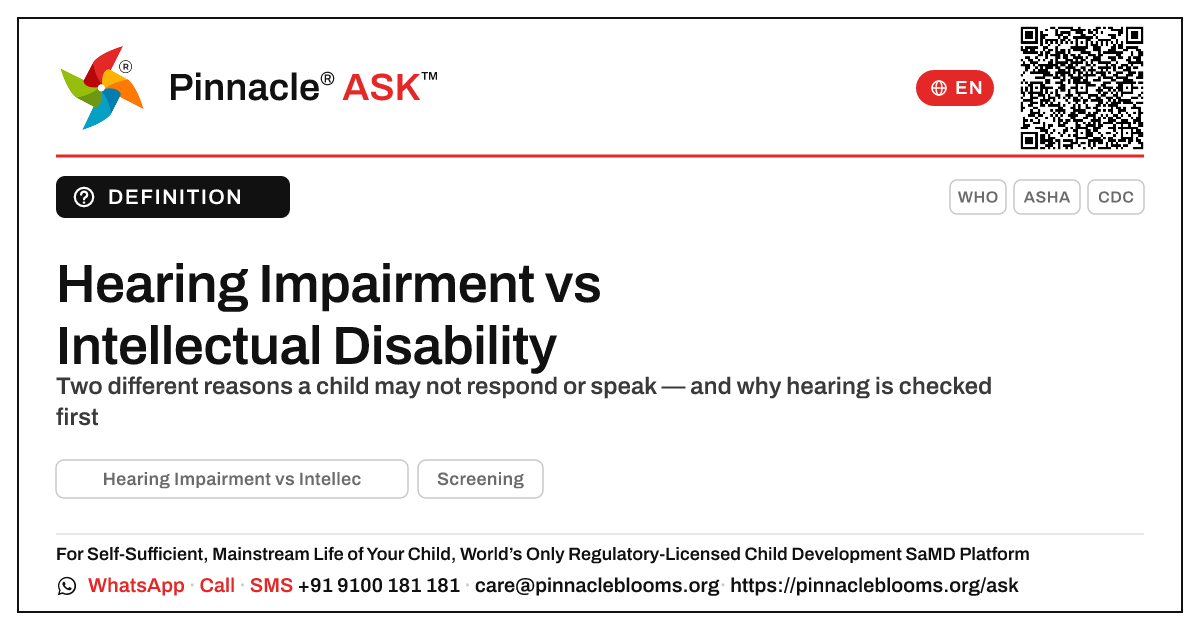
Hearing Impairment vs Intellectual Disability in Children
Hearing impairment means a child's ears or hearing pathway are not picking up sound fully, delaying language because the child cannot hear well; intellectual disability is a broader difference in how a child learns, reasons and manages daily skills across many areas. A child can have one without the other. Because both can look similar in a toddler who isn't talking, a hearing test is always the essential first step before any learning difference is considered.
In this answer 4 sections
Two different reasons a young child may not respond or speak as expected — one is about hearing the world, the other about how the brain learns and reasons.
In short
Hearing impairment means a child's ears or hearing pathway are not picking up sound fully, so language and responses are delayed because the child simply cannot hear well. Intellectual disability is a broader difference in how a child learns, reasons and manages everyday skills, present across many areas of thinking and daily living. A child can hear perfectly and still have an intellectual disability — or hear poorly with completely typical learning ability. Crucially, the two can look alike in a toddler who isn't talking, which is exactly why hearing is always checked first.
How they differ in everyday life
A child with hearing impairment often responds well to gestures, faces and visual cues, plays and problem-solves at age level, and may turn or react when sound is loud or felt as vibration — they are bright and curious, just missing the sound. A child with an intellectual disability tends to show slower progress across several areas together — play, understanding, self-care and language — even when sound is clearly heard. Because untreated hearing loss can itself slow language and learning, a hearing test (audiology) is the essential first step before anyone considers a learning difference. Many gaps respond beautifully to early support, hearing aids or therapy.
The Pinnacle way
This is general information, not a diagnosis — a clinical AbilityScore® and any diagnosis are formed only at a Pinnacle Blooms Network centre, under qualified clinician care. Our team first distinguishes hearing impairment from a learning difference, then shapes support that may include speech therapy and family guidance.
Trusted sources
WHO guidance on childhood hearing and developmental health; ASHA on hearing and language development; CDC developmental milestone resources.
Next step — If your child isn't responding to sound or speaking as expected, book a developmental review and hearing check to find the real reason early.
CONNECT THE ANSWER TO YOUR CHILD’S DAY
Something to notice. Something to discuss.
What to notice
Not responding to sound or name, but reacting well to faces, gestures and vibration (points to hearing); slower progress across play, understanding, self-care and language together even when sound is clearly heard (points to a learning difference).
In everyday life
Watch how your child responds to a soft sound from behind, out of sight — turning towards it is reassuring. If they don't, try the same with a gesture or smile; a strong response to visual cues but not sound is worth raising at a hearing check.
Bring your observations and questions to your child’s professional. Choose activities that suit your child’s comfort, abilities and agreed plan.
Bring your questions to a first visitQuestions families ask
Can a child have both hearing impairment and intellectual disability?
Yes. The two are separate and can occur together or alone. This is exactly why a clinician checks hearing first, then looks at the whole picture of learning and development before drawing any conclusion.
Why is a hearing test the first step?
Because untreated hearing loss can itself slow a child's language and learning, making it look like a thinking difference. Confirming how well a child hears prevents a hearing issue being mistaken for an intellectual disability.
My child plays cleverly but doesn't talk — what could that mean?
A bright, curious child who solves problems and responds to faces and gestures but doesn't respond to sound may have a hearing concern rather than a learning difference. A hearing check and developmental review will clarify.
FOLLOW THE SOURCE
References behind this answer.
- Source referenceWHO — childhood hearing health
- Source referenceASHA — hearing and language development
- Source referenceCDC — developmental milestones
References are supplied with this answer. An organisation homepage offers further reading; it does not establish an independent review of this page.
Content attribution: SETU Consortium · Pinnacle Blooms Network.
PEOPLE, TOPICS & DEVELOPMENT
See the connections.
Browse the wider question collections connected with this answer’s audience, developmental area and stage.
FROM UNDERSTANDING TO PURPOSEFUL SUPPORT
One question. Your child’s whole life.
Your child’s self-sufficient, mainstream-included life is the purpose from the beginning. At Pinnacle, that purpose shapes what we understand, the goals we choose, the people we bring together, everyday practice and review.
Connect this question with the right support.
Start with your child’s strengths, your observations and what you want everyday life to become.
Make the next conversation useful.
Bring the situations you notice at home or school. We’ll explain a suitable service, centre and first visit, including availability and fees, before you decide.
How PinnacleAI® connects the journeyExplore the seven stages
- 1Understand abilities
A starting picture of your child’s capabilities.
- 2Choose meaningful goals
Readiness and a plan shaped around the child.
- 3Bring the right support together
Suitable therapies and people for those goals.
- 4Carry practice into everyday life
Guidance for family, home and school.
- 5Track and correct
Use observations to adjust the plan.
- 6Reassess and review
Decide what to continue, change or do next.
- 7Grow independence and participation
The child’s life gives each step its purpose.
Explore the whole PinnacleAI® system → · Participation at school and in the community →
PINNACLE’S EVIDENCE, OPEN TO YOU
Look at the evidence behind our work.
Read our research, inspect the original regulatory documents and check what each institutional measure means.
General information supports a conversation with an appropriately qualified professional. Advice, goals and support depend on the individual child.