
YOUR QUESTION. A CLEARER NEXT STEP.
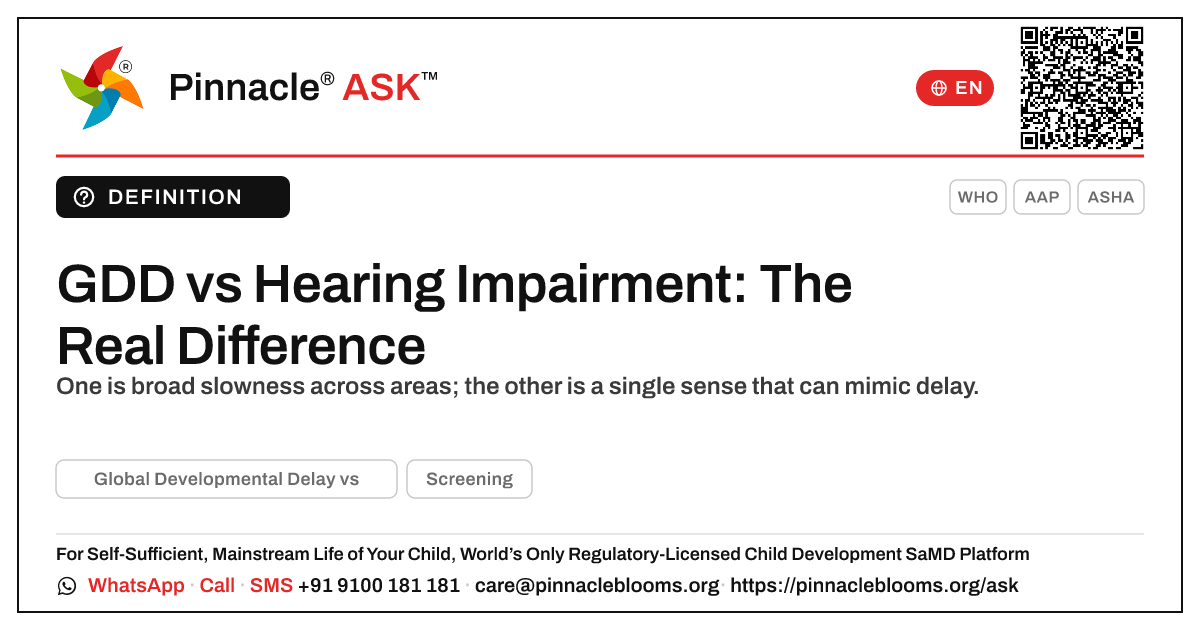
Global Developmental Delay vs Hearing Impairment
Global Developmental Delay (GDD) means a young child develops more slowly than expected across two or more areas — movement, speech, thinking, social skills and self-care. Hearing impairment is reduced or absent hearing in one specific sense, which can ripple into speech and language and may look like broader delay. The key difference is breadth: GDD spans many domains, while hearing impairment is one sense. Because undetected hearing loss can mimic delay, a hearing test is one of the first checks clinicians make.
In this answer 5 sections
Two children may both be slow to talk — but one cannot hear the words, while the other is developing more gradually across many areas. Telling them apart matters.
In short
Global Developmental Delay (GDD) means a young child (usually under five) is developing more slowly than expected across two or more areas at once — such as movement, speech, thinking, social skills and self-care. Hearing impairment means a child cannot hear sounds clearly, fully or at all — and because so much early learning flows through hearing, this can ripple into speech, language and attention. The key difference: GDD is a broad pattern across many domains, while hearing impairment is one specific sense whose effects can look like delay. A simple, painless hearing test is always one of the first things to check.
How they differ in everyday life
A child with hearing impairment may turn when they see you but not when called, watch faces intently, miss soft sounds, or have speech that lags while play, movement and problem-solving stay strong. A child with GDD tends to show a more even slowness — sitting, walking, babbling, understanding and interacting all arriving later than peers. Importantly, the two can overlap, and undetected hearing loss can itself mimic broader delay. This is exactly why clinicians check hearing first: treating it can unlock speech and learning remarkably.
When to seek a review
If your child does not respond to sound, is not babbling by around 12 months, or seems behind in several areas, request a hearing test and a developmental review promptly. Early answers change outcomes.
The Pinnacle way
This is general information, not a diagnosis — a clinical AbilityScore® and any diagnosis are formed only at a Pinnacle Blooms Network centre, under qualified clinician care, never from an app or form. We look at the whole child, confirm hearing, and where needed draw on speech therapy within an individualised plan for global developmental delay.
Trusted sources
WHO guidance on childhood hearing and early development; the American Academy of Pediatrics and HealthyChildren on developmental milestones; ASHA on hearing and speech in young children.
Next step — If you are unsure whether it is hearing, broader delay, or both, book a developmental review and hearing check to get clear answers early.
CONNECT THE ANSWER TO YOUR CHILD’S DAY
Something to notice. Something to discuss.
What to notice
Not responding or turning to sound or name, watching faces very intently, no babbling by around 12 months, speech lagging while movement and play stay strong (suggesting hearing), or a more even slowness across sitting, walking, talking and interacting (suggesting broader delay).
In everyday life
Notice how your child reacts to sound out of sight — a soft call from behind, a doorbell, music. If they respond to sights but rarely to sounds they cannot see, mention it and ask for a simple hearing test.
Bring your observations and questions to your child’s professional. Choose activities that suit your child’s comfort, abilities and agreed plan.
Bring your questions to a first visitQuestions families ask
Can hearing loss be mistaken for developmental delay?
Yes. Because so much early learning flows through hearing, undetected hearing loss can slow speech and attention and look like broader delay. That is why clinicians check hearing as one of the first steps.
Can a child have both GDD and hearing impairment?
Yes, the two can co-occur. A thorough review checks hearing and looks across all developmental areas so the right support is given for each.
What is the first test if my child is not talking?
A simple, painless hearing test is usually among the first checks, alongside a developmental review, so any hearing barrier is found and addressed early.
FOLLOW THE SOURCE
References behind this answer.
- Source referenceWHO: Deafness and hearing loss
- Source referenceAAP HealthyChildren: Ages & Stages milestones
- Source referenceASHA: Hearing in children
References are supplied with this answer. An organisation homepage offers further reading; it does not establish an independent review of this page.
Content attribution: SETU Consortium · Pinnacle Blooms Network.
PEOPLE, TOPICS & DEVELOPMENT
See the connections.
Browse the wider question collections connected with this answer’s audience, developmental area and stage.
FROM UNDERSTANDING TO PURPOSEFUL SUPPORT
One question. Your child’s whole life.
Your child’s self-sufficient, mainstream-included life is the purpose from the beginning. At Pinnacle, that purpose shapes what we understand, the goals we choose, the people we bring together, everyday practice and review.
Connect this question with the right support.
Explore how the relevant service contributes to everyday abilities, then speak with us about your child.
Make the next conversation useful.
Bring the situations you notice at home or school. We’ll explain a suitable service, centre and first visit, including availability and fees, before you decide.
How PinnacleAI® connects the journeyExplore the seven stages
- 1Understand abilities
A starting picture of your child’s capabilities.
- 2Choose meaningful goals
Readiness and a plan shaped around the child.
- 3Bring the right support together
Suitable therapies and people for those goals.
- 4Carry practice into everyday life
Guidance for family, home and school.
- 5Track and correct
Use observations to adjust the plan.
- 6Reassess and review
Decide what to continue, change or do next.
- 7Grow independence and participation
The child’s life gives each step its purpose.
Explore the whole PinnacleAI® system → · Participation at school and in the community →
PINNACLE’S EVIDENCE, OPEN TO YOU
Look at the evidence behind our work.
Read our research, inspect the original regulatory documents and check what each institutional measure means.
General information supports a conversation with an appropriately qualified professional. Advice, goals and support depend on the individual child.