
YOUR QUESTION. A CLEARER NEXT STEP.
FASD vs Non-Verbal / Minimally Verbal: the difference
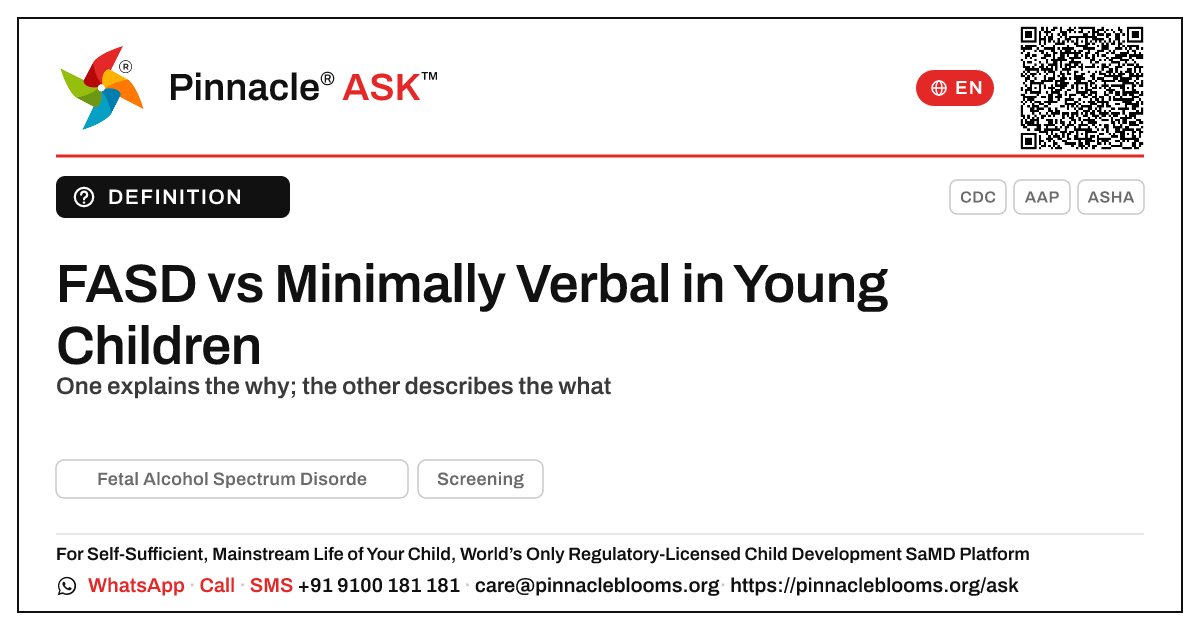
Fetal Alcohol Spectrum Disorder (FASD) is a lifelong, cause-based condition arising from alcohol exposure during pregnancy, affecting the whole child — learning, attention, regulation, movement, growth and sometimes speech. Non-verbal or minimally verbal presentation is not a diagnosis but a description of a child who speaks few or no words, which can have many causes including autism, hearing difficulty, speech-motor delay or FASD itself. FASD explains a why; minimally verbal describes a what. An assessment works out the reason behind the quiet voice so the right support follows.
In this answer 5 sections
One is about how a child's brain was built before birth; the other is simply a description of how much a child speaks right now — and telling them apart matters.
In short
Fetal Alcohol Spectrum Disorder (FASD) is a lifelong, cause-based condition — it describes brain and body differences that happen when a developing baby is exposed to alcohol during pregnancy. Non-verbal / minimally verbal presentation is not a diagnosis at all — it is a description of one thing: a child who speaks few or no words yet. A child can be minimally verbal for many different reasons (autism, hearing difficulty, a speech-motor delay, or indeed FASD). So FASD is a why; minimally verbal is a what we see.
How they differ in everyday life
FASD affects the whole child, not just speech. Because alcohol can shape how the brain develops, children may show a mix of differences — in learning and memory, attention and impulse control, emotional regulation, motor skills, growth, and sometimes subtle facial features. Speech and language may be delayed, but communication is only one strand of a much wider picture. Crucially, FASD is identified by considering the developmental profile together with a history of prenatal alcohol exposure — it is a medical understanding of cause, formed by clinicians.
Non-verbal / minimally verbal simply means a young child is not yet using spoken words to communicate, or is using very few. This tells us how the child is communicating today — not why. Many minimally verbal children understand far more than they can say, and many communicate beautifully through gestures, pointing, pictures or devices. The job of an assessment is to gently work out the reason behind the quiet voice, so the right support follows.
When to seek a look
If your child speaks far fewer words than peers, isn't combining words by around two years, or seems to understand but cannot get words out — that is reason for a friendly developmental check, whatever the cause. And if alcohol exposure during pregnancy is part of your family's story, please share it honestly and without shame; it helps clinicians help your child, and nothing about it changes how much your child can grow with the right support.
The Pinnacle way
This is general information, not a diagnosis — a clinical AbilityScore® and any diagnosis are formed only at a Pinnacle Blooms Network centre, under qualified clinician care, never from an app or form. Our team looks at the whole child — communication, learning, movement, regulation and history — to understand the why behind what you're seeing, then builds a plan. Learn more about Fetal Alcohol Spectrum Disorder, and where a quiet voice is part of the picture, speech therapy helps every child find their way to communicate.
Trusted sources
The CDC and American Academy of Pediatrics on prenatal alcohol exposure and FASD; the American Speech-Language-Hearing Association on early language delay and the many reasons a child may be minimally verbal.
Next step — Worried about your child's words or development? Book a developmental screening and let a clinician understand the whole picture before drawing any conclusions.
CONNECT THE ANSWER TO YOUR CHILD’S DAY
Something to notice. Something to discuss.
What to notice
A child who speaks far fewer words than peers, isn't combining words by around two years, or understands but cannot get words out — plus, where relevant, differences in learning, attention, growth or movement alongside any history of prenatal alcohol exposure.
In everyday life
Whatever the cause of few words, honour every attempt to communicate: respond warmly to a point, a gesture or a sound as if it were a sentence. Naming what your child reaches for ('you want the ball — ball!') builds the bridge to spoken words.
Bring your observations and questions to your child’s professional. Choose activities that suit your child’s comfort, abilities and agreed plan.
Bring your questions to a first visitQuestions families ask
Is being minimally verbal the same as having FASD?
No. Minimally verbal simply describes a child who speaks few or no words right now — it is not a diagnosis or a cause. A child can be minimally verbal for many reasons, including autism, hearing difficulty, a speech-motor delay, or FASD. FASD, by contrast, is a cause-based condition linked to alcohol exposure during pregnancy and affects far more than speech.
Does FASD always cause speech delay?
Not always. FASD affects the whole child in varying ways — learning, attention, emotional regulation, movement and growth — and speech and language may or may not be delayed. Communication is only one strand of a wider picture, which is why clinicians look at the whole child rather than speech alone.
Should I mention alcohol during pregnancy to the clinician?
Yes, gently and honestly — it genuinely helps. Sharing a history of prenatal alcohol exposure, without shame, allows clinicians to understand your child more accurately and support them better. It does not change how much your child can grow with the right help.
FOLLOW THE SOURCE
References behind this answer.
- Source referenceCDC — About FASD
- Source referenceAAP HealthyChildren — Fetal Alcohol Spectrum Disorders
- Source referenceASHA — Late-talking and early language
References are supplied with this answer. An organisation homepage offers further reading; it does not establish an independent review of this page.
Content attribution: SETU Consortium · Pinnacle Blooms Network.
PEOPLE, TOPICS & DEVELOPMENT
See the connections.
Browse the wider question collections connected with this answer’s audience, developmental area and stage.
FROM UNDERSTANDING TO PURPOSEFUL SUPPORT
One question. Your child’s whole life.
Your child’s self-sufficient, mainstream-included life is the purpose from the beginning. At Pinnacle, that purpose shapes what we understand, the goals we choose, the people we bring together, everyday practice and review.
Connect this question with the right support.
Start with your child’s strengths, your observations and what you want everyday life to become.
Make the next conversation useful.
Bring the situations you notice at home or school. We’ll explain a suitable service, centre and first visit, including availability and fees, before you decide.
How PinnacleAI® connects the journeyExplore the seven stages
- 1Understand abilities
A starting picture of your child’s capabilities.
- 2Choose meaningful goals
Readiness and a plan shaped around the child.
- 3Bring the right support together
Suitable therapies and people for those goals.
- 4Carry practice into everyday life
Guidance for family, home and school.
- 5Track and correct
Use observations to adjust the plan.
- 6Reassess and review
Decide what to continue, change or do next.
- 7Grow independence and participation
The child’s life gives each step its purpose.
Explore the whole PinnacleAI® system → · Participation at school and in the community →
PINNACLE’S EVIDENCE, OPEN TO YOU
Look at the evidence behind our work.
Read our research, inspect the original regulatory documents and check what each institutional measure means.
General information supports a conversation with an appropriately qualified professional. Advice, goals and support depend on the individual child.