
YOUR QUESTION. A CLEARER NEXT STEP.
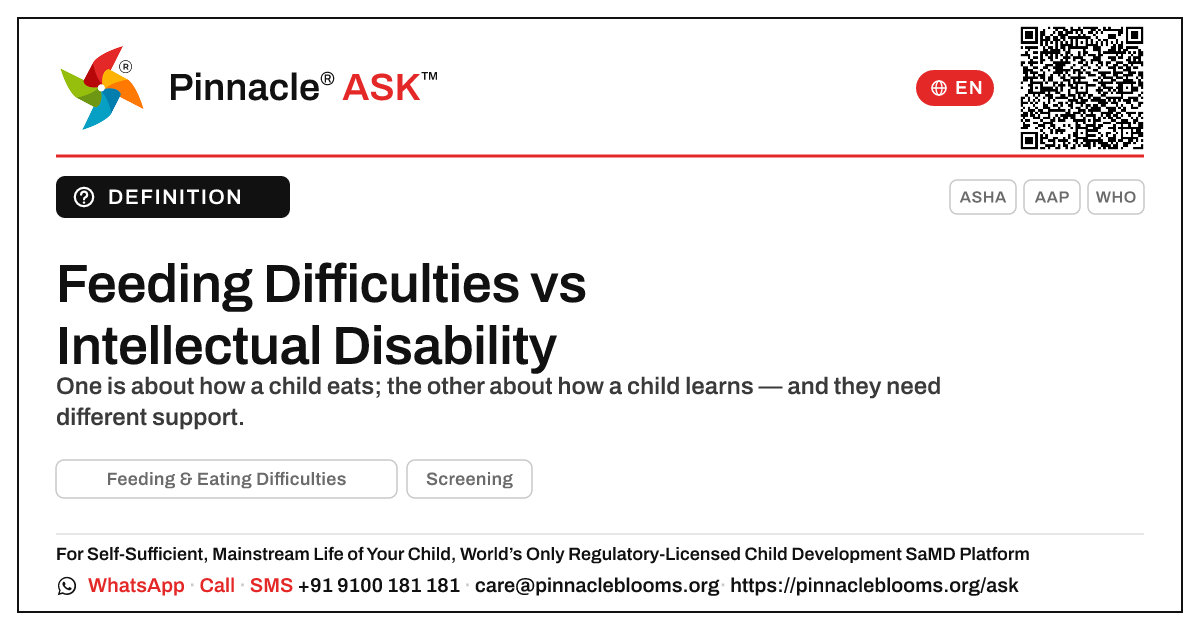
Feeding & Eating Difficulties vs Intellectual Disability in Young Children
Feeding & eating difficulties and intellectual disability can both appear at the dinner table but are very different. Feeding difficulties centre on the act of eating — food refusal, gagging, limited variety, trouble chewing or swallowing — often with typical learning and understanding. Intellectual disability describes broader, lasting differences in how a child learns, reasons and manages daily skills from early childhood. A child can have feeding difficulties with completely typical thinking; a child with intellectual disability may also have feeding challenges, but as part of a wider pattern. The clue is whether the struggle sits mainly at mealtimes or runs across many areas of development.
In this answer 5 sections
Two very different challenges that can look similar at the dinner table — one is about how a child eats, the other about how a child learns and understands.
In short
Feeding & eating difficulties describe a child who struggles with the act of eating — refusing foods, gagging, very limited variety, trouble chewing or swallowing, or distress at mealtimes — often with no impact on their overall learning and understanding. Intellectual disability is something quite different: it describes broader, lasting differences in how a child learns, reasons, solves problems and manages everyday self-care, present from early childhood. A child can have feeding difficulties with perfectly typical thinking and learning; a child with intellectual disability may also have feeding challenges — but the two are not the same thing, and each needs its own kind of support.
How they differ in everyday life
With feeding & eating difficulties, the worry is centred on the meal. You might notice your child eating only a handful of foods, gagging or coughing on certain textures, avoiding lumpy or new foods, taking very long to eat, or becoming highly distressed when asked to try something different. Their play, curiosity, talking and problem-solving may all be developing just as expected — it's the eating that feels stuck. Causes range from oral-motor coordination and sensory sensitivities to reflux, past medical experiences, or simple but stubborn food fussiness.
With intellectual disability, the picture is broader and touches many areas at once — a child may be slower to reach milestones across thinking, language, play and daily skills like dressing or following routines, not just eating. Feeding can be affected here too, but as one part of a wider developmental pattern rather than a standalone difficulty.
The key question a clinician asks is: is the challenge mainly at mealtimes, or does it run across many areas of how my child learns and copes? That distinction guides where support should begin.
When to seek a look
It's worth a professional view if your child gags or chokes often, eats fewer than around 10–15 foods, is losing weight or not gaining, melts down at every meal, or if you notice they are also slower than peers to talk, play, understand instructions or manage everyday tasks. Early, gentle support works best — and the right starting point depends on which picture fits your child.
The Pinnacle way
This is general information, not a diagnosis — a clinical AbilityScore® and any diagnosis are formed only at a Pinnacle Blooms Network centre, under qualified clinician care, never from an app or a form. Our team watches how your child eats, plays, communicates and learns, then shapes support around their strengths — drawing on feeding and occupational therapy where mealtimes are the focus, and broader developmental support where learning is involved. Learn more about feeding & eating difficulties and explore our full range of services.
Trusted sources
The American Speech-Language-Hearing Association on paediatric feeding and swallowing; the American Academy of Pediatrics and HealthyChildren on feeding milestones and developmental concerns; the World Health Organization's ICD on intellectual developmental disorders.
Next step — Unsure whether your child's mealtime struggles stand alone or are part of a wider picture? Book a developmental screening and let a clinician gently sort it out with you.
CONNECT THE ANSWER TO YOUR CHILD’S DAY
Something to notice. Something to discuss.
What to notice
Watch whether the struggle sits mainly at mealtimes (food refusal, gagging, very limited variety, trouble chewing or swallowing) or also shows up as slower progress in talking, playing, understanding instructions and everyday self-care. Mealtime-only concerns point toward feeding support; broader, across-the-board delays warrant a wider developmental check.
In everyday life
Keep mealtimes calm and pressure-free: offer one tiny new food alongside familiar favourites, let your child touch and explore it with no demand to eat, and praise the brave exploring, not just the swallowing. Lowering mealtime stress often does more than insisting.
Bring your observations and questions to your child’s professional. Choose activities that suit your child’s comfort, abilities and agreed plan.
Bring your questions to a first visitQuestions families ask
Can a child have feeding difficulties without any intellectual disability?
Yes — very commonly. Many children with typical learning and understanding still struggle at mealtimes due to oral-motor coordination, sensory sensitivities, reflux or fussy eating. Feeding difficulties on their own say nothing about a child's thinking or learning.
Can the two occur together?
They can. A child with intellectual disability may also have feeding challenges, but here the eating is one part of a wider developmental pattern rather than a standalone issue. A clinician looks at the whole picture to tell which is which.
How do I know which one my child has?
The simplest clue is the spread of the challenge. If the worry is mainly at mealtimes while play, language and problem-solving develop typically, it points toward feeding difficulties. If you also notice slower progress across learning, talking and daily skills, a broader developmental check is wise. Only a qualified clinician can sort this out properly.
FOLLOW THE SOURCE
References behind this answer.
- Source referenceASHA — paediatric feeding and swallowing
- Source referenceHealthyChildren (AAP) — ages, stages and feeding milestones
- Organisation website · further readingWHO ICD — intellectual developmental disorders
References are supplied with this answer. An organisation homepage offers further reading; it does not establish an independent review of this page.
Content attribution: SETU Consortium · Pinnacle Blooms Network.
PEOPLE, TOPICS & DEVELOPMENT
See the connections.
Browse the wider question collections connected with this answer’s audience, developmental area and stage.
FROM UNDERSTANDING TO PURPOSEFUL SUPPORT
One question. Your child’s whole life.
Your child’s self-sufficient, mainstream-included life is the purpose from the beginning. At Pinnacle, that purpose shapes what we understand, the goals we choose, the people we bring together, everyday practice and review.
Connect this question with the right support.
Explore how the relevant service contributes to everyday abilities, then speak with us about your child.
Make the next conversation useful.
Bring the situations you notice at home or school. We’ll explain a suitable service, centre and first visit, including availability and fees, before you decide.
How PinnacleAI® connects the journeyExplore the seven stages
- 1Understand abilities
A starting picture of your child’s capabilities.
- 2Choose meaningful goals
Readiness and a plan shaped around the child.
- 3Bring the right support together
Suitable therapies and people for those goals.
- 4Carry practice into everyday life
Guidance for family, home and school.
- 5Track and correct
Use observations to adjust the plan.
- 6Reassess and review
Decide what to continue, change or do next.
- 7Grow independence and participation
The child’s life gives each step its purpose.
Explore the whole PinnacleAI® system → · Participation at school and in the community →
PINNACLE’S EVIDENCE, OPEN TO YOU
Look at the evidence behind our work.
Read our research, inspect the original regulatory documents and check what each institutional measure means.
General information supports a conversation with an appropriately qualified professional. Advice, goals and support depend on the individual child.