
YOUR QUESTION. A CLEARER NEXT STEP.
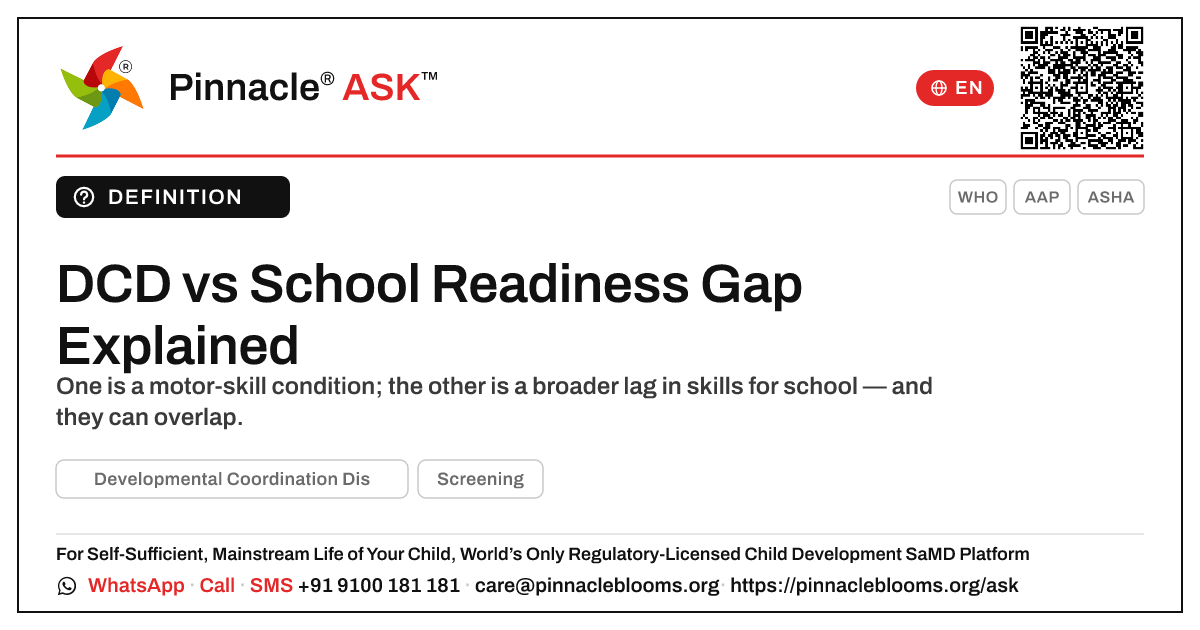
DCD vs School Readiness Gap: What's the Difference?
Developmental Coordination Disorder (DCD) is a recognised condition where a child's motor coordination is significantly behind age expectations — clumsiness, difficulty with pencils, buttons, catching or cycling despite trying hard. A School Readiness Gap is not a diagnosis; it describes a child who hasn't yet built the everyday skills (attention, sitting, following instructions, self-help, social confidence) for formal schooling, often reflecting age or opportunity rather than a condition. DCD is specific to movement and tends to persist; a readiness gap is broader and often closes with support. They can overlap, which is why a clinician's careful look matters.
In this answer 5 sections
One is about how a child's body learns to move; the other is about how ready a child is for the world of the classroom — and they are not the same thing.
In short
Developmental Coordination Disorder (DCD) is a recognised condition where a child's motor coordination is significantly behind what's expected for their age — they may be unusually clumsy, struggle to hold a pencil, do up buttons, catch a ball or ride a bike, despite trying hard. A School Readiness Gap is not a diagnosis at all — it simply describes a child who hasn't yet built the everyday skills (attention, sitting, following instructions, early language, self-help, social confidence) needed to settle smoothly into formal schooling. In short: DCD is a specific motor-skill condition; a readiness gap is a broader, often temporary lag across the skills school expects — and the two can overlap or exist completely separately.
How they differ in everyday life
With DCD, the heart of the difficulty is movement and coordination. You might notice a child who avoids drawing or puzzles, tires quickly with handwriting, bumps into things, finds dressing frustrating, or seems to learn each new physical skill far more slowly than other children — even though they are bright and motivated. It tends to persist over time and is usually identified once a child is a little older (often around school age), when motor demands rise.
A School Readiness Gap is wider and more situational. A child might find it hard to sit for a story, separate from a parent, wait their turn, hold a crayon or simply not have had many group experiences yet. Often it reflects opportunity, age, language exposure or temperament rather than any underlying condition — and with the right encouragement and a supportive early-learning environment, much of it closes naturally.
The overlap matters: a child with DCD may look 'not school-ready' because writing and self-help tasks are genuinely hard for them — but the right answer there is targeted motor support, not just more practice. That's why a careful look by a clinician is so valuable.
When to seek a closer look
Seek a developmental screening if your child is markedly clumsier than peers, avoids physical or fine-motor tasks, finds handwriting or dressing exhausting beyond age 5, or if you simply feel they are not coping with the demands of starting school. The aim is never to label — it is to understand why, so support fits the real cause.
The Pinnacle way
This is general information, not a diagnosis — a clinical AbilityScore® and any diagnosis are formed only at a Pinnacle Blooms Network centre, under qualified clinician care, never from an app or form. Our team gently observes how your child moves, plays, attends and self-helps, then separates a genuine coordination difficulty from a readiness lag — drawing on occupational therapy for motor and self-help skills and our school readiness programme support where needed. Explore more across our services.
Trusted sources
The World Health Organization's ICD framework on developmental motor coordination disorders; the American Academy of Pediatrics and HealthyChildren on motor milestones and school readiness; ASHA on the early skills that support learning.
Next step — Unsure whether it's coordination or readiness? Book a developmental screening and let a Pinnacle clinician find the real reason — and the right support.
CONNECT THE ANSWER TO YOUR CHILD’S DAY
Something to notice. Something to discuss.
What to notice
A child markedly clumsier than peers, who avoids drawing, puzzles or ball games, tires quickly with handwriting, struggles with buttons or dressing beyond age 5, or who simply isn't settling into the sitting, attention and turn-taking that school expects.
In everyday life
Build motor confidence through play, not pressure: threading beads, squeezing playdough, big arm movements like drawing in the air, and simple ball roll-and-catch. Keep it short, joyful and praise the effort — coordination grows through happy repetition.
Bring your observations and questions to your child’s professional. Choose activities that suit your child’s comfort, abilities and agreed plan.
Bring your questions to a first visitQuestions families ask
Is a School Readiness Gap a diagnosis?
No. It simply describes a child who hasn't yet built the everyday skills — attention, sitting, following instructions, early language, self-help and social confidence — needed to settle into formal schooling. It often reflects age, opportunity or temperament rather than an underlying condition, and much of it closes with the right encouragement and a supportive early-learning environment.
Can a child have both DCD and a readiness gap?
Yes. A child with Developmental Coordination Disorder may look 'not school-ready' because handwriting, dressing and fine-motor tasks are genuinely hard for them. The right response there is targeted motor support rather than just more practice — which is why a clinician's assessment helps separate the cause from the symptom.
When is DCD usually identified?
DCD is generally recognised once a child is a little older, often around school age, when motor demands rise and the gap between effort and result becomes clearer. If you notice persistent clumsiness, avoidance of physical or fine-motor tasks, or exhausting handwriting beyond age 5, a developmental screening is worthwhile.
FOLLOW THE SOURCE
References behind this answer.
- Organisation website · further readingWHO ICD — developmental motor coordination disorder
- Organisation website · further readingAAP HealthyChildren — motor milestones & school readiness
- Organisation website · further readingASHA — early skills that support learning
References are supplied with this answer. An organisation homepage offers further reading; it does not establish an independent review of this page.
Content attribution: SETU Consortium · Pinnacle Blooms Network.
PEOPLE, TOPICS & DEVELOPMENT
See the connections.
Browse the wider question collections connected with this answer’s audience, developmental area and stage.
FROM UNDERSTANDING TO PURPOSEFUL SUPPORT
One question. Your child’s whole life.
Your child’s self-sufficient, mainstream-included life is the purpose from the beginning. At Pinnacle, that purpose shapes what we understand, the goals we choose, the people we bring together, everyday practice and review.
Connect this question with the right support.
Explore how the relevant service contributes to everyday abilities, then speak with us about your child.
Make the next conversation useful.
Bring the situations you notice at home or school. We’ll explain a suitable service, centre and first visit, including availability and fees, before you decide.
How PinnacleAI® connects the journeyExplore the seven stages
- 1Understand abilities
A starting picture of your child’s capabilities.
- 2Choose meaningful goals
Readiness and a plan shaped around the child.
- 3Bring the right support together
Suitable therapies and people for those goals.
- 4Carry practice into everyday life
Guidance for family, home and school.
- 5Track and correct
Use observations to adjust the plan.
- 6Reassess and review
Decide what to continue, change or do next.
- 7Grow independence and participation
The child’s life gives each step its purpose.
Explore the whole PinnacleAI® system → · Participation at school and in the community →
PINNACLE’S EVIDENCE, OPEN TO YOU
Look at the evidence behind our work.
Read our research, inspect the original regulatory documents and check what each institutional measure means.
General information supports a conversation with an appropriately qualified professional. Advice, goals and support depend on the individual child.