
YOUR QUESTION. A CLEARER NEXT STEP.
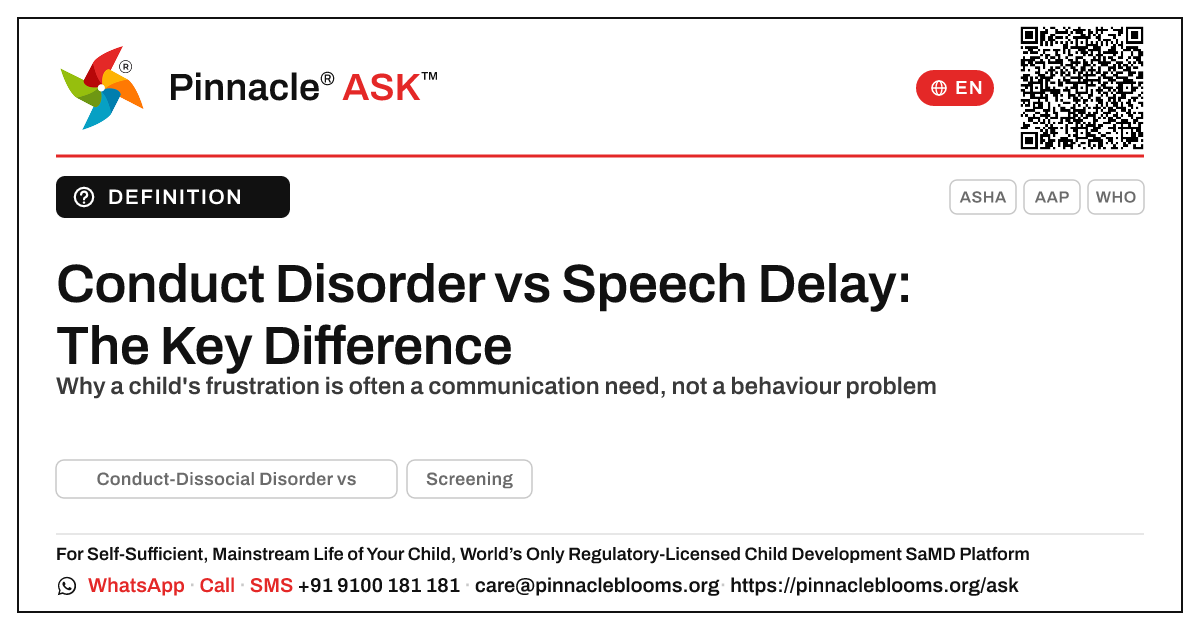
Conduct-Dissocial Disorder vs Speech and Language Delay
Speech and Language Delay means a child is behind in talking, understanding or being understood — the difficulty is with communication. Conduct-Dissocial Disorder describes a persistent pattern of behaviour that violates rules and others' rights, well beyond normal toddler tantrums. Importantly, a young child who cannot communicate often acts out from frustration, so apparent 'bad behaviour' is frequently an unmet communication need rather than a conduct disorder. The two can interact, which is why a careful clinician-led assessment matters before any conclusions.
In this answer 5 sections
One is about how a child behaves towards others; the other is about how a child communicates — and telling them apart matters enormously.
In short
Conduct-Dissocial Disorder and Speech and Language Delay are two very different things, even though both can show up as a frustrated, hard-to-reach young child. A speech and language delay means a child is behind in talking, understanding words, or being understood — the difficulty is with communication. Conduct-dissocial disorder describes a persistent pattern of behaviour that repeatedly violates rules and the rights of others — aggression, defiance, deceit or destructiveness well beyond ordinary toddler tantrums. Crucially, a young child who cannot get their needs across in words will often act out — so what looks like 'bad behaviour' is very frequently an unmet communication need, not a conduct disorder.
How they differ in everyday life
A child with a speech and language delay may have far fewer words than expected for their age, struggle to follow simple instructions, point or pull instead of asking, or become upset when others don't understand them. The root is communication — and when you give such a child better ways to express themselves, the frustration usually eases.
A pattern suggesting conduct difficulties looks different: repeated, intentional aggression or cruelty, deliberately breaking rules, taking others' things, or harming people or animals — a pattern that is persistent and out of step with the child's age, not a one-off bad day. In very young children this label is used cautiously, because tantrums, testing limits and big feelings are a normal part of growing up.
The two also interact. A child who can't communicate may hit or scream out of pure frustration; that is a consequence of the delay, not a conduct disorder. This is exactly why a careful, professional look matters — the same outward behaviour can have very different roots.
When to seek a developmental check
If your young child is noticeably behind in words or understanding, or if challenging behaviour is frequent, intense, or affecting daily life and relationships, a developmental screening is the right next step. A clinician will look at communication, behaviour, hearing and emotional development together — never at one piece alone — so the real cause is understood before any conclusions are drawn.
The Pinnacle way
This is general information, not a diagnosis — a clinical AbilityScore® and any diagnosis are formed only at a Pinnacle Blooms Network centre, under qualified clinician care, never from an app or checklist. Our team observes how your child communicates, behaves and copes, then supports the genuine need — often through speech therapy when words are the missing piece, and behavioural therapy where behaviour needs gentle, structured support. Learn more about conduct-dissocial difficulties.
Trusted sources
The American Speech-Language-Hearing Association on early speech and language milestones; the American Academy of Pediatrics and HealthyChildren on children's behaviour and emotional development; the World Health Organization's ICD-11 framework for classifying these conditions.
Next step — Unsure whether it's words or behaviour at the root? Book a developmental screening, and let a Pinnacle clinician look at the whole picture and guide you with clarity.
CONNECT THE ANSWER TO YOUR CHILD’S DAY
Something to notice. Something to discuss.
What to notice
Watch whether challenging behaviour eases when your child has a better way to communicate — pointing, pictures or first words. Frustration that melts when understood points to a communication need; persistent, intentional aggression or rule-breaking across many settings is worth a professional look.
In everyday life
When your child melts down, pause and ask: 'Could they be trying to tell me something they don't have words for?' Offer a simple choice or a picture to point at — giving a child a way to be understood often calms the behaviour faster than any correction.
Bring your observations and questions to your child’s professional. Choose activities that suit your child’s comfort, abilities and agreed plan.
Bring your questions to a first visitQuestions families ask
Can a speech delay cause behaviour problems in my child?
Yes, very commonly. A young child who can't get their needs across in words often becomes frustrated and may scream, hit or melt down. This is a consequence of the communication delay, not a conduct disorder — and giving the child better ways to express themselves usually eases the behaviour.
Is my toddler's tantrum a sign of conduct disorder?
Almost certainly not. Tantrums, testing limits and big feelings are a normal part of early childhood. Conduct difficulties describe a persistent, intentional pattern of harming others or breaking rules that is well out of step with a child's age — and this label is used very cautiously in young children. If you're worried, a developmental screening can offer clarity.
How will a clinician tell the difference?
A clinician looks at communication, behaviour, hearing and emotional development together — never at one behaviour alone. This is why a structured, clinician-led assessment matters: the same outward behaviour can have very different roots, and understanding the real cause guides the right support.
FOLLOW THE SOURCE
References behind this answer.
- Source referenceASHA — speech and language development
- Source referenceHealthyChildren (AAP) — toddler behaviour and development
- Organisation website · further readingWHO ICD-11 classification
References are supplied with this answer. An organisation homepage offers further reading; it does not establish an independent review of this page.
Content attribution: SETU Consortium · Pinnacle Blooms Network.
PEOPLE, TOPICS & DEVELOPMENT
See the connections.
Browse the wider question collections connected with this answer’s audience, developmental area and stage.
FROM UNDERSTANDING TO PURPOSEFUL SUPPORT
One question. Your child’s whole life.
Your child’s self-sufficient, mainstream-included life is the purpose from the beginning. At Pinnacle, that purpose shapes what we understand, the goals we choose, the people we bring together, everyday practice and review.
Connect this question with the right support.
Explore how the relevant service contributes to everyday abilities, then speak with us about your child.
Make the next conversation useful.
Bring the situations you notice at home or school. We’ll explain a suitable service, centre and first visit, including availability and fees, before you decide.
How PinnacleAI® connects the journeyExplore the seven stages
- 1Understand abilities
A starting picture of your child’s capabilities.
- 2Choose meaningful goals
Readiness and a plan shaped around the child.
- 3Bring the right support together
Suitable therapies and people for those goals.
- 4Carry practice into everyday life
Guidance for family, home and school.
- 5Track and correct
Use observations to adjust the plan.
- 6Reassess and review
Decide what to continue, change or do next.
- 7Grow independence and participation
The child’s life gives each step its purpose.
Explore the whole PinnacleAI® system → · Participation at school and in the community →
PINNACLE’S EVIDENCE, OPEN TO YOU
Look at the evidence behind our work.
Read our research, inspect the original regulatory documents and check what each institutional measure means.
General information supports a conversation with an appropriately qualified professional. Advice, goals and support depend on the individual child.