
YOUR QUESTION. A CLEARER NEXT STEP.
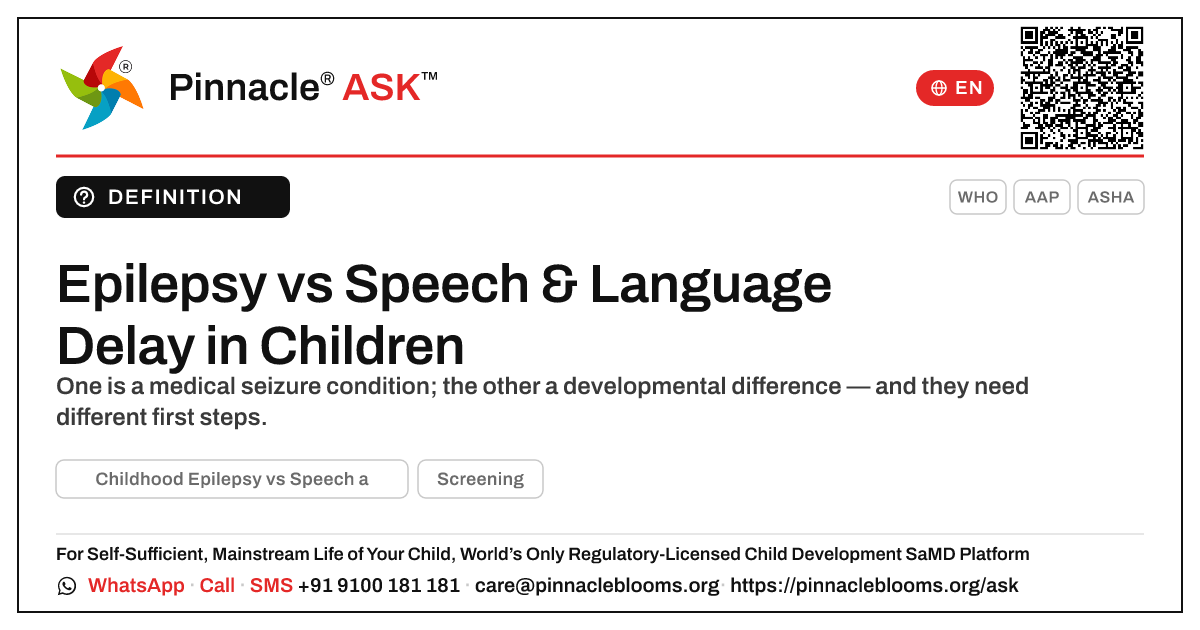
Childhood Epilepsy vs Speech and Language Delay
Childhood epilepsy is a medical brain condition causing repeated seizures — sudden episodes like staring, jerking or stiffening — that needs prompt medical attention from a doctor or paediatric neurologist. A speech and language delay is a developmental difference where a child is slower to understand or use words, supported through speech therapy. Epilepsy appears as sudden events and is diagnosed and treated medically; a speech delay unfolds gradually over time. The two are occasionally linked, so any seizure-like event should be seen by a doctor first.
In this answer 5 sections
One is a medical condition of the brain's electrical activity; the other is a developmental difference in how talking and understanding unfold — and telling them apart matters greatly.
In short
Childhood epilepsy is a medical condition where bursts of unusual electrical activity in the brain cause repeated seizures — which can look like staring spells, sudden jerks, stiffening, or moments of 'switching off'. A speech and language delay is a developmental difference: a child is slower than expected to understand words or to talk, but their brain is not having seizures. The simplest way to hold it: epilepsy is something a doctor diagnoses and treats medically; a speech and language delay is something a developmental therapist supports — and the two need very different first steps.
How they differ in everyday life
Childhood epilepsy shows up as events — sudden, often brief episodes that come and go. You might notice blank staring with no response, repetitive blinking or lip-smacking, sudden falls or jerks, stiffening, or a child who seems momentarily 'absent' and then carries on. These are not behaviour or stubbornness — they are neurological. Epilepsy needs prompt medical attention from a paediatrician or paediatric neurologist, who may arrange an EEG and start medical treatment. It is not a therapy-first situation.
A speech and language delay is steadier and shows up over time, not in sudden episodes. You might notice few or no words by the age peers are chatting, trouble following simple instructions, limited pointing or gesturing, or frustration when not understood. There are no staring spells or jerks — just a slower path to communication. This is supported through speech therapy and early developmental input.
The two can occasionally overlap — some children with epilepsy also have communication difficulties, and a small number of conditions affect both. That is exactly why any sudden change in a child's responsiveness or any seizure-like event deserves a doctor's eyes first, alongside developmental support.
When to act
If you ever see a possible seizure — staring with no response, repeated jerking, stiffening, or a sudden loss of awareness — treat it as urgent and see a doctor promptly; epilepsy is a medical referral, not a wait-and-watch. If instead your worry is that your child simply isn't talking or understanding as expected, a developmental and speech check is the right route. When in doubt, a clinician can tell the difference safely.
The Pinnacle way
This is general information, not a diagnosis — a clinical AbilityScore® and any diagnosis are formed only at a Pinnacle Blooms Network centre, under qualified clinician care, never from an app or form. If a seizure is suspected, our team will guide you straight to appropriate medical care first; for communication concerns we support children through speech therapy and structured developmental input. Learn more about childhood epilepsy and how it differs from developmental delays.
Trusted sources
The World Health Organization on epilepsy as a treatable neurological condition; the American Academy of Pediatrics and HealthyChildren on recognising seizures and on early speech and language milestones; the American Speech-Language-Hearing Association on communication development.
Next step — If you've seen anything that looks like a seizure, see a doctor promptly. If your worry is about talking and understanding, book a developmental and speech screening so a clinician can guide the right path.
CONNECT THE ANSWER TO YOUR CHILD’S DAY
Something to notice. Something to discuss.
What to notice
Sudden episodes — staring with no response, jerking, stiffening or momentary 'switching off' — point to a possible seizure and need prompt medical attention. A steady, gradual lag in talking or understanding words, without such episodes, points to a speech and language delay.
In everyday life
Keep a short note of anything unusual: if your child has odd 'absent' or jerking moments, jot down what you saw, how long it lasted and the time — a brief phone video, if safe, helps a doctor enormously. For talking worries, narrate daily routines out loud to bathe your child in everyday words.
Bring your observations and questions to your child’s professional. Choose activities that suit your child’s comfort, abilities and agreed plan.
Bring your questions to a first visitQuestions families ask
Can a speech delay be a sign of epilepsy?
Usually no — most speech and language delays are developmental and have nothing to do with seizures. However, a small number of conditions affect both, so if a child loses words they previously had, or has staring or jerking spells, see a doctor promptly so epilepsy can be checked.
Is epilepsy treated with speech therapy?
No. Epilepsy is a medical condition managed by a doctor or paediatric neurologist, often with an EEG and medication. Speech therapy supports communication, and can run alongside medical care if a child also has a speech delay, but it is never the first treatment for seizures.
How do I know if it's a seizure or just inattention?
Seizures tend to be sudden, brief and repeated, with no response during the episode and often a return to normal afterwards. Inattention can usually be interrupted by calling the child's name. If you're unsure, treat it as a medical question and see a doctor.
FOLLOW THE SOURCE
References behind this answer.
- Source referenceWHO — Epilepsy fact sheet
- Source referenceHealthyChildren (AAP) — Seizures and epilepsy in children
- Source referenceASHA — Speech and language development
References are supplied with this answer. An organisation homepage offers further reading; it does not establish an independent review of this page.
Content attribution: SETU Consortium · Pinnacle Blooms Network.
PEOPLE, TOPICS & DEVELOPMENT
See the connections.
Browse the wider question collections connected with this answer’s audience, developmental area and stage.
FROM UNDERSTANDING TO PURPOSEFUL SUPPORT
One question. Your child’s whole life.
Your child’s self-sufficient, mainstream-included life is the purpose from the beginning. At Pinnacle, that purpose shapes what we understand, the goals we choose, the people we bring together, everyday practice and review.
Connect this question with the right support.
Explore how the relevant service contributes to everyday abilities, then speak with us about your child.
Make the next conversation useful.
Bring the situations you notice at home or school. We’ll explain a suitable service, centre and first visit, including availability and fees, before you decide.
How PinnacleAI® connects the journeyExplore the seven stages
- 1Understand abilities
A starting picture of your child’s capabilities.
- 2Choose meaningful goals
Readiness and a plan shaped around the child.
- 3Bring the right support together
Suitable therapies and people for those goals.
- 4Carry practice into everyday life
Guidance for family, home and school.
- 5Track and correct
Use observations to adjust the plan.
- 6Reassess and review
Decide what to continue, change or do next.
- 7Grow independence and participation
The child’s life gives each step its purpose.
Explore the whole PinnacleAI® system → · Participation at school and in the community →
PINNACLE’S EVIDENCE, OPEN TO YOU
Look at the evidence behind our work.
Read our research, inspect the original regulatory documents and check what each institutional measure means.
General information supports a conversation with an appropriately qualified professional. Advice, goals and support depend on the individual child.