
YOUR QUESTION. A CLEARER NEXT STEP.
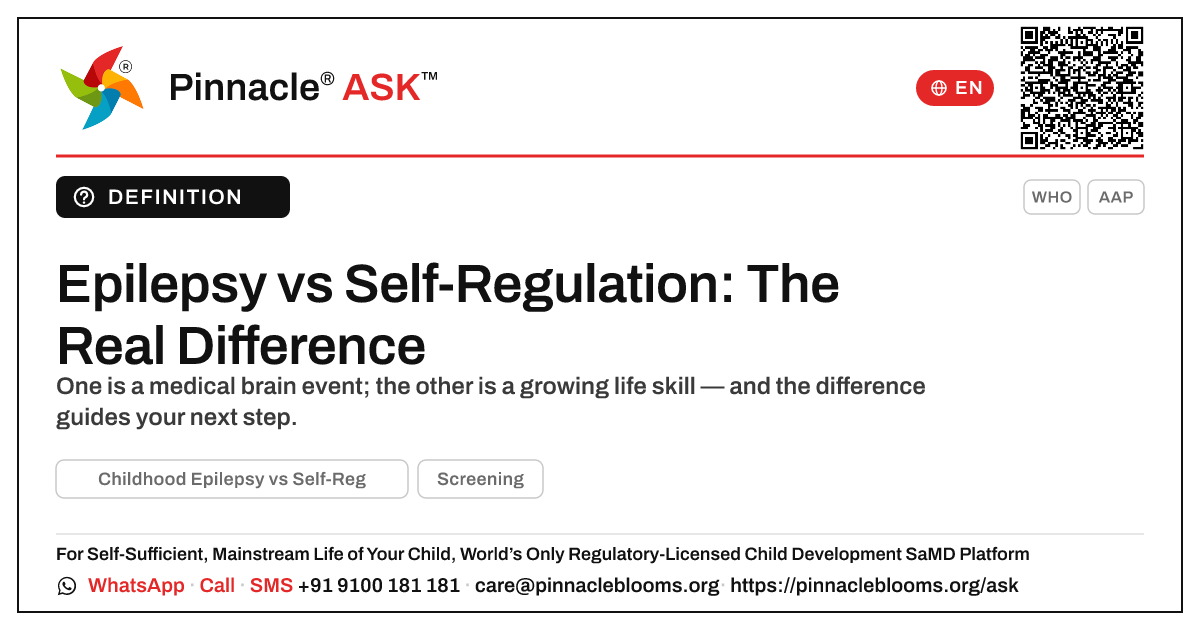
Childhood Epilepsy vs Self-Regulation Difficulties
Childhood epilepsy is a neurological condition of repeated, unprovoked seizures caused by abnormal brain electrical activity — a medical diagnosis needing prompt doctor-led care. Self-regulation difficulties are a developmental pattern where a young child struggles to manage feelings, impulses and calming, responding to supportive therapy and routine. Seizures are involuntary, often stereotyped, and the child can't be 'snapped out' of them; regulation struggles have triggers, the child stays responsive, and they ease with comfort. A staring spell is the key overlap to check medically.
In this answer 5 sections
One is a medical condition of the brain's electrical activity; the other is a developmental skill that's still growing — and telling them apart matters enormously.
In short
Childhood epilepsy is a neurological condition where the brain has repeated, unprovoked seizures caused by sudden bursts of abnormal electrical activity — it is a medical diagnosis that needs prompt doctor-led care. Self-regulation difficulties are a developmental and behavioural pattern, where a young child finds it hard to manage big feelings, impulses, attention or calming down — this is part of how regulation skills grow, and it responds to supportive therapy and routines. In short: epilepsy is a medical brain event; self-regulation difficulty is a developing life skill. They can look similar in a fleeting moment, but they are entirely different things.
How they differ — and why it matters
During a seizure, a child may stop and stare blankly (and not respond even when you call or touch them), have stiffening or rhythmic jerking, sudden falls, lip-smacking or fumbling movements, or a brief 'switching off' that they have no memory of afterwards. These events are involuntary, often stereotyped (they look the same each time), can happen during sleep, and the child cannot be 'snapped out' of them. Epilepsy is diagnosed by a doctor, often with an EEG.
With self-regulation difficulties, a child might have intense meltdowns, struggle to wait or share, find transitions hard, get easily overwhelmed by noise or change, or take a long time to calm down. Crucially, these are connected to a trigger (frustration, tiredness, an unmet need), the child is aware and responsive throughout, and the behaviour eases with comfort, routine and as skills mature.
A 'staring spell' is the classic overlap that worries parents — a daydreaming, distractible child can usually be brought back with a gentle touch or their name; an absence seizure cannot. When in doubt, this is always worth a medical look.
When to seek help
Any suspected seizure — staring that can't be interrupted, jerking, stiffening, unexplained falls, or 'absences' — needs prompt medical referral to a paediatrician or neurologist first, not therapy. If your child is healthy but struggles with emotions, impulses and calming, a developmental and behavioural assessment is the right path. The two can also coexist, which is why a careful clinical look matters.
The Pinnacle way
This is general information, not a diagnosis — a clinical AbilityScore® and any diagnosis are formed only at a Pinnacle Blooms Network centre, under qualified clinician care, never from an app or form. Where seizures are suspected, our team helps route your child to appropriate medical care first; where self-regulation is the picture, we support emotional and behavioural growth through behavioural therapy and structured routines. Learn more about childhood epilepsy.
Trusted sources
The World Health Organization on epilepsy as a neurological condition; the American Academy of Pediatrics and HealthyChildren on recognising seizures and on supporting children's emotional self-regulation.
Next step — If you've seen anything that looks like a seizure, see a doctor promptly. For emotional and behavioural support, book a developmental screening and let a Pinnacle clinician guide you.
CONNECT THE ANSWER TO YOUR CHILD’S DAY
Something to notice. Something to discuss.
What to notice
Staring that can't be interrupted by name or touch, stiffening or rhythmic jerking, sudden unexplained falls, lip-smacking or fumbling, or 'switching off' with no memory after — these suggest seizures and need a prompt doctor's review. Emotional meltdowns linked to triggers, where your child stays responsive and calms with comfort, point to self-regulation.
In everyday life
If your child has a 'staring' moment, gently say their name and touch their shoulder — a daydreaming child usually comes back; one who cannot be roused needs a doctor's review. For everyday upsets, name the feeling and model slow breathing together; calm grows with practice.
Bring your observations and questions to your child’s professional. Choose activities that suit your child’s comfort, abilities and agreed plan.
Bring your questions to a first visitQuestions families ask
How can I tell a staring seizure from daydreaming?
A daydreaming child can usually be brought back with their name or a gentle touch; an absence seizure cannot be interrupted and the child has no memory of it. If staring spells can't be interrupted, see a doctor promptly.
Can a child have both epilepsy and self-regulation difficulties?
Yes. The two can coexist, which is why a careful clinical look matters. Seizures need medical care first, and self-regulation can be supported through therapy and routines alongside.
Is self-regulation difficulty a disease?
No. It is a developmental skill that is still maturing. With supportive routines, behavioural therapy and patience, most young children's ability to manage feelings and impulses grows steadily over time.
Who should I see if I suspect a seizure?
See a paediatrician or neurologist promptly — suspected seizures are a medical matter, not therapy-first. Note what you saw, how long it lasted, and whether your child responded, to help the doctor.
FOLLOW THE SOURCE
References behind this answer.
- Source referenceWHO — Epilepsy fact sheet
- Source referenceHealthyChildren (AAP) — Seizures in children
- Organisation website · further readingAmerican Academy of Pediatrics — child development
References are supplied with this answer. An organisation homepage offers further reading; it does not establish an independent review of this page.
Content attribution: SETU Consortium · Pinnacle Blooms Network.
PEOPLE, TOPICS & DEVELOPMENT
See the connections.
Browse the wider question collections connected with this answer’s audience, developmental area and stage.
FROM UNDERSTANDING TO PURPOSEFUL SUPPORT
One question. Your child’s whole life.
Your child’s self-sufficient, mainstream-included life is the purpose from the beginning. At Pinnacle, that purpose shapes what we understand, the goals we choose, the people we bring together, everyday practice and review.
Connect this question with the right support.
Start with your child’s strengths, your observations and what you want everyday life to become.
Make the next conversation useful.
Bring the situations you notice at home or school. We’ll explain a suitable service, centre and first visit, including availability and fees, before you decide.
How PinnacleAI® connects the journeyExplore the seven stages
- 1Understand abilities
A starting picture of your child’s capabilities.
- 2Choose meaningful goals
Readiness and a plan shaped around the child.
- 3Bring the right support together
Suitable therapies and people for those goals.
- 4Carry practice into everyday life
Guidance for family, home and school.
- 5Track and correct
Use observations to adjust the plan.
- 6Reassess and review
Decide what to continue, change or do next.
- 7Grow independence and participation
The child’s life gives each step its purpose.
Explore the whole PinnacleAI® system → · Participation at school and in the community →
PINNACLE’S EVIDENCE, OPEN TO YOU
Look at the evidence behind our work.
Read our research, inspect the original regulatory documents and check what each institutional measure means.
General information supports a conversation with an appropriately qualified professional. Advice, goals and support depend on the individual child.