
YOUR QUESTION. A CLEARER NEXT STEP.
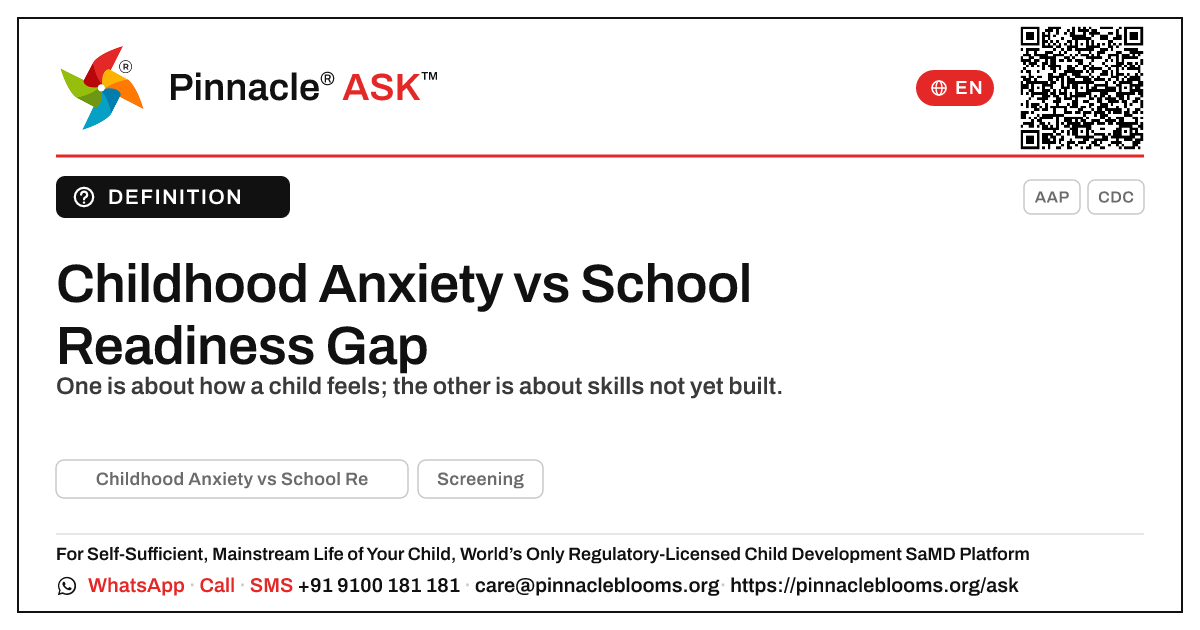
Childhood Anxiety vs School Readiness Gap: What's the Difference?
Childhood anxiety is an emotional pattern — a child feels worry, fear or overwhelm more often or intensely than expected, sometimes with tummy aches, clinginess or meltdowns, across many settings. A school readiness gap is different: the child is usually calm and willing but hasn't yet built classroom skills like listening, following instructions, fine-motor control, separating from a parent, or group play. Anxiety is about how a child feels; a readiness gap is about what a child has had the chance to learn. The two can overlap, which is why a whole-picture screening matters.
In this answer 5 sections
Both can make the school years feel hard — but one is about big feelings, and the other is about the skills a child has had the chance to build.
In short
Childhood anxiety is an emotional pattern — a child feels worried, fearful or overwhelmed more often or more intensely than the situation calls for, sometimes with tummy aches, clinginess, sleep trouble or meltdowns. A school readiness gap is different: it describes a child who simply hasn't yet built some of the skills that help them thrive in a classroom — like sitting and listening, following instructions, holding a pencil, separating from a parent, or playing alongside other children. In short: anxiety is about how a child feels; a readiness gap is about what a child has had the chance to learn so far.
How they show up differently
With childhood anxiety, the distress travels with the child. They may be capable at a task but freeze, refuse, cry or complain of headaches and stomach aches when faced with it — and the same worry can appear at home, at parties, at bedtime, not only at school. Reassurance helps for a moment, but the fear returns. The skill is often there; the feeling gets in the way.
With a school readiness gap, the child is usually calm and willing but genuinely hasn't mastered the building blocks yet — attention span, early language, fine-motor control, self-help skills like managing a bag or shoes, and playing in a group. Give them the right practice and these skills grow steadily. The feeling isn't the barrier; the skill simply needs time and teaching.
The two can overlap. A child who finds classroom tasks hard may grow anxious about school; an anxious child may miss the practice that builds readiness. That is exactly why a gentle, whole-picture look matters — so support targets the real root, not just the surface.
When to look closer
If worry, tears or physical complaints appear across many settings and don't ease with comfort, lean towards exploring anxiety. If your child is happy and settled but lagging behind peers in listening, language, drawing, or coping with classroom routines, lean towards a readiness check. Either way, a short developmental screening sorts one from the other kindly and clearly.
The Pinnacle way
This is general information, not a diagnosis — a clinical AbilityScore® and any diagnosis are formed only at a Pinnacle Blooms Network centre, under qualified clinician care, never from an app or form. Our team observes how your child feels, communicates and copes, then shapes the right support — emotional and behavioural help for childhood anxiety, and skill-building through behavioural therapy where readiness is the gap. Explore more across our services.
Trusted sources
The American Academy of Pediatrics and HealthyChildren on emotional development and school readiness in young children; the CDC's developmental milestones guidance on age-appropriate skills.
Next step — Unsure whether it's worry or readiness? Book a developmental screening and let a clinician gently tell the two apart and guide your next step.
CONNECT THE ANSWER TO YOUR CHILD’S DAY
Something to notice. Something to discuss.
What to notice
Worry, tears or tummy aches that follow your child across home, school and outings and don't ease with comfort point towards anxiety. A calm, willing child who lags peers in listening, language, drawing or classroom routines points towards a readiness gap. When both appear together, a screening helps sort the root.
In everyday life
Watch where the struggle shows up. If your child can do a task happily at home but freezes at school, the issue may be feelings, not skill. If the task is hard everywhere even when they're calm, practise it in tiny playful steps — and either way, share what you notice with a clinician.
Bring your observations and questions to your child’s professional. Choose activities that suit your child’s comfort, abilities and agreed plan.
Bring your questions to a first visitQuestions families ask
Can a child have both anxiety and a school readiness gap?
Yes. A child who finds classroom tasks hard may grow anxious about school, and an anxious child may miss the practice that builds readiness. They often feed into each other, which is why a whole-picture screening helps target the real root rather than just the surface.
How do I tell the difference at home?
Notice where the struggle appears. Anxiety usually travels with your child across settings and doesn't ease much with reassurance, even when the skill is there. A readiness gap shows up as a calm, willing child who simply hasn't built a skill yet — and who improves steadily with practice.
Will my child grow out of a school readiness gap?
Readiness skills grow with the right practice and teaching, and many children catch up beautifully with gentle support. A short developmental screening confirms which skills need attention and shows you and your child's teacher how to build them step by step.
FOLLOW THE SOURCE
References behind this answer.
- Organisation website · further readingAAP HealthyChildren — emotional development and school readiness
- Source referenceCDC — developmental milestones by age
References are supplied with this answer. An organisation homepage offers further reading; it does not establish an independent review of this page.
Content attribution: SETU Consortium · Pinnacle Blooms Network.
PEOPLE, TOPICS & DEVELOPMENT
See the connections.
Browse the wider question collections connected with this answer’s audience, developmental area and stage.
FROM UNDERSTANDING TO PURPOSEFUL SUPPORT
One question. Your child’s whole life.
Your child’s self-sufficient, mainstream-included life is the purpose from the beginning. At Pinnacle, that purpose shapes what we understand, the goals we choose, the people we bring together, everyday practice and review.
Connect this question with the right support.
Explore how the relevant service contributes to everyday abilities, then speak with us about your child.
Make the next conversation useful.
Bring the situations you notice at home or school. We’ll explain a suitable service, centre and first visit, including availability and fees, before you decide.
How PinnacleAI® connects the journeyExplore the seven stages
- 1Understand abilities
A starting picture of your child’s capabilities.
- 2Choose meaningful goals
Readiness and a plan shaped around the child.
- 3Bring the right support together
Suitable therapies and people for those goals.
- 4Carry practice into everyday life
Guidance for family, home and school.
- 5Track and correct
Use observations to adjust the plan.
- 6Reassess and review
Decide what to continue, change or do next.
- 7Grow independence and participation
The child’s life gives each step its purpose.
Explore the whole PinnacleAI® system → · Participation at school and in the community →
PINNACLE’S EVIDENCE, OPEN TO YOU
Look at the evidence behind our work.
Read our research, inspect the original regulatory documents and check what each institutional measure means.
General information supports a conversation with an appropriately qualified professional. Advice, goals and support depend on the individual child.