
YOUR QUESTION. A CLEARER NEXT STEP.
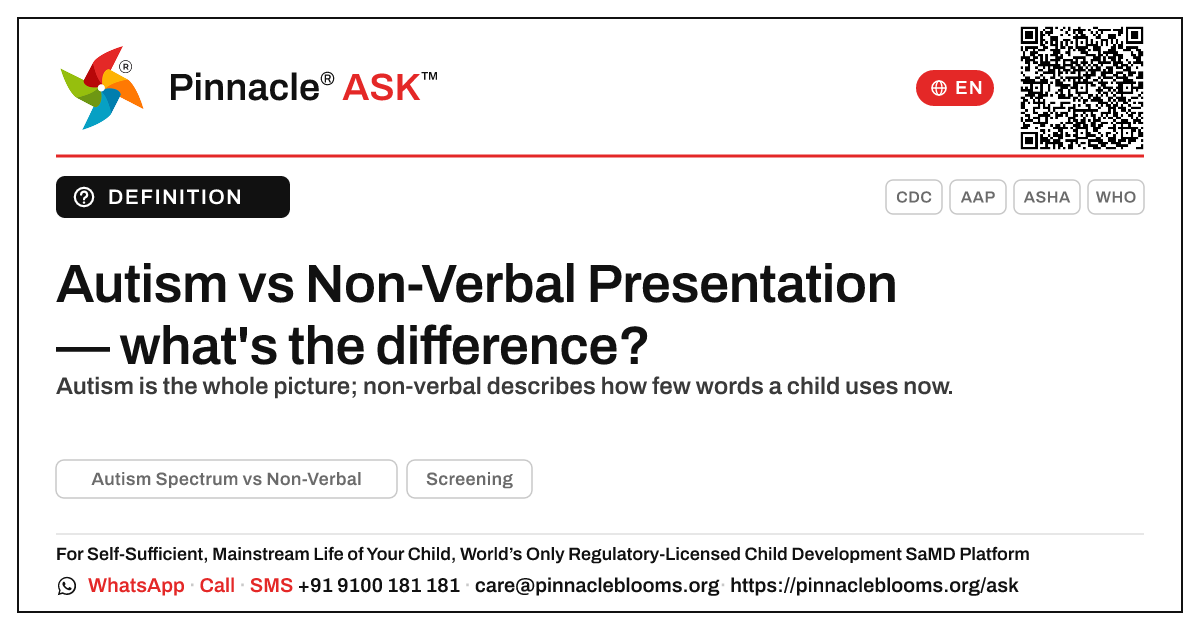
Autism Spectrum vs Non-Verbal / Minimally Verbal: the difference
Autism Spectrum is a neurodevelopmental difference in how a child communicates, relates and experiences the world. Non-verbal or minimally verbal is not a separate condition — it simply describes how few spoken words a child is using right now, which can have several causes including autism, hearing differences, speech-motor difficulties or developmental delay. Being non-verbal does not automatically mean autism, and many autistic children are highly verbal. Communication and speech are different — a quiet child often has a great deal to say.
In this answer 5 sections
One is a way a child experiences and connects with the world; the other simply describes how much a child is speaking right now — and the two are easy to confuse.
In short
Autism Spectrum is a neurodevelopmental difference in how a child communicates, relates and experiences the world — it shows up across social connection, communication, sensory responses and patterns of interest. Non-verbal / minimally verbal presentation is not a separate condition at all — it is a description of how much spoken language a child is using right now (few or no words). A child can be non-verbal for many reasons, and being non-verbal does not automatically mean autism — just as many autistic children are highly verbal. In short: autism is the bigger picture; non-verbal/minimally verbal is one possible feature within it, or on its own.
How they differ in everyday life
Autism Spectrum is about a whole pattern, not a single trait. You might notice differences in eye contact and back-and-forth play, strong focused interests, a love of routine, big reactions to sounds, textures or lights, and communication that may be spoken, gestured, or expressed in other ways. Crucially, autistic children vary enormously — that is why it is called a spectrum.
Non-verbal or minimally verbal simply means a child is using very few or no spoken words at the age you would usually expect them. This can happen for several reasons — a child may be autistic, may have a hearing difference, a speech-motor difficulty (like apraxia), a global developmental delay, or may be a 'late talker' who simply needs time and support. Many minimally verbal children understand far more than they can say, and communicate richly through gestures, pictures, signs or devices.
The key point for parents: not speaking is not the same as having nothing to say. Communication and speech are different things — a child can be a wonderful communicator while still being minimally verbal.
When to seek a look
If your child is not using single words by around 16 months, no two-word phrases by 24 months, has lost words or skills at any age, rarely responds to their name, or seldom shares attention through pointing and showing, it is worth a gentle developmental check. This is about opening doors early — the earlier we understand why a child is quiet, the sooner the right support begins.
The Pinnacle way
This is general information, not a diagnosis — a clinical AbilityScore® and any diagnosis are formed only at a Pinnacle Blooms Network centre, under qualified clinician care, never from an app or a checklist. Our clinicians look at the whole child — how they connect, understand and express themselves — to tell apart autism, a speech-language difference, or both, and then build the right plan. For children using few words, this often blends speech therapy with autism-informed support across our autism services.
Trusted sources
The CDC's developmental milestones and the American Academy of Pediatrics (HealthyChildren) on early communication; the American Speech-Language-Hearing Association on minimally verbal communication and augmentative supports; the World Health Organization on autism spectrum.
Next step — Worried your little one is quiet, or unsure whether it's autism or a speech delay? Book a developmental screening and let a clinician understand the whole picture with you.
CONNECT THE ANSWER TO YOUR CHILD’S DAY
Something to notice. Something to discuss.
What to notice
A child who uses very few or no words by 16-24 months, has lost words or skills, rarely responds to their name, or seldom points and shows things to share interest. Being quiet can have many causes — a developmental check helps find the right one.
In everyday life
Honour every attempt to communicate — a gesture, a glance, a point, a sound. Respond as if your child has spoken: name what they want out loud ('you want the ball!') and pause for their reply. This builds communication whether or not the words come yet.
Bring your observations and questions to your child’s professional. Choose activities that suit your child’s comfort, abilities and agreed plan.
Bring your questions to a first visitQuestions families ask
Does being non-verbal mean my child is autistic?
Not necessarily. Non-verbal or minimally verbal simply means a child is using very few or no spoken words. This can happen for many reasons — a hearing difference, a speech-motor difficulty, a global developmental delay, being a late talker, or autism. Only a qualified clinician can understand the full picture after a proper developmental look.
Can an autistic child speak normally?
Yes. Autism is a spectrum, and many autistic children are highly verbal with rich vocabularies. Autism is about how a child communicates, connects and experiences the world overall — not simply about whether or how much they speak.
My child understands everything but doesn't talk. Should I worry?
Understanding far more than you can say is common and reassuring — it shows strong comprehension. But a persistent gap between understanding and speaking is worth a gentle developmental check, so a clinician can find the reason and start the right support early.
At what age should I seek help if my child isn't talking?
It's worth a look if there are no single words by around 16 months, no two-word phrases by 24 months, or if a child loses words or skills at any age. Early support opens doors, so there is no harm in checking sooner rather than later.
FOLLOW THE SOURCE
References behind this answer.
- Source referenceCDC — Developmental milestones
- Source referenceAAP HealthyChildren — Early language development
- Source referenceASHA — Minimally verbal communication
- Source referenceWHO — Autism spectrum
References are supplied with this answer. An organisation homepage offers further reading; it does not establish an independent review of this page.
Content attribution: SETU Consortium · Pinnacle Blooms Network.
PEOPLE, TOPICS & DEVELOPMENT
See the connections.
Browse the wider question collections connected with this answer’s audience, developmental area and stage.
FROM UNDERSTANDING TO PURPOSEFUL SUPPORT
One question. Your child’s whole life.
Your child’s self-sufficient, mainstream-included life is the purpose from the beginning. At Pinnacle, that purpose shapes what we understand, the goals we choose, the people we bring together, everyday practice and review.
Connect this question with the right support.
Explore how the relevant service contributes to everyday abilities, then speak with us about your child.
Make the next conversation useful.
Bring the situations you notice at home or school. We’ll explain a suitable service, centre and first visit, including availability and fees, before you decide.
How PinnacleAI® connects the journeyExplore the seven stages
- 1Understand abilities
A starting picture of your child’s capabilities.
- 2Choose meaningful goals
Readiness and a plan shaped around the child.
- 3Bring the right support together
Suitable therapies and people for those goals.
- 4Carry practice into everyday life
Guidance for family, home and school.
- 5Track and correct
Use observations to adjust the plan.
- 6Reassess and review
Decide what to continue, change or do next.
- 7Grow independence and participation
The child’s life gives each step its purpose.
Explore the whole PinnacleAI® system → · Participation at school and in the community →
PINNACLE’S EVIDENCE, OPEN TO YOU
Look at the evidence behind our work.
Read our research, inspect the original regulatory documents and check what each institutional measure means.
General information supports a conversation with an appropriately qualified professional. Advice, goals and support depend on the individual child.