
YOUR QUESTION. A CLEARER NEXT STEP.
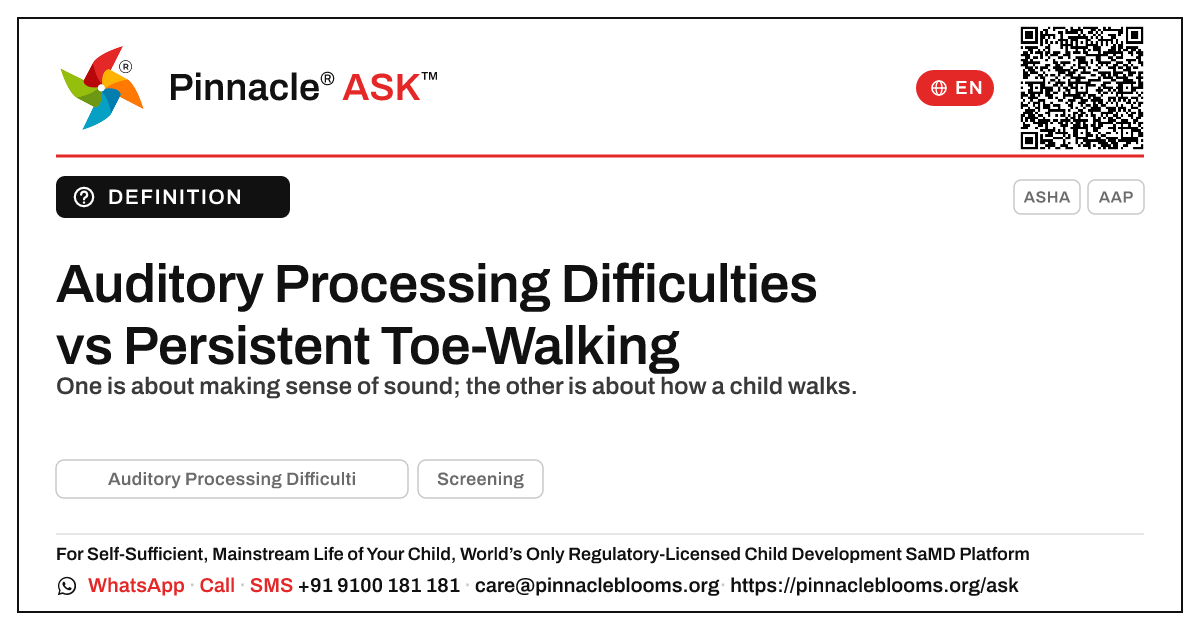
Auditory Processing Difficulties vs Persistent Toe-Walking
Auditory Processing Difficulties and Persistent Toe-Walking are completely different. Auditory Processing Difficulties describe a child who hears well but whose brain struggles to make sense of sound — following speech in noise, telling similar sounds apart. Persistent Toe-Walking is a movement pattern where a child keeps walking on the balls of their feet past the toddler stage. One is about understanding what is heard; the other is about how the body walks. They are noticed differently and supported through different therapy paths.
In this answer 5 sections
Two completely different things — one is about how the brain makes sense of sound, the other is about how a child walks — and they begin in entirely separate places.
In short
Auditory Processing Difficulties describe a child whose ears hear perfectly well, but whose brain finds it hard to make sense of sounds — especially telling similar sounds apart or following speech in a noisy room. Persistent Toe-Walking is a movement pattern where a child keeps walking on the balls of their feet, with heels off the ground, well beyond the toddler stage when most children settle into a flat-footed walk. In short: one is about understanding what is heard; the other is about how the feet and legs move when walking.
How they differ in everyday life
A child with Auditory Processing Difficulties usually passes a standard hearing test — the ears are fine. What you notice instead is a mismatch: they ask "what?" often, struggle to follow instructions in a busy classroom or noisy home, mishear similar-sounding words, or seem to 'tune out' when there is background noise. They may be slower to respond to spoken language even though they clearly want to engage. This becomes clearer in the preschool and early-school years, when more listening and following of instructions is expected.
A child with Persistent Toe-Walking is identified by how they move, not how they listen. Many toddlers toe-walk for a short phase as they learn to walk; it becomes worth a look when it carries on past around two years, happens most of the time, or comes with tight calf muscles or difficulty standing flat. Sometimes it is simply a habit; sometimes it is linked to tight tendons, sensory preferences or other developmental factors — which is why a clinician looks at the whole picture rather than the feet alone.
The key contrast: Auditory Processing Difficulties live in how the brain interprets sound; Persistent Toe-Walking lives in how the body moves when walking. They are noticed in very different ways and supported by very different paths.
When to seek a look
If your child frequently mishears, struggles to follow spoken instructions in noise, or seems to 'switch off' when listening — yet hears soft sounds fine — a developmental and hearing-related check is worth arranging. If your child is still walking on their toes most of the time past about two years, or you notice tight calves or stiffness, a gentle clinical look is sensible — not a cause for alarm, but a reason to understand why.
The Pinnacle way
This is general information, not a diagnosis — a clinical AbilityScore® and any diagnosis are formed only at a Pinnacle Blooms Network centre, under qualified clinician care, never from an app or form. Our team looks at how your child listens, moves and learns, then shapes the right support — drawing on occupational therapy for toe-walking, sensory and movement needs, and speech therapy where listening and language are part of the picture. Learn more on auditory processing difficulties.
Trusted sources
The American Speech-Language-Hearing Association on auditory processing and how children make sense of sound; the American Academy of Pediatrics and HealthyChildren on walking milestones and toe-walking in young children.
Next step — Unsure which path fits what you're seeing? Book a developmental screening and let a clinician gently map your child's strengths and needs.
CONNECT THE ANSWER TO YOUR CHILD’S DAY
Something to notice. Something to discuss.
What to notice
For listening: frequent 'what?', trouble following instructions in noise, mishearing similar words, 'tuning out' when there's background sound — yet hearing soft sounds fine. For movement: walking on the balls of the feet most of the time past about two years, tight calves, or difficulty standing flat-footed.
In everyday life
When giving an instruction, get down to your child's level, reduce background noise, and use short, clear steps — this helps a child who finds listening hard. For walking, gentle barefoot play on different surfaces encourages heels-down movement; if toe-walking persists, mention it at your next developmental check.
Bring your observations and questions to your child’s professional. Choose activities that suit your child’s comfort, abilities and agreed plan.
Bring your questions to a first visitQuestions families ask
Can a child have both auditory processing difficulties and toe-walking?
Yes — they are unrelated in origin, but a child can have both. Because both can sit alongside wider developmental patterns, a clinician looks at the whole picture rather than each in isolation.
Does toe-walking mean something is wrong?
Not necessarily. Many toddlers toe-walk for a short phase while learning to walk. It becomes worth a gentle clinical look when it persists past about two years, happens most of the time, or comes with tight calves or stiffness.
My child hears fine but doesn't follow instructions — is that an auditory processing difficulty?
It can be one possibility. A child with auditory processing difficulties hears soft sounds normally but struggles to make sense of speech, especially in noise. A developmental and hearing-related check helps understand what's behind it.
FOLLOW THE SOURCE
References behind this answer.
- Source referenceASHA — understanding auditory processing in children
- Source referenceHealthyChildren (AAP) — toddler milestones and walking
References are supplied with this answer. An organisation homepage offers further reading; it does not establish an independent review of this page.
Content attribution: SETU Consortium · Pinnacle Blooms Network.
PEOPLE, TOPICS & DEVELOPMENT
See the connections.
Browse the wider question collections connected with this answer’s audience, developmental area and stage.
FROM UNDERSTANDING TO PURPOSEFUL SUPPORT
One question. Your child’s whole life.
Your child’s self-sufficient, mainstream-included life is the purpose from the beginning. At Pinnacle, that purpose shapes what we understand, the goals we choose, the people we bring together, everyday practice and review.
Connect this question with the right support.
Start with your child’s strengths, your observations and what you want everyday life to become.
Make the next conversation useful.
Bring the situations you notice at home or school. We’ll explain a suitable service, centre and first visit, including availability and fees, before you decide.
How PinnacleAI® connects the journeyExplore the seven stages
- 1Understand abilities
A starting picture of your child’s capabilities.
- 2Choose meaningful goals
Readiness and a plan shaped around the child.
- 3Bring the right support together
Suitable therapies and people for those goals.
- 4Carry practice into everyday life
Guidance for family, home and school.
- 5Track and correct
Use observations to adjust the plan.
- 6Reassess and review
Decide what to continue, change or do next.
- 7Grow independence and participation
The child’s life gives each step its purpose.
Explore the whole PinnacleAI® system → · Participation at school and in the community →
PINNACLE’S EVIDENCE, OPEN TO YOU
Look at the evidence behind our work.
Read our research, inspect the original regulatory documents and check what each institutional measure means.
General information supports a conversation with an appropriately qualified professional. Advice, goals and support depend on the individual child.