
YOUR QUESTION. A CLEARER NEXT STEP.
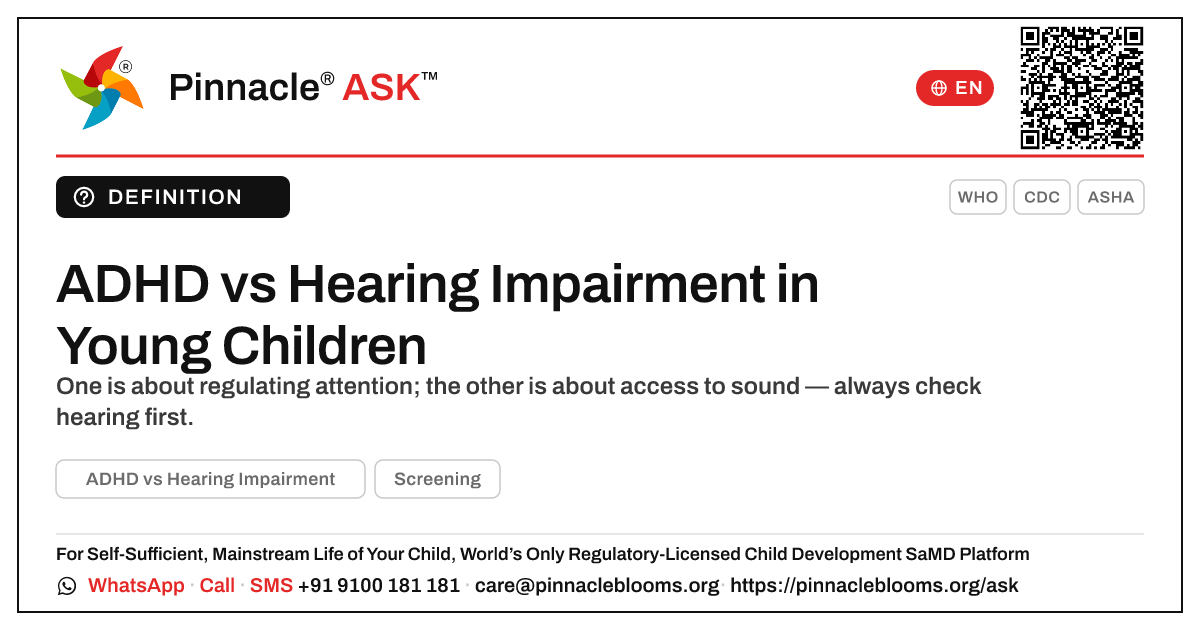
ADHD vs Hearing Impairment in Young Children
ADHD and hearing impairment can look alike in young children — both may seem not to listen or have delayed speech — but they are very different. ADHD is about regulating attention, activity and impulses while hearing works normally; hearing impairment is about reduced access to sound while the wish to attend is intact. Because the signs overlap, hearing should always be checked first before attention is considered.
In this answer 4 sections
Two very different reasons a young child may seem 'not to listen' — one is about attention, the other about access to sound.
In short
ADHD (attention-deficit/hyperarousal-type challenges) is about how a child regulates attention, activity and impulse — the hearing pathway works, but staying focused does not. Hearing impairment is about access to sound — the child may want to attend, but the words simply do not arrive clearly. Both can look similar at first (a child who does not respond when called, seems distracted, or has delayed speech), which is exactly why a hearing check comes first before anyone thinks about attention.
How they differ in everyday life
A child with hearing impairment often responds inconsistently depending on background noise, watches faces and lips closely, turns one ear towards sound, has speech that is delayed or unclear, or startles less to loud sounds. Crucially, they usually do settle and attend well to things they can see or that catch their interest.
A child with ADHD patterns typically hears perfectly but finds it hard to stay with any task — moving on quickly, fidgeting, acting before thinking, and being distracted across all settings, quiet or noisy alike. The difficulty is in regulation, not reception.
Because the early signs overlap, the golden rule is simple: always rule out hearing first. An undetected hearing loss can be mistaken for inattention for years.
The Pinnacle way
This is general information, not a diagnosis — a clinical AbilityScore® and any diagnosis are formed only at a Pinnacle Blooms Network centre, under qualified clinician care, never from an app or form. We begin by confirming how your child hears, then map attention, language and play together through ADHD support and speech therapy as needed.
Trusted sources
WHO and CDC guidance on childhood hearing and developmental milestones; the American Academy of Pediatrics and ASHA on attention, listening and early speech-language development.
Next step — If your child often seems not to listen, start with a developmental review so hearing is checked first and the right support follows.
CONNECT THE ANSWER TO YOUR CHILD’S DAY
Something to notice. Something to discuss.
What to notice
Inconsistent responses to sound that change with background noise, watching faces and lips closely, or unclear speech suggest hearing; constant distraction, fidgeting and acting before thinking across all settings — quiet or noisy — suggest attention difficulties.
In everyday life
Notice when your child responds: if they attend well to things they can see but miss spoken words, especially in noise, ask for a hearing check before assuming inattention.
Bring your observations and questions to your child’s professional. Choose activities that suit your child’s comfort, abilities and agreed plan.
Bring your questions to a first visitQuestions families ask
Can hearing loss be mistaken for ADHD?
Yes. A child who does not respond when called or seems distracted may have an undetected hearing loss rather than an attention difficulty. This is why a hearing check should always come first.
Can a child have both ADHD and hearing impairment?
Yes, the two can occur together. A thorough review looks at hearing, attention, language and play as a whole picture rather than assuming a single cause.
How can I tell which one my child might have?
A simple clue: children with hearing difficulties usually attend well to things they can see and respond differently in quiet versus noisy rooms, while children with attention difficulties find focus hard everywhere. A clinician confirms this properly.
FOLLOW THE SOURCE
References behind this answer.
- Source referenceWHO: Deafness and hearing loss
- Source referenceCDC: Hearing loss in children
- Source referenceASHA: Hearing in children
References are supplied with this answer. An organisation homepage offers further reading; it does not establish an independent review of this page.
Content attribution: SETU Consortium · Pinnacle Blooms Network.
PEOPLE, TOPICS & DEVELOPMENT
See the connections.
Browse the wider question collections connected with this answer’s audience, developmental area and stage.
FROM UNDERSTANDING TO PURPOSEFUL SUPPORT
One question. Your child’s whole life.
Your child’s self-sufficient, mainstream-included life is the purpose from the beginning. At Pinnacle, that purpose shapes what we understand, the goals we choose, the people we bring together, everyday practice and review.
Connect this question with the right support.
Start with your child’s strengths, your observations and what you want everyday life to become.
Make the next conversation useful.
Bring the situations you notice at home or school. We’ll explain a suitable service, centre and first visit, including availability and fees, before you decide.
How PinnacleAI® connects the journeyExplore the seven stages
- 1Understand abilities
A starting picture of your child’s capabilities.
- 2Choose meaningful goals
Readiness and a plan shaped around the child.
- 3Bring the right support together
Suitable therapies and people for those goals.
- 4Carry practice into everyday life
Guidance for family, home and school.
- 5Track and correct
Use observations to adjust the plan.
- 6Reassess and review
Decide what to continue, change or do next.
- 7Grow independence and participation
The child’s life gives each step its purpose.
Explore the whole PinnacleAI® system → · Participation at school and in the community →
PINNACLE’S EVIDENCE, OPEN TO YOU
Look at the evidence behind our work.
Read our research, inspect the original regulatory documents and check what each institutional measure means.
General information supports a conversation with an appropriately qualified professional. Advice, goals and support depend on the individual child.