
YOUR QUESTION. A CLEARER NEXT STEP.
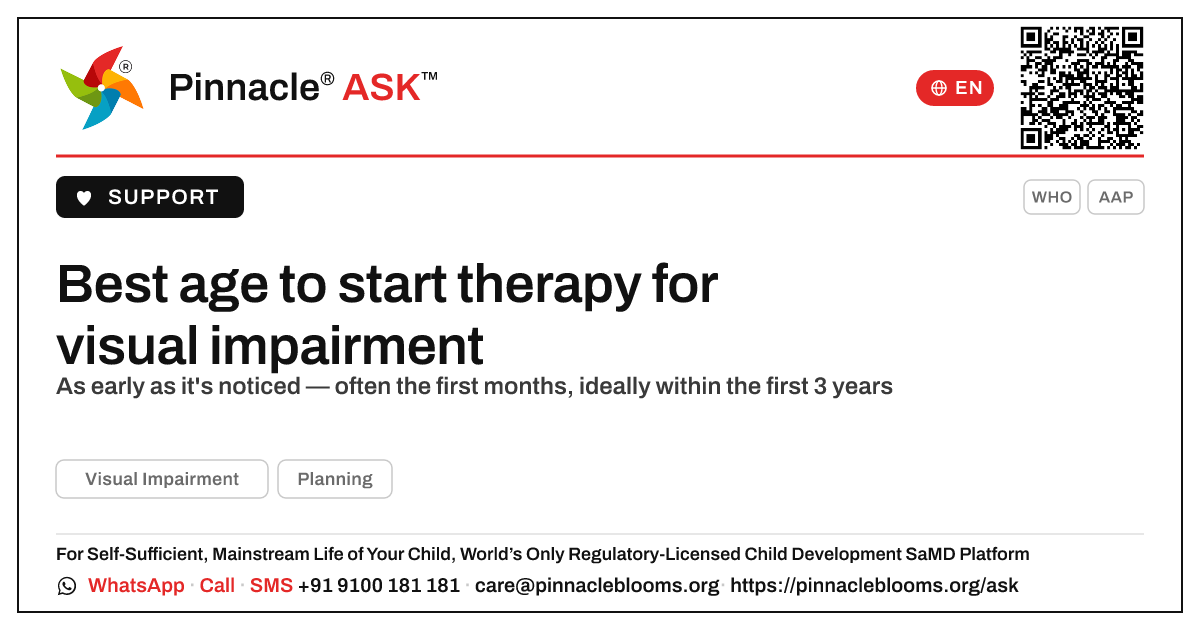
Best age to start therapy for visual impairment
Support for visual impairment is best started as early as it is noticed — often in the first weeks or months of life and ideally within the first three years, when the brain is most adaptable. You do not need a full diagnosis to begin; early support helps a child use any vision they have while building the other senses, movement and communication, alongside paediatric eye-specialist care. AbilityScore® is part of Pinnacle’s developmental assessment. Diagnosis, where needed, requires an appropriately qualified healthcare professional.
In this answer 5 sections
The moment you notice your baby isn't quite looking, following or reaching the way you expected, that is the moment support can begin — and the earlier it starts, the more a child's whole world opens up.
In short
The best time to start support for visual impairment is as early as it is noticed — often in the first weeks or months of life, and ideally within the first three years when the brain's visual and learning pathways are most adaptable. You do not need a complete diagnosis to begin: gentle early intervention can start the moment a concern is raised, alongside the eye-specialist care your child needs. Early support helps a child use whatever vision they have, while building the other senses, movement and communication that grow alongside it.
Why early matters so much
A baby's brain builds its sensory and movement "wiring" fastest in the first two to three years. When vision is reduced or absent, early support helps in two powerful ways:
- Maximising functional vision — many children with visual impairment have some usable vision. Early stimulation with high-contrast, light and movement helps the brain learn to use it.
- Building the other pathways — touch, sound, movement and spatial awareness become a child's map of the world. Early work on these supports reaching, crawling, exploring, communication and confidence.
In practice this means:
- Prompt eye-specialist (paediatric ophthalmology) care first — to identify any treatable cause and confirm the nature of the visual impairment.
- Early developmental and vision-support therapy — occupational therapy and developmental support to encourage exploration, play, movement and self-help skills using non-visual and low-vision strategies.
- Speech and communication support where language or interaction needs a boost, since babies often learn language partly by following gaze and gesture.
- Parent coaching — simple ways to describe the world aloud, use sound and touch cues, and arrange a safe, explorable space at home.
When to seek a check
Seek a check promptly if your baby does not seem to fix on or follow your face or a light by around 2–3 months, has eyes that wander, jiggle or do not move together, shows a white or cloudy appearance in the pupil, is unusually unbothered by bright light or visual play, or is not reaching for objects they can hear. Any sudden change in the eyes or vision needs same-day medical review. Concerns about the eyes themselves always go first to a paediatric eye specialist; developmental support can run alongside.
The Pinnacle way
AbilityScore® is part of Pinnacle’s developmental assessment. Diagnosis, where needed, requires an appropriately qualified healthcare professional — never from an app or online form. From there your child receives a structured developmental profile and a plan built around their functional vision and every other strength, through our occupational and developmental therapy support. Learn how the AbilityScore® assessment works, and explore how Pinnacle supports children from the very first concern.
Trusted sources
World Health Organization guidance on childhood vision and the importance of early intervention; American Academy of Pediatrics (HealthyChildren.org) on infant vision development and eye-health checks; WHO Nurturing Care Framework on early childhood development and responsive support.
Next step — Noticed something about how your child sees? Book an early developmental assessment with a Pinnacle clinician — early support changes everything.
This is general information, not a diagnosis — individual assessment and diagnosis require an appropriately qualified healthcare professional.
CONNECT THE ANSWER TO YOUR CHILD’S DAY
Something to notice. Something to discuss.
What to notice
Watch if your baby does not fix on or follow your face or a light by 2–3 months, has eyes that wander, jiggle or don't move together, shows a white or cloudy pupil, seems unbothered by bright light, or does not reach for objects they can hear — and seek same-day review for any sudden change in the eyes.
In everyday life
Give your baby's other senses plenty to explore: describe what you're doing aloud, use sound and touch cues, and offer high-contrast (black-white-red) or gently lit toys close to them — and always announce yourself with your voice and a soft touch before lifting them.
Bring your observations and questions to your child’s professional. Choose activities that suit your child’s comfort, abilities and agreed plan.
Bring your questions to a first visitQuestions families ask
Is my child too young to start support for visual impairment?
No — support can begin in the first weeks or months of life. The earlier it starts, the more it helps your child's brain learn to use any vision they have and build the other senses, movement and communication. You do not need a complete diagnosis to begin gentle early support.
Do I have to wait for a full diagnosis before starting therapy?
No. Eye-specialist care to identify the cause should happen promptly, but early developmental and vision-support therapy can run alongside it. Early support focuses on helping your child explore, move, play and communicate, whatever the final diagnosis.
What kind of therapy helps a child with visual impairment?
Occupational and developmental therapy to encourage exploration, movement and self-help skills using touch, sound and any usable vision; speech and communication support where needed; and parent coaching for everyday strategies at home — always alongside paediatric eye-specialist care.
FOLLOW THE SOURCE
References behind this answer.
- Source referenceWHO — Blindness and vision impairment
- Source referenceAAP HealthyChildren.org — Children's eye health and vision
- Organisation website · further readingWHO Nurturing Care Framework — early childhood development
References are supplied with this answer. An organisation homepage offers further reading; it does not establish an independent review of this page.
Content attribution: SETU Consortium · Pinnacle Blooms Network.
PEOPLE, TOPICS & DEVELOPMENT
See the connections.
Browse the wider question collections connected with this answer’s audience, developmental area and stage.
FROM UNDERSTANDING TO PURPOSEFUL SUPPORT
One question. Your child’s whole life.
Your child’s self-sufficient, mainstream-included life is the purpose from the beginning. At Pinnacle, that purpose shapes what we understand, the goals we choose, the people we bring together, everyday practice and review.
Connect this question with the right support.
Start with your child’s strengths, your observations and what you want everyday life to become.
Make the next conversation useful.
Bring the situations you notice at home or school. We’ll explain a suitable service, centre and first visit, including availability and fees, before you decide.
How PinnacleAI® connects the journeyExplore the seven stages
- 1Understand abilities
A starting picture of your child’s capabilities.
- 2Choose meaningful goals
Readiness and a plan shaped around the child.
- 3Bring the right support together
Suitable therapies and people for those goals.
- 4Carry practice into everyday life
Guidance for family, home and school.
- 5Track and correct
Use observations to adjust the plan.
- 6Reassess and review
Decide what to continue, change or do next.
- 7Grow independence and participation
The child’s life gives each step its purpose.
Explore the whole PinnacleAI® system → · Participation at school and in the community →
PINNACLE’S EVIDENCE, OPEN TO YOU
Look at the evidence behind our work.
Read our research, inspect the original regulatory documents and check what each institutional measure means.
General information supports a conversation with an appropriately qualified professional. Advice, goals and support depend on the individual child.