
YOUR QUESTION. A CLEARER NEXT STEP.
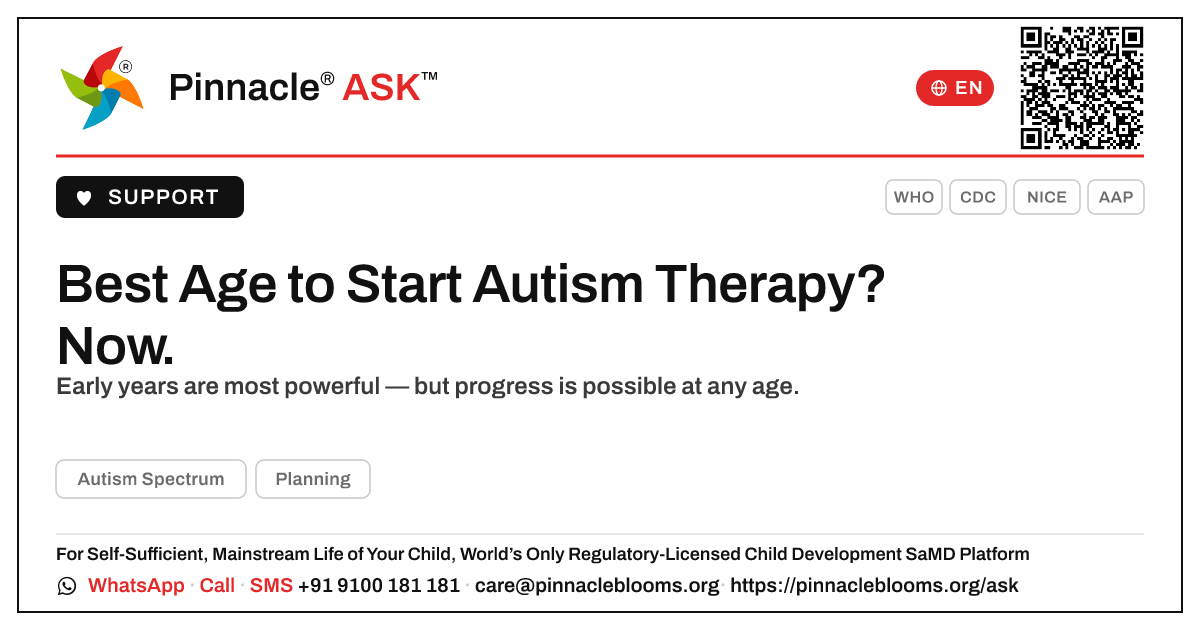
What is the best age to start therapy for autism spectrum?
The best age to start autism support is as early as concerns appear — you do not need a formal diagnosis to begin. The years between 18 months and 5 are most powerful because of neuroplasticity, but meaningful progress is possible at any age. AbilityScore® is part of Pinnacle’s developmental assessment. Diagnosis, where needed, requires an appropriately qualified healthcare professional.
In this answer 5 sections
The honest answer brings relief: the best time to start is now — at whatever age your child is today, support helps.
In short
The best age to start support for autism is as early as concerns appear — you do not need to wait for a formal diagnosis to begin. The early years, especially between 18 months and 5 years, are when a child's brain is most adaptable, so early, play-based therapy tends to bring the strongest gains. But if your child is older, please do not lose heart: the brain keeps learning and growing throughout childhood, so meaningful progress is possible at any age.
Why earlier helps — and why later still works
In the first five years, a child's brain forms connections at a remarkable pace — this is what scientists call neuroplasticity. Starting support during this window means therapy can gently shape communication, play, social connection and daily skills while those pathways are most flexible.
- If you have a concern now — at 18 months, 2 years, 3 years — begin a developmental check straight away. Early support can start even while assessment is underway; you never have to "wait and see".
- There is no minimum readiness — therapy for very young children looks like play, songs, routines and parent coaching, not clinical drills.
- Older children gain too — a 6, 8 or 10-year-old who starts now still makes real progress. The most important factor is starting, consistency, and a plan matched to your child.
- Parents are central — the strategies you use at home, every day, often matter more than hours in a therapy room.
So the truthful answer is: the best age is your child's age today.
When to seek a check
Book a developmental check if your child shows limited eye contact or response to their name, delayed or unusual speech, little pretend play, strong reactions to sounds or textures, repetitive movements, or a loss of skills they once had. None of these confirm autism — they are simply reasons to look closer, sooner.
The Pinnacle way
AbilityScore® is part of Pinnacle’s developmental assessment. Diagnosis, where needed, requires an appropriately qualified healthcare professional — never from an app or online form. With 25 million+ therapy sessions and 4.95 lakh+ families served across 70+ centres, our team builds an early, child-led plan shaped to your child's profile. Learn how the AbilityScore® assessment works, explore our early intervention and speech therapy support, or start at our home page to find your nearest centre.
Trusted sources
WHO ICD-11 (6A02, Autism spectrum disorder); CDC "Learn the Signs. Act Early." developmental milestones; NICE guideline CG128 on autism recognition and diagnosis; American Academy of Pediatrics (HealthyChildren.org) early-intervention guidance.
Next step — The best time is now. Book an early developmental check with a Pinnacle clinician.
This is general information, not a diagnosis — individual assessment and diagnosis require an appropriately qualified healthcare professional.
CONNECT THE ANSWER TO YOUR CHILD’S DAY
Something to notice. Something to discuss.
What to notice
Watch for limited eye contact or response to name, delayed or unusual speech, little pretend play, strong reactions to sounds or textures, repetitive movements, or loss of previously gained skills — these are reasons to seek an earlier check, not a diagnosis.
In everyday life
You don't need to wait — start at home today by naming what your child looks at, following their lead in play, and turning daily routines into chances to connect and communicate.
Bring your observations and questions to your child’s professional. Choose activities that suit your child’s comfort, abilities and agreed plan.
Bring your questions to a first visitQuestions families ask
Is there a minimum age to start autism therapy?
No. Support for very young children looks like play, songs, routines and parent coaching, and can begin as soon as you have a concern — there is no minimum readiness age.
Do I have to wait for a diagnosis before starting?
No. Early support can begin even while assessment is underway. You never have to 'wait and see' if you are worried about your child's development.
My child is older — is it too late?
Not at all. The brain keeps learning and growing throughout childhood. Children of 6, 8 or 10 years still make real, meaningful progress with consistent, well-matched support.
Why are the early years considered so important?
In the first five years the brain forms connections at a remarkable pace (neuroplasticity), so therapy can shape communication, play and daily skills while those pathways are most flexible.
FOLLOW THE SOURCE
References behind this answer.
- Source referenceWHO ICD-11 6A02 · Autism spectrum disorder
- Source referenceCDC — Learn the Signs. Act Early.
- Source referenceNICE CG128 — Autism recognition & diagnosis
- Organisation website · further readingAmerican Academy of Pediatrics (HealthyChildren.org)
References are supplied with this answer. An organisation homepage offers further reading; it does not establish an independent review of this page.
Content attribution: SETU Consortium · Pinnacle Blooms Network.
PEOPLE, TOPICS & DEVELOPMENT
See the connections.
Browse the wider question collections connected with this answer’s audience, developmental area and stage.
FROM UNDERSTANDING TO PURPOSEFUL SUPPORT
One question. Your child’s whole life.
Your child’s self-sufficient, mainstream-included life is the purpose from the beginning. At Pinnacle, that purpose shapes what we understand, the goals we choose, the people we bring together, everyday practice and review.
Connect this question with the right support.
Explore how the relevant service contributes to everyday abilities, then speak with us about your child.
Make the next conversation useful.
Bring the situations you notice at home or school. We’ll explain a suitable service, centre and first visit, including availability and fees, before you decide.
How PinnacleAI® connects the journeyExplore the seven stages
- 1Understand abilities
A starting picture of your child’s capabilities.
- 2Choose meaningful goals
Readiness and a plan shaped around the child.
- 3Bring the right support together
Suitable therapies and people for those goals.
- 4Carry practice into everyday life
Guidance for family, home and school.
- 5Track and correct
Use observations to adjust the plan.
- 6Reassess and review
Decide what to continue, change or do next.
- 7Grow independence and participation
The child’s life gives each step its purpose.
Explore the whole PinnacleAI® system → · Participation at school and in the community →
PINNACLE’S EVIDENCE, OPEN TO YOU
Look at the evidence behind our work.
Read our research, inspect the original regulatory documents and check what each institutional measure means.
General information supports a conversation with an appropriately qualified professional. Advice, goals and support depend on the individual child.