
YOUR QUESTION. A CLEARER NEXT STEP.
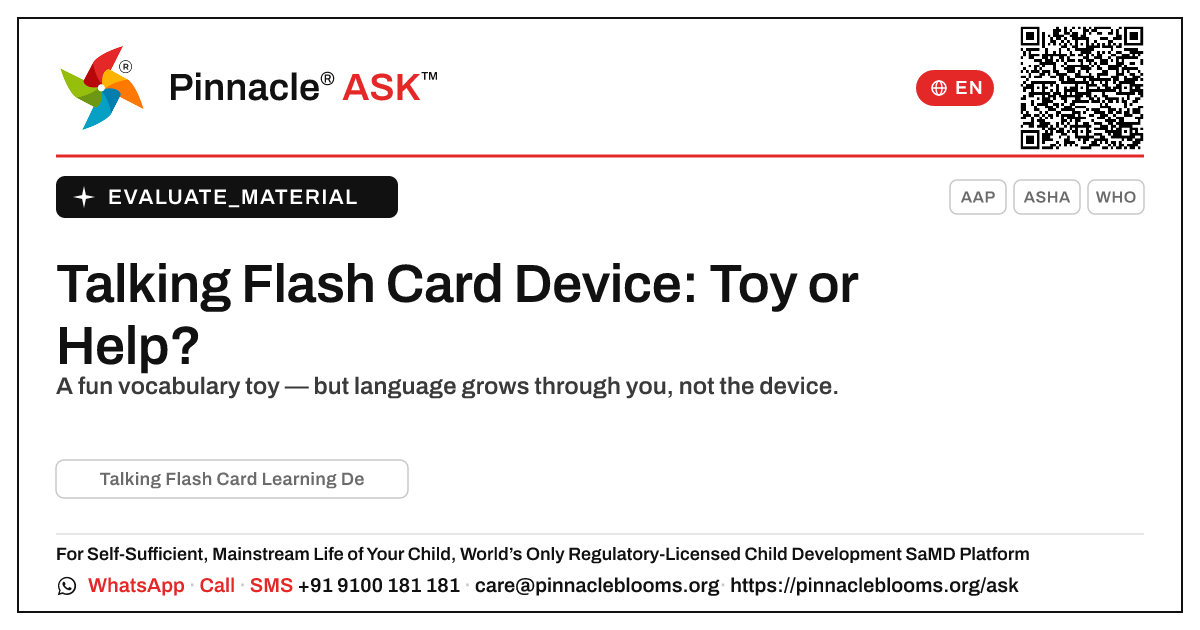
Talking Flash Card Learning Device (224 Words): is it right for my child?
A Talking Flash Card Learning Device (224 Words) is an electronic toy that speaks picture-card words aloud. It can add fun vocabulary play but is a toy, not a therapy — language grows through warm back-and-forth conversation, not a device alone. Use it with your child, never instead of you, and seek a professional check if you have communication concerns.
In this answer 5 sections
A glowing card lights up, says a word, and your little one's eyes go wide — but does that wonder actually build language?
In short
A Talking Flash Card Learning Device (224 Words) is an electronic early-learning toy: a set of picture cards that, when slotted into a reader, speaks the word aloud — typically across 224 everyday words like animals, fruits, colours and vehicles. It can be a fun, low-pressure way to share new vocabulary with a young child, but it is a toy, not a therapy — it works best as a small part of warm, back-and-forth play, never as a substitute for talking with your child or for professional support if you have concerns.
What it does well — and its limits
Where it helps
- Introduces and labels everyday words your child can see and hear together
- Gives repetition and clear pronunciation, which some children enjoy
- Can spark joint attention when you sit alongside and chat about each card
Where it falls short
- Real language grows through serve-and-return conversation — your child says or gestures, you respond. A device that only speaks at a child cannot do this.
- Screen-like or single-direction toys do not teach a child to use words to connect, request or share.
- It will not, on its own, close a genuine speech or communication delay.
The simple test: use it with your child, not instead of you. Name what you both see, wait for their sound or point, and respond warmly. That interaction — not the device — is what builds communication.
When to look beyond the toy
If your child isn't babbling or gesturing by around 12 months, has no single words by 16 months, no two-word phrases by 24 months, or has lost words they once used, a learning toy is not the answer — a developmental check is. Those are signs to seek a professional view rather than buy another product.
The Pinnacle way
A toy can support play, but it cannot tell you where your child stands. A clinical AbilityScore® — and any diagnosis — is formed only at a Pinnacle Blooms Network centre, by qualified clinicians, never from an app, a form or a flash-card reader. With 4.95 lakh+ families served across 70+ centres, our approach starts with understanding your child, then building a plan around real interaction. Explore speech therapy if communication is your concern, or learn how the AbilityScore is established.
Trusted sources
American Academy of Pediatrics guidance on media and early learning; ASHA guidance on how young children acquire speech and language through interaction; WHO Nurturing Care Framework on responsive caregiving.
Next step — Unsure whether your child's words are on track? Book a developmental assessment with a Pinnacle clinician.
This is general information, not a diagnosis — individual assessment and diagnosis require an appropriately qualified healthcare professional.
CONNECT THE ANSWER TO YOUR CHILD’S DAY
Something to notice. Something to discuss.
What to notice
Watch whether your child uses words to connect with you — pointing, asking, sharing — not just repeating after the device. By around 12 months expect babble and gestures, single words by 16 months, and two-word phrases by 24 months.
In everyday life
Sit beside your child with the cards, name what you both see, then pause and wait for their sound, point or word before responding warmly. That back-and-forth does more than any button.
Bring your observations and questions to your child’s professional. Choose activities that suit your child’s comfort, abilities and agreed plan.
Bring your questions to a first visitQuestions families ask
Can a talking flash card device teach my child to speak?
It can introduce and repeat words, which some children enjoy, but it cannot teach a child to use language to connect. Real speech grows through back-and-forth conversation, so use the device alongside your own talking, never as a replacement for it.
Is this device suitable for a child with a speech delay?
It may be a pleasant play extra, but it will not close a genuine speech or communication delay on its own. If you have concerns, a developmental check with a qualified clinician is the right step, not buying another learning product.
At what age can my child use a talking flash card?
There is no fixed age, but for toddlers the value comes entirely from how you share it. Sit together, name pictures, and wait for your child's response — the interaction matters far more than the device.
FOLLOW THE SOURCE
References behind this answer.
- Organisation website · further readingAAP HealthyChildren: media and early learning
- Organisation website · further readingASHA: how children learn speech and language
- Organisation website · further readingWHO Nurturing Care Framework: responsive caregiving
References are supplied with this answer. An organisation homepage offers further reading; it does not establish an independent review of this page.
Content attribution: SETU Consortium · Pinnacle Blooms Network.
PEOPLE, TOPICS & DEVELOPMENT
See the connections.
Browse the wider question collections connected with this answer’s audience, developmental area and stage.
FROM UNDERSTANDING TO PURPOSEFUL SUPPORT
One question. Your child’s whole life.
Your child’s self-sufficient, mainstream-included life is the purpose from the beginning. At Pinnacle, that purpose shapes what we understand, the goals we choose, the people we bring together, everyday practice and review.
Connect this question with the right support.
Explore how the relevant service contributes to everyday abilities, then speak with us about your child.
Make the next conversation useful.
Bring the situations you notice at home or school. We’ll explain a suitable service, centre and first visit, including availability and fees, before you decide.
How PinnacleAI® connects the journeyExplore the seven stages
- 1Understand abilities
A starting picture of your child’s capabilities.
- 2Choose meaningful goals
Readiness and a plan shaped around the child.
- 3Bring the right support together
Suitable therapies and people for those goals.
- 4Carry practice into everyday life
Guidance for family, home and school.
- 5Track and correct
Use observations to adjust the plan.
- 6Reassess and review
Decide what to continue, change or do next.
- 7Grow independence and participation
The child’s life gives each step its purpose.
Explore the whole PinnacleAI® system → · Participation at school and in the community →
PINNACLE’S EVIDENCE, OPEN TO YOU
Look at the evidence behind our work.
Read our research, inspect the original regulatory documents and check what each institutional measure means.
General information supports a conversation with an appropriately qualified professional. Advice, goals and support depend on the individual child.