
YOUR QUESTION. A CLEARER NEXT STEP.
An Everyday Therapy Activity for Toddler Vocabulary
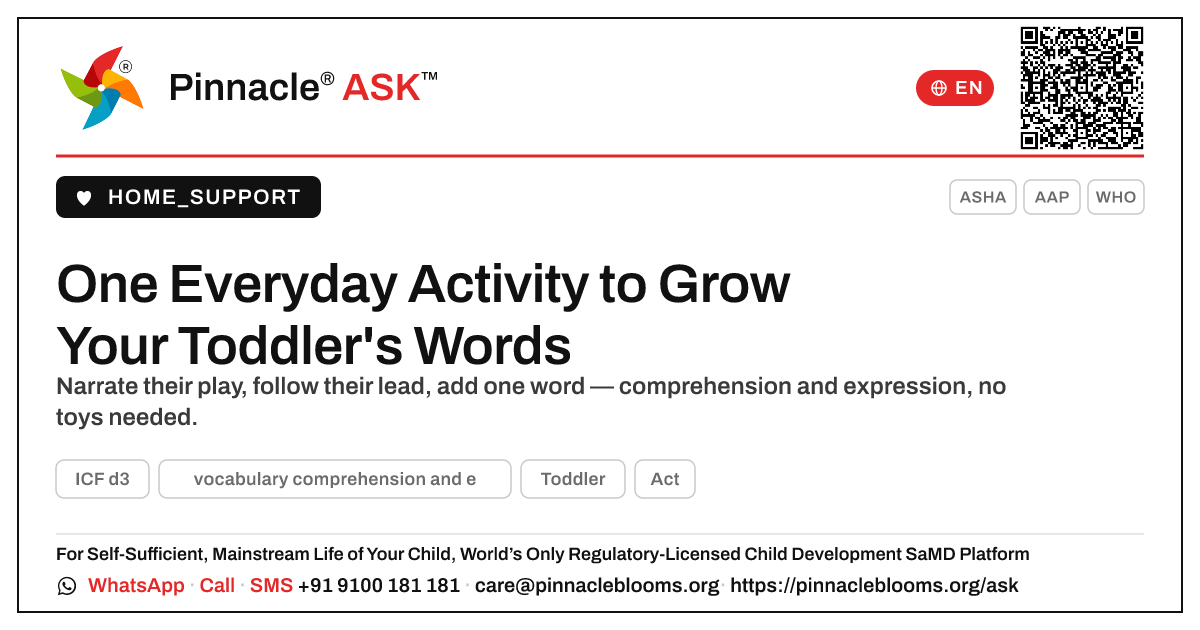
One simple Everyday Therapy activity is "sportscasting" — narrating your toddler's play in short, clear sentences while following their attention. It builds both comprehension and expression, needs no toys, and works best when you keep it short, add one new word, and wait for a response.
In this answer 5 sections
The richest vocabulary lessons hide inside the most ordinary moments — and you already have everything you need.
In short
Try "Sportscasting" — narrate your child's day out loud, simply and warmly. As your toddler plays, eats or walks with you, describe what they see, touch and do in short, clear sentences: "You're holding the red ball. Round ball. Now you throw it!" This single habit feeds both comprehension (words going in) and expression (words coming out), and you can do it anywhere — no toys or screens required.
How to do it
- Follow their lead. Talk about whatever your child is looking at right now — their attention is already there, so the word sticks.
- Keep it short and slow. One idea per sentence. Pause and wait — a few seconds of silence invites them to respond.
- Add one word. When your child says "ball," you say "big ball!" This gentle expansion shows the next step without correcting them.
- Repeat naturally. Hearing the same word across the day — at bath, snack and play — builds lasting understanding.
- Make it two-way. Smile, name, and wait for a sound, point or word back. Conversation, not commentary, is the goal.
The science
Between 12 and 36 months, vocabulary grows fastest when language is tied to a child's own focus and offered in responsive back-and-forth turns — the principle behind tools like the MacArthur–Bates Communicative Development Inventories that track early word growth. Narrating during shared attention links sound to meaning, and expansions model new words within reach. This maps to ICF domain d3 (Communication).
The Pinnacle way
Across 25 million+ therapy sessions, our therapists weave this everyday narration into play-based speech therapy so families can carry it home. Developmental measurement supports care planning; diagnosis requires an appropriately qualified healthcare professional. under qualified clinician care — see how the AbilityScore® gives an objective baseline to track your child's word growth over time.
Trusted sources
Guided by WHO ICF communication domains, the American Speech-Language-Hearing Association on early language, and AAP/HealthyChildren guidance on talking and reading with toddlers.
Next step — start with one 10-minute narrated playtime today, then message our team on WhatsApp +91 91001 81181 to learn more about Everyday Therapy at home.
This is general information, not a diagnosis — individual assessment and diagnosis require an appropriately qualified healthcare professional.
CONNECT THE ANSWER TO YOUR CHILD’S DAY
Something to notice. Something to discuss.
What to notice
If by 16 months your toddler uses no single words, or by 24 months no two-word phrases, or seems not to understand simple everyday requests, share this with your clinician for a developmental check rather than waiting.
In everyday life
Pick one daily routine — bath, snack or a walk — and narrate it in short sentences. Name what your child sees and does, pause, and wait for any sound, point or word back.
Bring your observations and questions to your child’s professional. Choose activities that suit your child’s comfort, abilities and agreed plan.
Bring your questions to a first visitQuestions families ask
How often should I do this narration activity?
There's no fixed dose — little and often works best. Weave short bursts of narration into routines you already do, like meals, bath and play, so it becomes a natural habit rather than a task.
My toddler doesn't talk back yet — is this still useful?
Yes. Comprehension grows before expression, so the words you narrate are going in even before they come out. Keep pausing and waiting; a sound, gesture or point is a meaningful reply.
Should I correct my child's words?
Rather than correcting, gently expand. If your child says 'ball,' you say 'big ball!' This models the next step warmly without making conversation feel like a test.
When should I seek a professional opinion?
If you have ongoing concerns about your child's understanding or use of words, or they're not meeting word milestones, speak with your clinician. A structured developmental check can reassure you or guide next steps.
FOLLOW THE SOURCE
References behind this answer.
- Source referenceASHA: early speech and language development
- Source referenceAAP HealthyChildren: toddler development
- Organisation website · further readingWHO ICF communication domain (d3)
References are supplied with this answer. An organisation homepage offers further reading; it does not establish an independent review of this page.
Content attribution: SETU Consortium · Pinnacle Blooms Network.
PEOPLE, TOPICS & DEVELOPMENT
See the connections.
Browse the wider question collections connected with this answer’s audience, developmental area and stage.
FROM UNDERSTANDING TO PURPOSEFUL SUPPORT
One question. Your child’s whole life.
Your child’s self-sufficient, mainstream-included life is the purpose from the beginning. At Pinnacle, that purpose shapes what we understand, the goals we choose, the people we bring together, everyday practice and review.
Connect this question with the right support.
Start with your child’s strengths, your observations and what you want everyday life to become.
Make the next conversation useful.
Bring the situations you notice at home or school. We’ll explain a suitable service, centre and first visit, including availability and fees, before you decide.
How PinnacleAI® connects the journeyExplore the seven stages
- 1Understand abilities
A starting picture of your child’s capabilities.
- 2Choose meaningful goals
Readiness and a plan shaped around the child.
- 3Bring the right support together
Suitable therapies and people for those goals.
- 4Carry practice into everyday life
Guidance for family, home and school.
- 5Track and correct
Use observations to adjust the plan.
- 6Reassess and review
Decide what to continue, change or do next.
- 7Grow independence and participation
The child’s life gives each step its purpose.
Explore the whole PinnacleAI® system → · Participation at school and in the community →
PINNACLE’S EVIDENCE, OPEN TO YOU
Look at the evidence behind our work.
Read our research, inspect the original regulatory documents and check what each institutional measure means.
General information supports a conversation with an appropriately qualified professional. Advice, goals and support depend on the individual child.