
YOUR QUESTION. A CLEARER NEXT STEP.
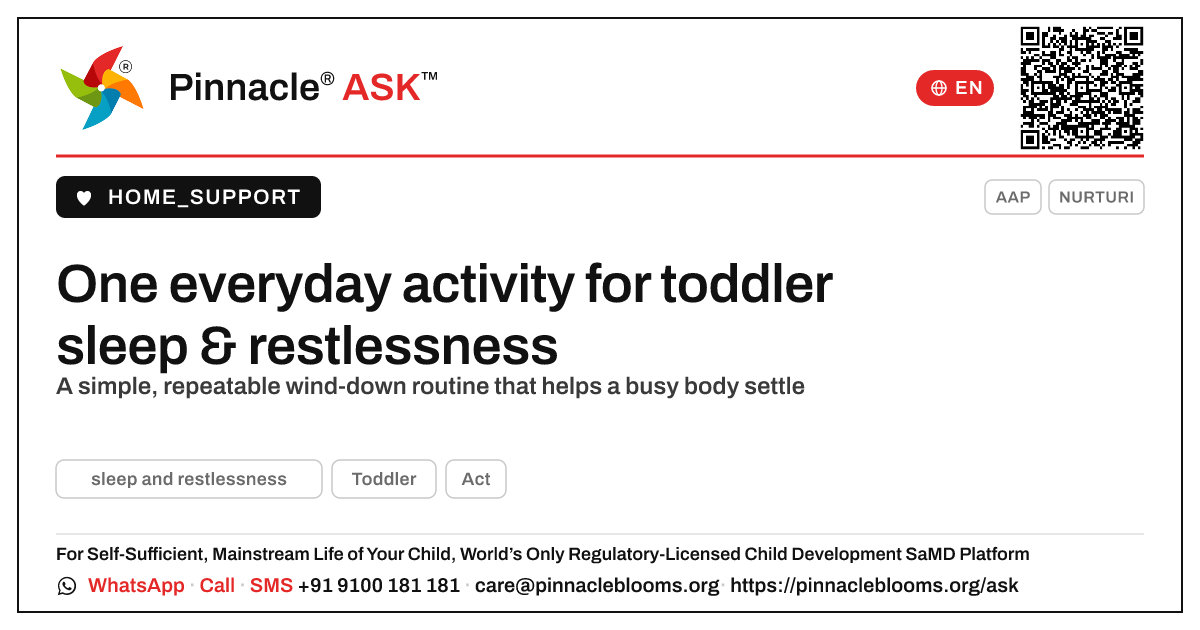
An everyday activity for toddler sleep and restlessness
One high-yield Everyday Therapy activity for toddler sleep and restlessness is a short, fixed wind-down routine — the same 3–4 calm, low-stimulation steps in the same order at the same time each night — which lowers arousal and lets natural sleep signals settle a busy body.
In this answer 5 sections
Bedtime battles and a restless little body can wear a whole family down — but a calm, predictable wind-down can change the whole night.
In short
One of the most effective Everyday Therapy activities for sleep and restlessness is a short, repeated wind-down routine — the same 3–4 calm steps, in the same order, at the same time every evening. For a toddler this might be: dim the lights, a warm bath, a quiet cuddle with one book, then bed. Predictability tells a busy little body that sleep is coming, so it can settle on its own.
Try this tonight
- Pick a fixed time and start 30–45 minutes before sleep — consistency matters more than the exact hour.
- Lower the energy step by step: bright play → dim lights → quiet voices → still bodies. Avoid screens in this window, as their light delays sleepiness.
- Keep the same order each night. Toddlers feel safe in repetition; the sequence itself becomes the cue for sleep.
- Add a calming sensory anchor — a firm goodnight hug, slow back rubs, or a soft song. For a restless child, gentle deep pressure can soothe the nervous system.
- Keep the room cool, dim and boring for sleep, so it's clearly different from daytime play.
The science
Young children's sleep is regulated by daily rhythms that thrive on routine. A consistent, low-stimulation wind-down lowers arousal and helps the body's natural sleep signals take over — which is why paediatric guidance worldwide recommends a regular bedtime routine as a first-line, drug-free strategy for settling and restlessness.
The Pinnacle way
A clinical AbilityScore® and any diagnosis are formed only at a Pinnacle Blooms Network centre under qualified clinician care — this home activity supports, but never replaces, that. If restlessness, very short sleep or frequent night waking persist, our team can look closer through occupational therapy and tailored sleep and restlessness support.
Trusted sources
Aligned with American Academy of Pediatrics and HealthyChildren.org guidance on consistent toddler bedtime routines, and WHO nurturing-care principles on responsive caregiving and healthy sleep.
Next step — try one fixed wind-down routine for a week, then message our team on WhatsApp (+91 91001 81181) to share how nights are going and whether a developmental check would help.
This is general information, not a diagnosis — individual assessment and diagnosis require an appropriately qualified healthcare professional.
CONNECT THE ANSWER TO YOUR CHILD’S DAY
Something to notice. Something to discuss.
What to notice
Watch for routines that still don't help after 2–3 weeks, very short total sleep, loud snoring or pauses in breathing, or restlessness that spills into daytime — these warrant a developmental and medical check rather than more home strategies alone.
In everyday life
Same 3 steps, same order, same time: dim lights, one quiet book, goodnight cuddle. The sequence itself becomes your toddler's signal that sleep is coming.
Bring your observations and questions to your child’s professional. Choose activities that suit your child’s comfort, abilities and agreed plan.
Bring your questions to a first visitQuestions families ask
How long before my toddler's sleep should I start the wind-down routine?
Begin about 30–45 minutes before sleep with low-energy, screen-free steps. Starting at the same time each evening matters more than the exact clock time.
My toddler is still restless after the routine — what should I do?
Give any new routine two to three weeks of consistency. If restlessness, very short sleep or frequent waking persists, or if there is loud snoring or breathing pauses, ask for a developmental and medical check rather than adding more home strategies.
Are screens really a problem at bedtime?
Yes — screen light and stimulation delay natural sleepiness in young children. Keep the wind-down window screen-free and swap to a quiet book or cuddle instead.
FOLLOW THE SOURCE
References behind this answer.
- Organisation website · further readingHealthyChildren.org (AAP) — toddler bedtime routines
- Organisation website · further readingAmerican Academy of Pediatrics — healthy sleep guidance
- Organisation website · further readingNurturing Care Framework — responsive caregiving
References are supplied with this answer. An organisation homepage offers further reading; it does not establish an independent review of this page.
Content attribution: SETU Consortium · Pinnacle Blooms Network.
PEOPLE, TOPICS & DEVELOPMENT
See the connections.
Browse the wider question collections connected with this answer’s audience, developmental area and stage.
FROM UNDERSTANDING TO PURPOSEFUL SUPPORT
One question. Your child’s whole life.
Your child’s self-sufficient, mainstream-included life is the purpose from the beginning. At Pinnacle, that purpose shapes what we understand, the goals we choose, the people we bring together, everyday practice and review.
Connect this question with the right support.
Start with your child’s strengths, your observations and what you want everyday life to become.
Make the next conversation useful.
Bring the situations you notice at home or school. We’ll explain a suitable service, centre and first visit, including availability and fees, before you decide.
How PinnacleAI® connects the journeyExplore the seven stages
- 1Understand abilities
A starting picture of your child’s capabilities.
- 2Choose meaningful goals
Readiness and a plan shaped around the child.
- 3Bring the right support together
Suitable therapies and people for those goals.
- 4Carry practice into everyday life
Guidance for family, home and school.
- 5Track and correct
Use observations to adjust the plan.
- 6Reassess and review
Decide what to continue, change or do next.
- 7Grow independence and participation
The child’s life gives each step its purpose.
Explore the whole PinnacleAI® system → · Participation at school and in the community →
PINNACLE’S EVIDENCE, OPEN TO YOU
Look at the evidence behind our work.
Read our research, inspect the original regulatory documents and check what each institutional measure means.
General information supports a conversation with an appropriately qualified professional. Advice, goals and support depend on the individual child.