
YOUR QUESTION. A CLEARER NEXT STEP.
An Everyday Therapy Activity for Quantitative Reasoning
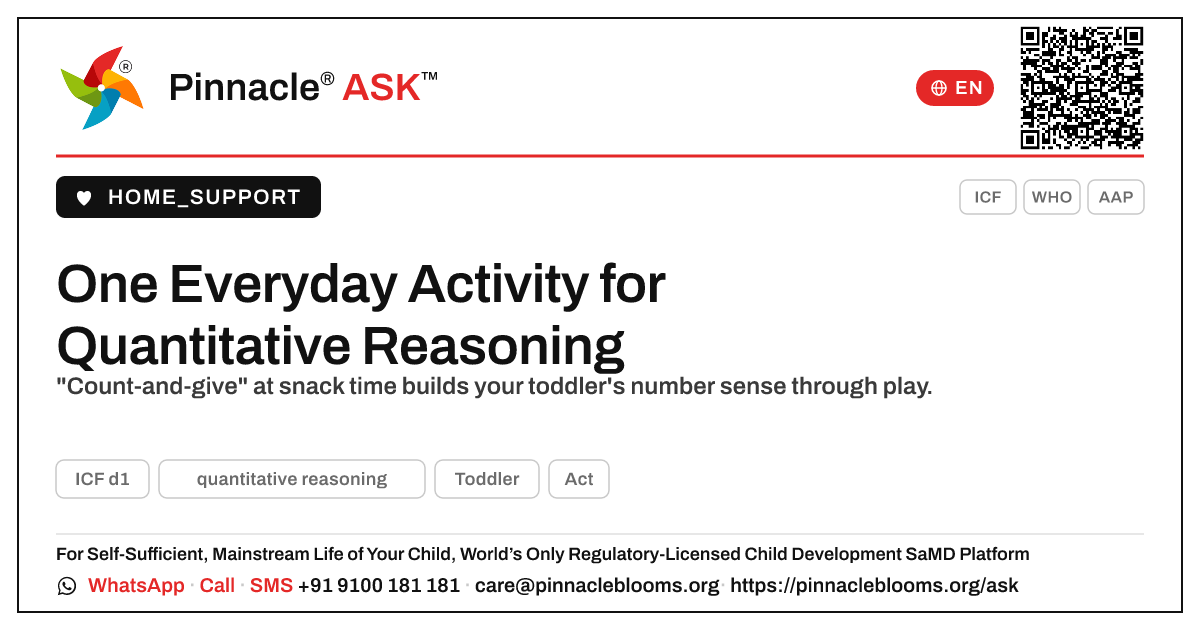
One everyday activity is "count-and-give" — ask your toddler to hand you a number of objects ("give me two grapes") while counting aloud together. This builds one-to-one correspondence and early number sense through warm, playful daily routines, no worksheets needed.
In this answer 5 sections
Maths begins long before school — it begins at the snack bowl, on the stairs, in the giggles of "one more!"
In short
One lovely everyday activity is "count-and-give" — during snacks or play, ask your toddler to give you a number of objects: "Can you give me two grapes?" Counting aloud together as your child hands them over builds the earliest foundations of quantitative reasoning — that numbers map onto real amounts. Do it for a few cheerful minutes a day; no worksheets, no pressure.
The activity, step by step
- Start small (12–24 months): Count familiar objects aloud as you touch each one — "one block, two blocks!" Your child is simply soaking in the rhythm of numbers.
- Add the give (around 24–36 months): "Give me one spoon... now give me two." Touching each item while saying the number teaches one-to-one correspondence, the heart of early number sense.
- Sprinkle maths into the day: Count steps as you climb, biscuits onto a plate, claps in a song. Use words like more, less, big, small, empty, full.
- Celebrate, don't correct: If she gives three when you said two, smile and count together — "one, two, three! Let's try two." Warmth keeps her curious.
Why this works
Quantitative reasoning grows from concrete, hands-on experiences before it ever becomes abstract sums. When a toddler links the word "two" to two grapes she can hold, she is building number sense, language, and reasoning all at once — and play is exactly how toddlers learn best. Everyday counting embedded in routines is more powerful than any flashcard.
The Pinnacle way
A clinical AbilityScore® and any diagnosis are formed only at a Pinnacle Blooms Network centre under qualified clinician care — this home activity supports your child's growth but does not assess or diagnose. Explore more on building quantitative reasoning, and if you'd like guided support, our occupational therapy team can tailor playful learning to your child.
Trusted sources
Guided by WHO Nurturing Care framework and AAP/HealthyChildren guidance on play-based early learning, which emphasise everyday, responsive interactions as the foundation of cognitive growth in toddlers.
Next step — try "count-and-give" at today's snack time, and message our team on WhatsApp (+91 91001 81181) for a friendly developmental check.
This is general information, not a diagnosis — individual assessment and diagnosis require an appropriately qualified healthcare professional.
CONNECT THE ANSWER TO YOUR CHILD’S DAY
Something to notice. Something to discuss.
What to notice
Watch for joyful engagement and growing interest in numbers and amounts over weeks. If by around 36 months your child shows no interest in counting, can't follow simple one-step requests, or has limited words, mention it at a general developmental check — not as alarm, but for reassurance and guidance.
In everyday life
At snack time, ask your child to give you 'one', then 'two' of something, touching each item as you count aloud together. Celebrate every attempt warmly.
Bring your observations and questions to your child’s professional. Choose activities that suit your child’s comfort, abilities and agreed plan.
Bring your questions to a first visitQuestions families ask
At what age can my toddler start learning to count?
From around 12 months you can simply count aloud as you touch objects — your child absorbs the rhythm long before they count themselves. Hands-on "give me two" games suit roughly 24–36 months. Every child grows at their own pace, so keep it playful, not pressured.
My toddler counts wrong — should I worry?
Not at all. Mixing up numbers is completely normal as children learn. Just gently count together again rather than correcting. Curiosity and joy matter far more than accuracy at this age.
Do I need toys or flashcards for this?
No. Everyday objects — grapes, spoons, stairs, claps — work beautifully. Real, hands-on counting in daily routines builds stronger number sense than any flashcard.
FOLLOW THE SOURCE
References behind this answer.
- Source referenceICF d1
- Organisation website · further readingWHO Nurturing Care Framework
- Organisation website · further readingAAP HealthyChildren: Play & Early Learning
References are supplied with this answer. An organisation homepage offers further reading; it does not establish an independent review of this page.
Content attribution: SETU Consortium · Pinnacle Blooms Network.
PEOPLE, TOPICS & DEVELOPMENT
See the connections.
Browse the wider question collections connected with this answer’s audience, developmental area and stage.
FROM UNDERSTANDING TO PURPOSEFUL SUPPORT
One question. Your child’s whole life.
Your child’s self-sufficient, mainstream-included life is the purpose from the beginning. At Pinnacle, that purpose shapes what we understand, the goals we choose, the people we bring together, everyday practice and review.
Connect this question with the right support.
Start with your child’s strengths, your observations and what you want everyday life to become.
Make the next conversation useful.
Bring the situations you notice at home or school. We’ll explain a suitable service, centre and first visit, including availability and fees, before you decide.
How PinnacleAI® connects the journeyExplore the seven stages
- 1Understand abilities
A starting picture of your child’s capabilities.
- 2Choose meaningful goals
Readiness and a plan shaped around the child.
- 3Bring the right support together
Suitable therapies and people for those goals.
- 4Carry practice into everyday life
Guidance for family, home and school.
- 5Track and correct
Use observations to adjust the plan.
- 6Reassess and review
Decide what to continue, change or do next.
- 7Grow independence and participation
The child’s life gives each step its purpose.
Explore the whole PinnacleAI® system → · Participation at school and in the community →
PINNACLE’S EVIDENCE, OPEN TO YOU
Look at the evidence behind our work.
Read our research, inspect the original regulatory documents and check what each institutional measure means.
General information supports a conversation with an appropriately qualified professional. Advice, goals and support depend on the individual child.