
YOUR QUESTION. A CLEARER NEXT STEP.
An Everyday Therapy Activity for Expressive Language
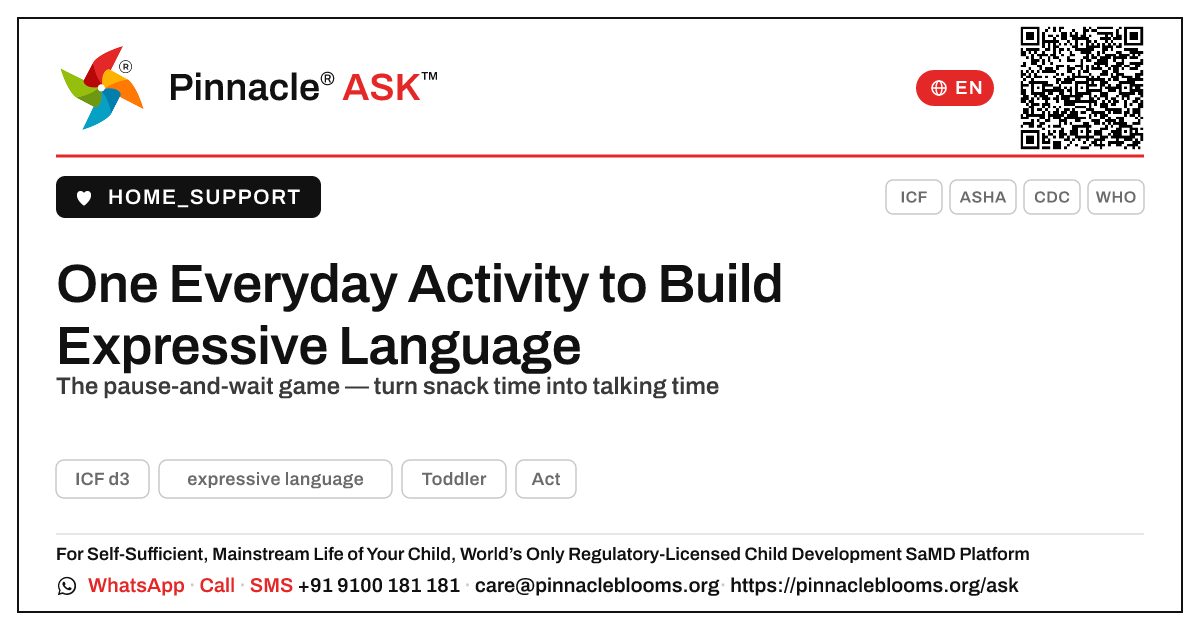
One high-value everyday activity is the pause-and-wait game: offer something your toddler wants, then pause expectantly so they communicate with a sound, word or gesture — honouring any attempt and modelling the next word. Repeated across daily routines, it turns ordinary moments into hundreds of chances to build expressive language.
In this answer 5 sections
The most powerful language lab in your home is the floor, the kitchen, the playmat — and you are already the lead therapist.
In short
A wonderful everyday activity for expressive language is the pause-and-wait game: offer your toddler something they want, then pause and look at them expectantly — giving them space to ask with a sound, a word or a gesture. This simple shift, repeated through the day, turns ordinary moments into hundreds of chances to communicate.
How to do it
Pick anything your child loves — a bubble bottle, a favourite snack, a wind-up toy. Then:
- Show, then wait. Hold the bubbles up, blow one, and pause. Look at your child with a warm, expectant face for a slow count of five.
- Honour any attempt. A reach, a point, an 'eh', or 'buh' all count. Respond instantly so the child learns: my communication makes things happen.
- Model the next step. Say the word simply — 'bubble!' — and give it. You are stretching their language one notch beyond where they are now.
- Repeat in tiny doses. Snack time, bath time, getting dressed — every routine becomes a turn-taking conversation.
The science
Expressive language (ICF d3 communication) grows through responsive back-and-forth. When you wait, you create a communication temptation — a gap the child is motivated to fill. Decades of evidence on responsive, child-led interaction show that following your child's lead and adding one word above their level is among the most reliable ways to build talking. The magic is not in the toy, but in the pause.
The Pinnacle way
Developmental measurement supports care planning; diagnosis requires an appropriately qualified healthcare professional. under qualified clinician care — never from a home activity alone. If you'd like tailored strategies, our speech therapy team can match activities to your child's exact stage, and the AbilityScore® gives an objective baseline to track every new word.
Trusted sources
Aligned with ASHA guidance on early language facilitation, CDC 'Learn the Signs. Act Early.' milestones, and the WHO Nurturing Care Framework on responsive caregiving.
Next step — try the pause-and-wait game at your next snack time, and message our team on WhatsApp +91 91001 81181 for a free expressive-language activity guide.
This is general information, not a diagnosis — individual assessment and diagnosis require an appropriately qualified healthcare professional.
CONNECT THE ANSWER TO YOUR CHILD’S DAY
Something to notice. Something to discuss.
What to notice
Watch for your child taking a turn — any sound, word or gesture in response to your pause. If by 16 months there are no single words, or by 24 months no two-word phrases, share this with your clinician for a developmental check.
In everyday life
At snack time, hold the food, blow on it, and pause for a slow count of five. Reward any attempt to ask — a look, a reach, a sound — then model the word.
Bring your observations and questions to your child’s professional. Choose activities that suit your child’s comfort, abilities and agreed plan.
Bring your questions to a first visitQuestions families ask
How often should I do the pause-and-wait game?
There's no quota — weave it into routines you already do, like snacks, bath and getting dressed. Many small pauses across the day work far better than one long 'lesson'.
My child gets frustrated when I wait. What do I do?
Keep the pause short and warm — a slow count of five, then help. The aim is gentle encouragement, never a test. Honour any attempt instantly so the moment stays joyful.
At what age should I expect first words?
Many toddlers say single words around 12–16 months and two-word phrases by 24 months, but there's natural variation. If you're unsure, a developmental check with a clinician is the right step.
FOLLOW THE SOURCE
References behind this answer.
- Source referenceICF d3
- Source referenceASHA: how speech and language develop
- Source referenceCDC Learn the Signs. Act Early. milestones
- Organisation website · further readingWHO Nurturing Care Framework
References are supplied with this answer. An organisation homepage offers further reading; it does not establish an independent review of this page.
Content attribution: SETU Consortium · Pinnacle Blooms Network.
PEOPLE, TOPICS & DEVELOPMENT
See the connections.
Browse the wider question collections connected with this answer’s audience, developmental area and stage.
FROM UNDERSTANDING TO PURPOSEFUL SUPPORT
One question. Your child’s whole life.
Your child’s self-sufficient, mainstream-included life is the purpose from the beginning. At Pinnacle, that purpose shapes what we understand, the goals we choose, the people we bring together, everyday practice and review.
Connect this question with the right support.
Explore how the relevant service contributes to everyday abilities, then speak with us about your child.
Make the next conversation useful.
Bring the situations you notice at home or school. We’ll explain a suitable service, centre and first visit, including availability and fees, before you decide.
How PinnacleAI® connects the journeyExplore the seven stages
- 1Understand abilities
A starting picture of your child’s capabilities.
- 2Choose meaningful goals
Readiness and a plan shaped around the child.
- 3Bring the right support together
Suitable therapies and people for those goals.
- 4Carry practice into everyday life
Guidance for family, home and school.
- 5Track and correct
Use observations to adjust the plan.
- 6Reassess and review
Decide what to continue, change or do next.
- 7Grow independence and participation
The child’s life gives each step its purpose.
Explore the whole PinnacleAI® system → · Participation at school and in the community →
PINNACLE’S EVIDENCE, OPEN TO YOU
Look at the evidence behind our work.
Read our research, inspect the original regulatory documents and check what each institutional measure means.
General information supports a conversation with an appropriately qualified professional. Advice, goals and support depend on the individual child.