
YOUR QUESTION. A CLEARER NEXT STEP.
Developmental Regression: Definition and ICD-11 Features in Early Childhood
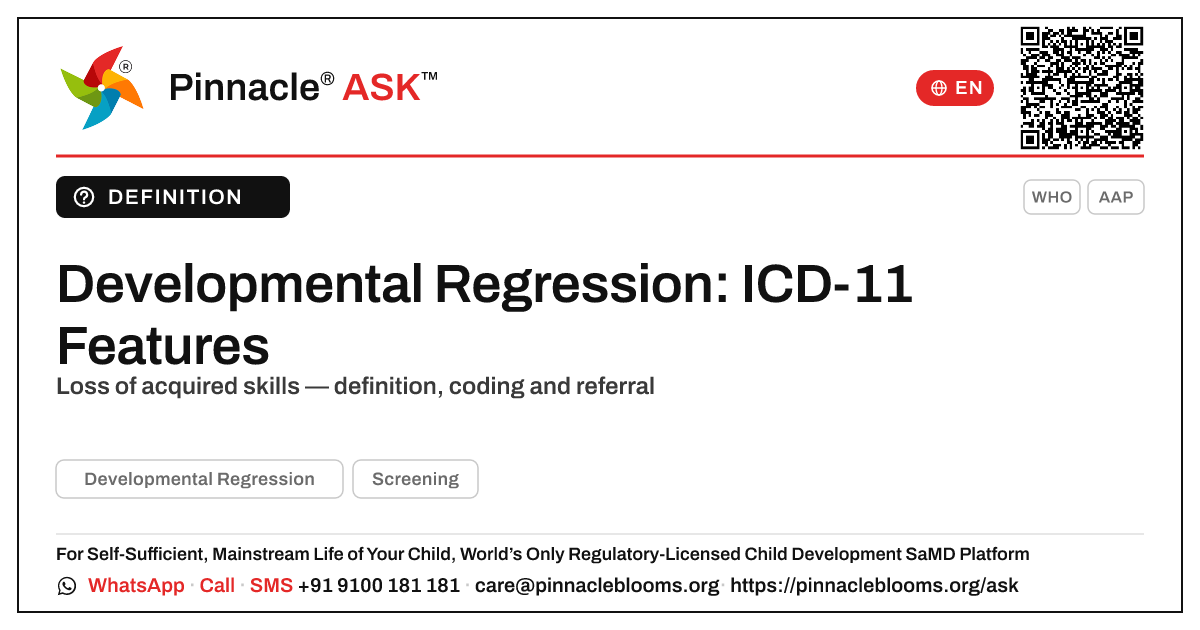
Developmental regression is the loss of previously acquired skills in language, social, motor, play or self-care domains after typical acquisition. ICD-11 codes it via its underlying cause — neurodevelopmental (6A00–6A02), epileptic (8A60–8A6Z) or metabolic (5C50–5D2Z) — not as a standalone entity. True regression warrants prompt medical evaluation.
In this answer 4 sections
A child who loses skills they once had is a signal that demands prompt, structured attention — not reassurance alone.
In short
Developmental regression is the loss of previously acquired developmental skills — in language, social engagement, motor function, play or self-care — after a period of typical or near-typical acquisition. In early childhood it is clinically significant because true loss (as distinct from plateau) carries a wider differential, including neurodegenerative, epileptic, metabolic and neurodevelopmental causes. Any genuine regression warrants prompt medical evaluation before therapy-first framing.
The science, briefly
ICD-11 does not code "regression" as a standalone entity; it is a clinical feature mapped to its underlying cause. Relevant codings include disorders of intellectual development (6A00), developmental speech or language disorders (6A01), autism spectrum disorder (6A02) — where early skill loss in language or social reciprocity is recognised — and neurological entities such as the epilepsies (8A60–8A6Z) and inborn metabolic disorders (5C50–5D2Z). Characterise regression by domain, age of onset, tempo (acute vs insidious), and whether isolated or global; pair with the ICF functioning model to document baseline versus current capacity. Red flags mandating urgent neurology referral: loss of head control or gait, seizures, lethargy, organomegaly, or rapidly progressive multi-domain decline.
The Pinnacle way
Developmental measurement supports care planning; diagnosis requires an appropriately qualified healthcare professional., under qualified clinician care — never from an online form. We co-ordinate paediatric neurology liaison alongside our developmental-therapy pathways, tracking baseline-to-current functioning via the structured AbilityScore® assessment once medical causes are addressed. See our regression overview for the full pathway.
Trusted sources
WHO ICD-11 (Foundation, mental/neurodevelopmental and neurological chapters); WHO ICF functioning framework; AAP developmental surveillance guidance.
Next step — Refer any child with suspected true skill loss for prompt evaluation — partner with a Pinnacle centre to co-ordinate neurology and developmental assessment.
This is general information, not a diagnosis — individual assessment and diagnosis require an appropriately qualified healthcare professional.
CONNECT THE ANSWER TO YOUR CHILD’S DAY
Something to notice. Something to discuss.
What to notice
Domain affected, age of onset, tempo (acute vs insidious), and whether loss is isolated or global; act urgently on loss of gait or head control, seizures, lethargy or organomegaly.
In everyday life
Document a clear before-and-after timeline of the skill that was lost — date last seen, date noticed absent — as this tempo detail sharpens the differential and referral.
Bring your observations and questions to your child’s professional. Choose activities that suit your child’s comfort, abilities and agreed plan.
Bring your questions to a first visitQuestions families ask
Is developmental regression a diagnosis in ICD-11?
No. ICD-11 treats regression as a clinical feature mapped to an underlying cause rather than a standalone code — for example neurodevelopmental disorders (6A00–6A02), epilepsies (8A60–8A6Z) or inborn metabolic disorders (5C50–5D2Z).
How is regression distinguished from a developmental plateau?
Regression is true loss of previously demonstrated skills; a plateau is arrested or slowed acquisition without loss. The distinction shifts the differential and urgency — genuine loss warrants prompt medical and neurological evaluation.
Which features warrant urgent referral?
Loss of gait or head control, new seizures, lethargy, organomegaly, or rapidly progressive multi-domain decline mandate urgent paediatric neurology referral rather than therapy-first management.
FOLLOW THE SOURCE
References behind this answer.
- Organisation website · further readingWHO ICD-11
- Source referenceWHO ICF functioning framework
- Organisation website · further readingAmerican Academy of Pediatrics developmental surveillance
References are supplied with this answer. An organisation homepage offers further reading; it does not establish an independent review of this page.
Content attribution: SETU Consortium · Pinnacle Blooms Network.
PEOPLE, TOPICS & DEVELOPMENT
See the connections.
Browse the wider question collections connected with this answer’s audience, developmental area and stage.
FROM UNDERSTANDING TO PURPOSEFUL SUPPORT
One question. Your child’s whole life.
Your child’s self-sufficient, mainstream-included life is the purpose from the beginning. At Pinnacle, that purpose shapes what we understand, the goals we choose, the people we bring together, everyday practice and review.
Connect this question with the right support.
Explore how the relevant service contributes to everyday abilities, then speak with us about your child.
Make the next conversation useful.
Bring the situations you notice at home or school. We’ll explain a suitable service, centre and first visit, including availability and fees, before you decide.
How PinnacleAI® connects the journeyExplore the seven stages
- 1Understand abilities
A starting picture of your child’s capabilities.
- 2Choose meaningful goals
Readiness and a plan shaped around the child.
- 3Bring the right support together
Suitable therapies and people for those goals.
- 4Carry practice into everyday life
Guidance for family, home and school.
- 5Track and correct
Use observations to adjust the plan.
- 6Reassess and review
Decide what to continue, change or do next.
- 7Grow independence and participation
The child’s life gives each step its purpose.
Explore the whole PinnacleAI® system → · Participation at school and in the community →
PINNACLE’S EVIDENCE, OPEN TO YOU
Look at the evidence behind our work.
Read our research, inspect the original regulatory documents and check what each institutional measure means.
General information supports a conversation with an appropriately qualified professional. Advice, goals and support depend on the individual child.