
YOUR QUESTION. A CLEARER NEXT STEP.
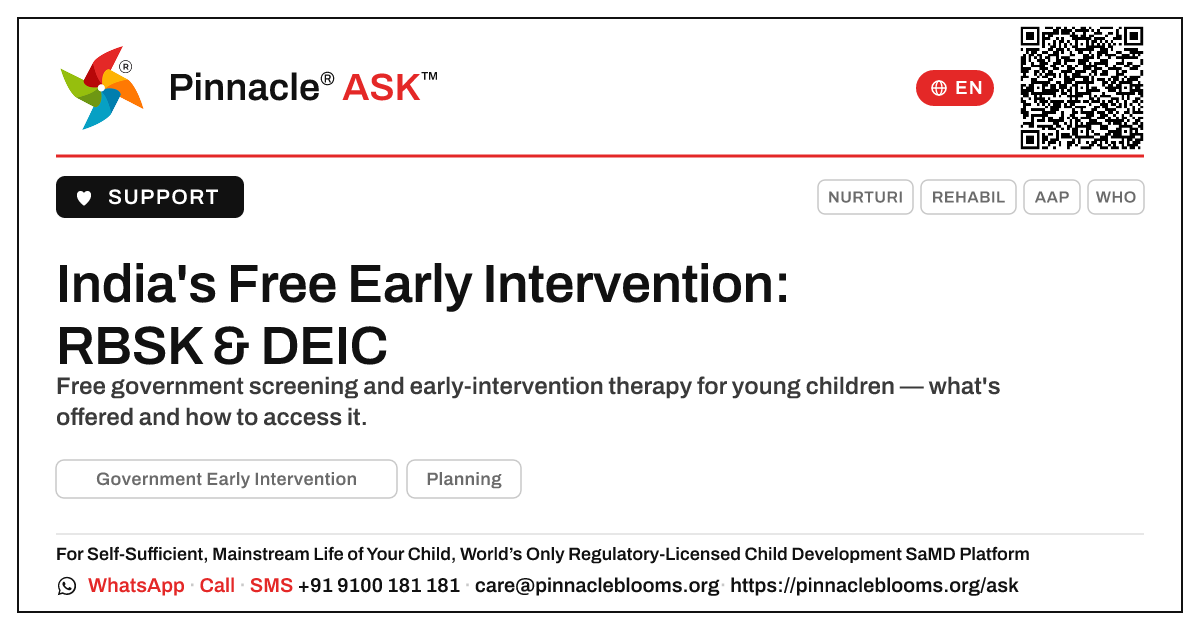
Government Early Intervention in India: RBSK & DEIC
India provides free government early-intervention through RBSK (national child-health screening for the 4 Ds — defects at birth, deficiencies, diseases, developmental delays/disabilities) and its specialist DEIC at District Hospitals, accessed via Anganwadis, schools and government health facilities. AbilityScore® is part of Pinnacle’s developmental assessment. Diagnosis, where needed, requires an appropriately qualified healthcare professional.
In this answer 5 sections
Knowing that India already has free, government-run early-help services means no family has to wait alone — support can start the moment you ask.
In short
India runs a national early-intervention system mainly through Rashtriya Bal Swasthya Karyakram (RBSK) — a child-health screening programme — and its specialist arm, the District Early Intervention Centre (DEIC). Together they screen children from birth to 18 years for the 4 Ds — defects at birth, deficiencies, diseases and developmental delays and disabilities — and provide free assessment, therapy and referral. These services are free at government facilities, and you can access them through Anganwadi centres, government schools and your District Hospital.
What these services offer
- RBSK (Rashtriya Bal Swasthya Karyakram) — under the National Health Mission, mobile health teams visit Anganwadis and government schools to screen children for the 4 Ds, including developmental delays, hearing and vision problems, and conditions such as cerebral palsy, Down syndrome and autism spectrum concerns. Screening is free.
- DEIC (District Early Intervention Centre) — usually based at the District Hospital, this is where children flagged by RBSK (especially under 6 years) come for fuller assessment by a team that may include a paediatrician, physiotherapist, occupational therapist, speech therapist, audiologist, psychologist and special educator. Early-intervention therapy and follow-up are provided free.
- Anganwadi & ICDS — your local Anganwadi worker is often the first point of contact for growth monitoring and early referral.
- Disability certification & schemes — DEIC and District Disability Rehabilitation Centres can guide you toward a disability certificate (UDID card), assistive aids, and rights under the Rights of Persons with Disabilities Act, 2016, which entitles children to early intervention, education and support.
- Referral pathway — children needing surgery or specialist care (e.g. heart defects, cleft lip and palate, hearing implants) can be referred upward, often with costs covered under government schemes.
How to access them
Start with your nearest Anganwadi centre, government school health programme, or District Hospital and ask for the RBSK team or the DEIC. There is no fee for screening or early-intervention services at government facilities. Bring your child's immunisation card and any earlier health records. You do not need a referral to walk in and ask — early help is your child's right, not a favour.
The Pinnacle way
These government services are an excellent first step, and they work well alongside specialist developmental support. AbilityScore® is part of Pinnacle’s developmental assessment. Diagnosis, where needed, requires an appropriately qualified healthcare professional — never from an app or form. Many families use government screening to begin, then add focused therapy; you can learn how a structured clinician-administered assessment builds a precise plan, explore speech therapy for early language support, or reach our team to understand how to combine government and specialist care for your child.
Trusted sources
WHO guidance on early childhood development and nurturing care; the Rehabilitation Council of India and the Rights of Persons with Disabilities framework on early intervention; American Academy of Pediatrics (HealthyChildren.org) on developmental monitoring and early action.
Next step — Want help understanding which government and specialist services suit your child? Talk to a Pinnacle team member and we will guide your next move.
This is general information, not a diagnosis — individual assessment and diagnosis require an appropriately qualified healthcare professional.
CONNECT THE ANSWER TO YOUR CHILD’S DAY
Something to notice. Something to discuss.
What to notice
Watch for missed early milestones, concerns flagged at Anganwadi or school health screening, hearing or vision worries, or any condition noticed at birth — these are reasons to ask the RBSK team or your District Hospital's DEIC for assessment without delay.
In everyday life
Keep your child's immunisation card and any health records together in one folder — having them ready makes RBSK screening and DEIC visits faster and smoother.
Bring your observations and questions to your child’s professional. Choose activities that suit your child’s comfort, abilities and agreed plan.
Bring your questions to a first visitQuestions families ask
Are RBSK and DEIC services free?
Yes. Screening through RBSK and assessment and early-intervention therapy at District Early Intervention Centres are provided free at government facilities. Certain specialist treatments and surgeries identified through screening are also often covered under government schemes.
What is the difference between RBSK and DEIC?
RBSK is the national screening programme — mobile teams check children from birth to 18 years for the 4 Ds at Anganwadis and schools. DEIC is the specialist centre, usually at the District Hospital, where flagged children (especially under 6) receive fuller assessment and early-intervention therapy.
Do I need a referral to access these services?
No. You can approach your nearest Anganwadi centre or your District Hospital's DEIC directly and ask for assessment. Anganwadi workers and school health teams can also refer your child onward.
Can I use government services and private therapy together?
Yes, many families do. Government screening and early intervention are an excellent first step, and focused specialist therapy can run alongside. A clinician can help you plan how to combine both for your child.
FOLLOW THE SOURCE
References behind this answer.
- Organisation website · further readingNurturing Care Framework for early childhood development
- Organisation website · further readingRehabilitation Council of India — early intervention & disability
- Organisation website · further readingAAP HealthyChildren.org — developmental monitoring
- Organisation website · further readingWHO — early childhood development
References are supplied with this answer. An organisation homepage offers further reading; it does not establish an independent review of this page.
Content attribution: SETU Consortium · Pinnacle Blooms Network.
PEOPLE, TOPICS & DEVELOPMENT
See the connections.
Browse the wider question collections connected with this answer’s audience, developmental area and stage.
FROM UNDERSTANDING TO PURPOSEFUL SUPPORT
One question. Your child’s whole life.
Your child’s self-sufficient, mainstream-included life is the purpose from the beginning. At Pinnacle, that purpose shapes what we understand, the goals we choose, the people we bring together, everyday practice and review.
Connect this question with the right support.
Start with your child’s strengths, your observations and what you want everyday life to become.
Make the next conversation useful.
Bring the situations you notice at home or school. We’ll explain a suitable service, centre and first visit, including availability and fees, before you decide.
How PinnacleAI® connects the journeyExplore the seven stages
- 1Understand abilities
A starting picture of your child’s capabilities.
- 2Choose meaningful goals
Readiness and a plan shaped around the child.
- 3Bring the right support together
Suitable therapies and people for those goals.
- 4Carry practice into everyday life
Guidance for family, home and school.
- 5Track and correct
Use observations to adjust the plan.
- 6Reassess and review
Decide what to continue, change or do next.
- 7Grow independence and participation
The child’s life gives each step its purpose.
Explore the whole PinnacleAI® system → · Participation at school and in the community →
PINNACLE’S EVIDENCE, OPEN TO YOU
Look at the evidence behind our work.
Read our research, inspect the original regulatory documents and check what each institutional measure means.
General information supports a conversation with an appropriately qualified professional. Advice, goals and support depend on the individual child.